


AI form builders are useful.
You type:
Create a webinar registration form.
The system returns fields for name, email, company, session preference, consent, and a question or two. It may also generate labels, helper text, validation, and a first version of the success message.
That is a real improvement. It removes the blank-page problem. It helps non-technical teams move faster. It reduces the time between "we need to collect this" and "there is a draft form."
But I do not think prompt-to-form generation is where the durable product surface will be.
Creation is becoming table stakes. The harder product problem starts after the form is published.
Creation Is Getting Cheaper
The creation step is easy to demo because it is bounded.
An AI model can infer a reasonable field list from a short prompt. It can generate labels. It can suggest required fields. It can add a privacy consent checkbox. It can create a plausible title and description.
For a lot of use cases, that is enough to produce a good first draft.
The problem is that first drafts are becoming cheap across the category. Almost every form product can add some version of "create a form from a prompt." The output quality will vary, but the basic interaction will converge.
That means the interesting product question is not:
Can AI create a form?
The more durable question is:
Can AI operate the workflow that starts with the form?
A form is rarely the end of the workflow. It is the intake point. The work begins when responses arrive.
A Published Form Is an Event Source
Once a form is published, it starts emitting business events.
response.submitted
response.updated
deadline.approaching
capacity.reached
response.classified
follow_up.required
Those events need operational handling.
For a webinar form, the system may need to send a confirmation email, add the registrant to a list, remind them before the session, detect duplicates, export attendees, and send a follow-up survey.
For a contact form, the team may need to filter sales pitches, route real inquiries, mark status, notify the right person, and measure response time.
For a hiring form, the workflow may include candidate intake, document review, interview scheduling, rejection emails, and privacy-sensitive data handling.
None of that is solved by generating the initial field list.
This is why I think "AI form builder" is too narrow as a category label. It describes the pre-publish experience. The more important surface is post-publish operations.
MCP Changes the Surface Area
MCP turns a product into tools and resources that AI clients can use. In the context of form software, the obvious tools are:
create_form
edit_form
list_forms
get_submissions
These are useful. They make the product accessible from an AI client.
But they still describe the product as a form editor plus a database. They expose objects, not necessarily operations.
The more interesting tools look different:
set_auto_reply_email
schedule_reminder
classify_sales_message
exclude_sales_from_analysis
set_response_status
create_follow_up_workflow
generate_pdf_report
sync_google_sheets
start_ab_test
These tools model actual work.
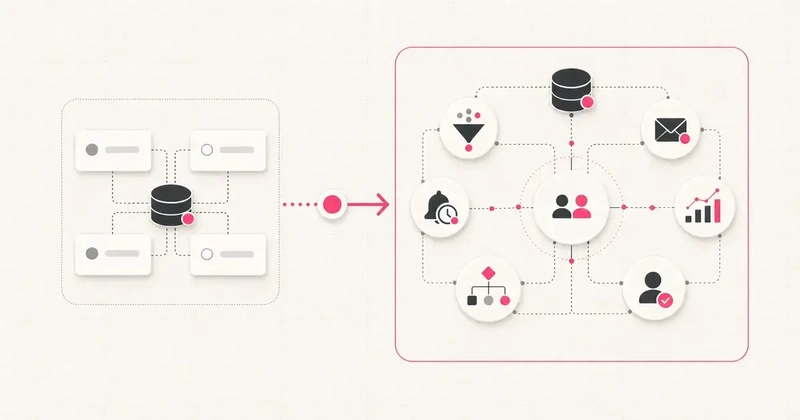
This distinction matters because an AI client does not use a SaaS product the same way a human uses a dashboard.
A human can see the screen, notice labels, read surrounding copy, infer context, and decide whether a button is safe. An AI client needs the product to expose capabilities with names, schemas, descriptions, permissions, and predictable responses.
If the MCP server only wraps CRUD endpoints, the model has to invent the workflow in the prompt. It has to know which rows matter, which state transitions are valid, which actions need confirmation, and what the next safe step should be.
That is too much product meaning to leave outside the product.
CRUD Wrappers Are Not Enough
A thin MCP wrapper can be useful for internal tools, prototypes, or power users. It may expose the same endpoints that already exist in the REST API:
GET /forms
POST /forms
PATCH /forms/:id
GET /forms/:id/submissions
That is a good starting point. It proves connectivity.
But production-grade MCP design usually needs a higher layer of intent.
Consider the user request:
Find the leads from yesterday that look real and prepare a follow-up.
A CRUD-style server can fetch submissions. The model still has to decide what "looks real" means, how to identify sales pitches, whether the form has a lead score field, whether the user has permission to see all answers, and whether sending a follow-up is allowed.
An operations-oriented server can expose a safer sequence:
list_recent_responses
classify_sales_messages
summarize_qualified_responses
draft_follow_up_email
request_send_approval
The important part is not that there are more tools. The important part is that the tools match the workflow boundary.
Approval Is Part of the Product Surface
Form operations include side effects. Some are harmless. Some are not.
Reading a response is different from editing a live form. Drafting an email is different from sending it. Marking a response as reviewed is different from deleting the response. Exporting data is different from changing a public field.
That means an MCP form server should not just expose write actions. It should expose safe write actions.
I would split write operations into three groups.
| Group | Examples | Product requirement |
|---|---|---|
| Low-risk writes | create a draft form, add a draft question | usually safe to automate |
| Medium-risk writes | update an auto-reply draft, change status | show a diff and request approval |
| High-risk writes | publish changes, send email, delete data | require explicit approval and ideally a UI preview |
OpenAI's Agents SDK MCP documentation describes approval flows for hosted MCP tools. That is the right mental model: connection is not the same as delegation.
For forms, approval is not a compliance afterthought. It is part of the product surface. The safer the product makes review, the more useful the AI integration becomes.
Some Operations Need UI, Not Just Text
Forms are visual and interactive.
An AI client can tell you that it created a field list, but someone still needs to see the mobile layout, required fields, confirmation screen, error states, and email preview.
This is why I think MCP tooling and UI tooling will increasingly meet.
Jotform's MCP-App direction is interesting here because it points toward richer UI surfaces inside AI clients: live previews, visual asset lists, and submission tables. Whether or not a specific team uses Jotform, the product direction is worth noticing.
For form operations, the design question is:
Which actions can be safely completed in text, and which actions need a visual confirmation surface?
Response summarization can be mostly text. Sales-message classification can be text plus confidence. A reminder email should show the recipient set and the message. A published form change should show a preview. A/B test results should probably show a structured comparison.
The deeper the MCP integration goes, the more important this boundary becomes.
FORMLOVA's Angle
FORMLOVA can create forms from chat, but that is not the main bet.
The main bet is that form software should treat post-publish operations as the core product surface.
That means modeling operations such as:
- response management
- response status
- auto-reply emails
- reminder emails
- conditional emails
- sales email classification
- analytics
- PDF reports
- A/B testing
- Google Sheets sync
- workflows
- team operations
In this framing, an AI form builder is the entry point. An MCP form service is the operating layer.
The official blog has a more direct comparison here:
- AI Form Builder vs MCP Form Service
- How FORMLOVA Compares to Major Form Services
- What Is an MCP Form Service?
A Practical Rubric For Form MCP Servers
If you are evaluating or building a form MCP server, I would ask:
[ ] Can it create forms?
[ ] Can it edit forms?
[ ] Can it fetch responses?
[ ] Can it search and filter responses?
[ ] Can it manage response status?
[ ] Can it configure auto-reply emails?
[ ] Can it schedule reminders?
[ ] Can it classify unwanted submissions?
[ ] Can it create or update workflows?
[ ] Can it run analysis?
[ ] Can it return previews or review surfaces?
[ ] Can humans approve important writes?
[ ] Can users revoke client access?
[ ] Does the tool schema match business intent?
The first three are becoming table stakes.
The rest are where product design starts.
The Bet
AI form creation will become common.
It is useful, but it is not the whole workflow. It solves the blank-page problem. It does not automatically solve response handling, routing, email operations, analysis, permissions, or review.
MCP-native form operations are harder to build because they require product semantics. The system needs to know what a response means, what actions are safe, where human approval belongs, and how the workflow should continue.
That is why I think the next wave of form software will not be won by the best prompt-to-form demo alone.
It will be won by the product that best understands what a response means after it arrives.