





“The knowledge is not produced in a vacuum; culture plays a fundamental role in its generation, whether in a corporate environment or outside it.”
That sentence opens the document I wrote in 2024. Back then, I was looking for a more complete and integrated way to manage knowledge inside organizations — going beyond the traditional division into personal, departmental, and corporate knowledge.
The result was the Integrated Knowledge Cycle (IKC)
What is the Integrated Knowledge Cycle (IKC)?
The CCI is a practical framework designed to create Autonomous and Continuous Knowledge Production Systems.
Its core idea is simple but powerful: turn all the knowledge generated by individuals (tacit, explicit, procedural, etc.) into a living organizational asset that the company can use, evolve, and never lose.
The 8 Types of Knowledge (based on behavioral psychology)
Declarative Knowledge (“knowing what”)
Facts and information that can be verbalized.Procedural Knowledge (“knowing how”)
How to perform tasks and processes — learned through practice.Conditional Knowledge (“knowing when and why”)
Judgment and decision-making in the right context.
4.Implicit / Tacit Knowledge
Subconscious knowledge acquired through direct experience.
5.Explicit Knowledge
Knowledge that can be easily articulated, codified, and shared (manuals, texts, formulas).
Associative Knowledge
Learning through association of stimuli (classic and operant conditioning).Situational Knowledge
Knowledge specific to a particular context, rules, norms, or expectations.
Metacognitive Knowledge
8.“Knowledge about knowledge” — the ability to monitor and control your own cognitive processes.
The SKR Model (Rasmussen, 1983)
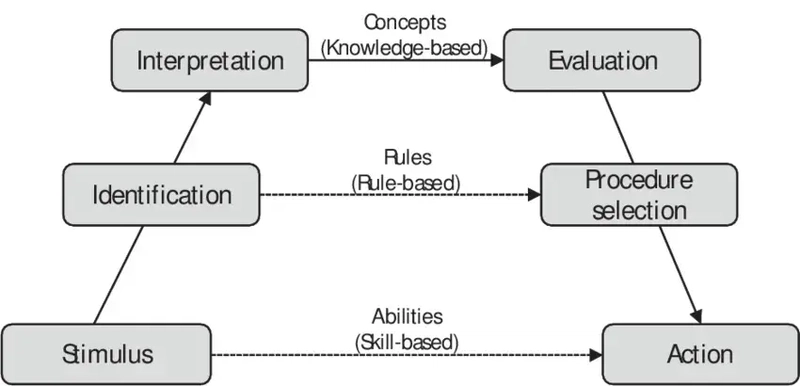
The IKC also uses the SKR model:
- Skills → Automatic, intuitive behaviors
- Rules → Behaviors based on procedures and norms
- Knowledge → Deep reasoning in new or complex situations
Knowledge Embodied
This is the knowledge embedded in:
- Rules, compliance, ethics, and codes of conduct
- Processes, manuals, and organizational routines
- Culture, products, artifacts, and structures
It can be incorporated formally (by management initiatives) or informally (through daily use).
The Core Concept
The organization is seen as a complex adaptive system. Individuals produce knowledge → culture organizes and gives it importance → knowledge is embodied in larger structures → the company adapts and innovates → new adaptations generate even more knowledge.
This creates a continuous, dynamic, non-linear cycle: Capture → Classification → Embodiment → Reuse → Evolution.
The final goal of the CCI is to build systems that produce knowledge autonomously and continuously, making the organization more competitive and resilient.
How to Apply CCI + Paperclip in Practice
Paperclip is an open-source AI agent orchestration tool that turns a simple server (or even your computer) into a full “zero-human” company with CEO Agent, CTO Agent, CMO Agent, Designer Agent, etc., all working 24/7.
When you combine CCI + Paperclip, you get exactly what the CCI was designed for: a real autonomous knowledge production system.
Here’s the exact step-by-step implementation I use:
Create the /knowledge folder in your Paperclip workspace
Place inside:
Your original CCI document (PDF)
Identity guidelines, old tasks, processes, examples, etc.
Run the strategic onboarding prompt
Create one task for the CEO Agent and paste the full CCI onboarding prompt (I can send you the exact prompt if you comment “CCI Prompt”).
The agents internalize the entire CCI
They automatically classify every new output using the 8 types of knowledge + SKR model.
They transform everything into embodied knowledge (documents, rules, SKILLS.md files).
A new agent called Knowledge Architect Agent is created to close the CCI loop 24/7.
Autonomous knowledge production becomes reality
Every task completed automatically:
Classifies the knowledge generated
Updates the central Knowledge Base
Turns it into reusable embodied knowledge
Feeds it back into future decisions
The result? Your company now has memory that never dies and produces new knowledge autonomously — even if you don’t open the dashboard for days.
Documentation stops being a boring chore and becomes a natural byproduct of the work. The knowledge no longer depends on people. It lives inside the company forever.
This is the practical realization of the vision I described in 2022: a true Autonomous and Continuous Knowledge Production System.
Want to implement this in your company?
Comment “CCI + Paperclip” below and I’ll send you:
The complete onboarding prompt
The ready-to-use Company_Knowledge_Base_CCI_v1.md
The folder structure template
Let’s turn human knowledge into autonomous corporate intelligence.