






Most engineering organizations have dashboards. They have tagging policies. They have monthly cost reports that go out to team leads. And spending keeps climbing.
The problem is not visibility. The problem is that visibility without financial consequence produces awareness, not action. During showback-only programs, teams act on 10-20% of cost recommendations. After chargeback goes live, that number jumps to 40-60%. The difference is not better data. It is whether the number hits the team's budget.
This is the governance layer that sits between "we can see our costs" and "teams actually change how they spend." Chargeback and showback are the two models that bridge that gap. Getting the choice and implementation right determines whether your FinOps program produces reports or produces results.
Why Visibility Alone Doesn't Change Spending Behavior
Every FinOps journey starts with tagging. You enforce cost-center, team, and environment tags. You build dashboards in AWS Cost Explorer or Azure Cost Management. You send weekly digests to engineering leads.
Then nothing changes.
The reason is straightforward. A dashboard that shows "your team spent $47,000 last month" creates awareness. It does not create accountability. No one's budget shrinks. No one's quarterly planning adjusts. The number is informational, not operational.

A financial services firm measured this directly. With showback dashboards alone, they cut AWS spend by 18% in one quarter. That sounds productive until you realize the remaining 82% of waste stayed untouched. The teams that acted were already cost-conscious. The teams that ignored the reports faced no consequences for ignoring them.
The missing piece is a feedback loop that connects cloud spend to team-level financial planning. That feedback loop has two forms: showback and chargeback.
Showback vs Chargeback: What Each Model Actually Does
Showback means teams receive cost reports showing what they consumed. The costs are visible but do not affect team budgets or P&L statements. Think of it as an itemized receipt with no bill attached.
Chargeback means cloud costs are allocated directly to team budgets. The costs reduce available budget, show up in quarterly reviews, and factor into capacity planning. The receipt comes with a bill.
The FinOps Foundation is explicit on this: neither model is inherently more mature than the other. Showback is foundational to every FinOps practice. Chargeback depends on whether your organization has separate P&Ls per team or product line. A company where all engineering runs under one cost center gains little from chargeback mechanics — showback with executive visibility achieves the same behavioral change.
| Dimension | Showback | Chargeback |
|---|---|---|
| Budget impact | None — informational only | Direct — costs hit team P&L |
| Behavior change rate | 10-20% action on recommendations | 40-60% action on recommendations |
| Data trust requirement | Moderate — directional accuracy sufficient | High — teams will dispute inaccurate charges |
| Implementation complexity | Low — dashboards and reports | High — allocation rules, GL integration, dispute process |
| Shared cost handling | Can defer or simplify | Must resolve — every dollar needs an owner |
| Best fit | Single P&L orgs, early FinOps maturity | Multi-BU orgs with separate budgets |
The same financial services firm that saw 18% reduction with showback added chargeback one year later. The additional reduction was 22%. Combined, that is a 40% spend reduction — but the chargeback portion required 12 months of building allocation accuracy and organizational trust first.
The Allocation Problem: Tagging, Shared Costs, and the Unallocated Bucket
Before any cost reaches a team's report, it must be allocated. This is where most chargeback programs stall.
Direct costs are simple. An EC2 instance tagged team:payments costs $420 per month. That $420 goes to the payments team. No ambiguity.
Shared costs are the problem. Your Kubernetes control plane, NAT gateways, enterprise support contract, CI/CD infrastructure, and networking egress serve multiple teams simultaneously. These costs have no single owner and cannot be tagged to one team.
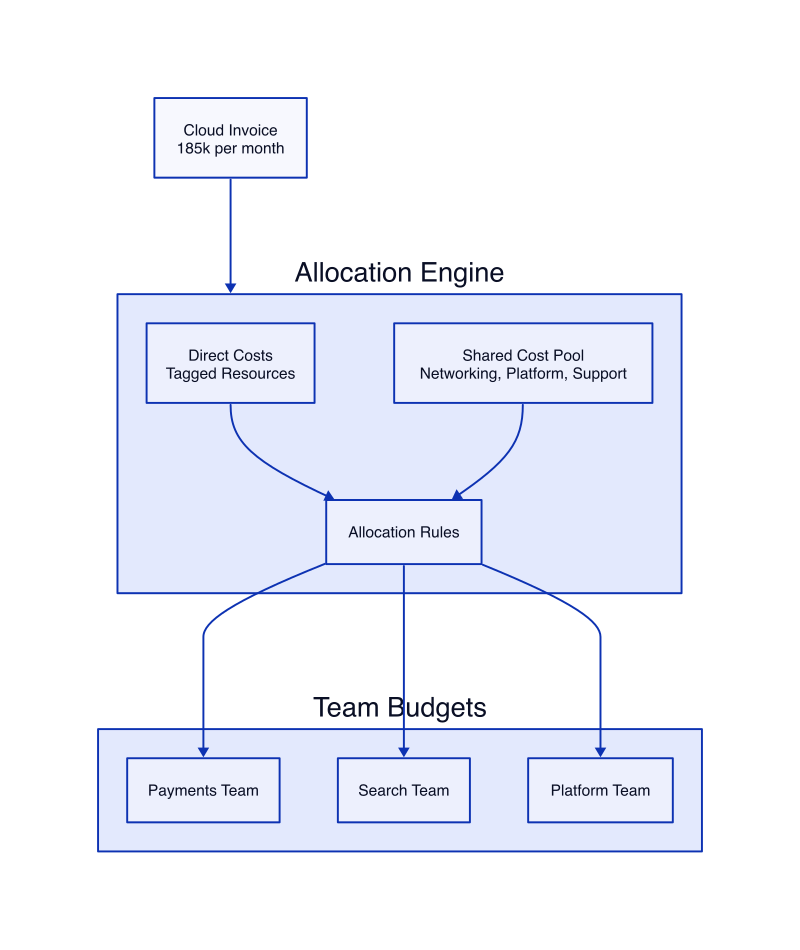
Three allocation methods dominate for shared costs:
| Method | How It Works | Accuracy | Overhead | Best When |
|---|---|---|---|---|
| Even split | Total shared cost divided equally across consuming teams | Low | Minimal | Early maturity, small team count |
| Proportional split | Allocated by usage proxy — CPU-hours, request count, data volume | High | Significant — requires metering | Teams have measurably different consumption patterns |
| Fixed proportional | Predetermined percentages, refreshed quarterly | Medium | Low after initial setup | Consumption patterns are relatively stable |
The pragmatic guidance from FinOps practitioners: not every shared cost needs allocation. Platform team salaries, enterprise support contracts, and security tooling often belong in a central overhead pool. Allocating them to product teams creates complexity without changing behavior because no team can reduce those costs through their own actions.
The danger is the unallocated bucket. When shared costs are poorly defined, teams learn to shift spend toward untagged or shared categories. The unallocated pool becomes a dumping ground. A telecom provider discovered this pattern when one microservice accounted for 40% of data transfer costs — costs that had been sitting in the "shared networking" bucket for months. Identifying and reassigning that cost saved $45,000 per month.
Target tagging compliance of 85-90% overall and 95%+ for production resources before activating chargeback. With approximately 32% of cloud spend sitting on improperly tagged resources industry-wide, most organizations need 2-3 months of tagging enforcement before the data is trustworthy enough.
The Crawl-Walk-Run Implementation Path
Deploying chargeback on day one is a recipe for organizational friction. The phased approach works because each stage builds the data accuracy and organizational trust required for the next.
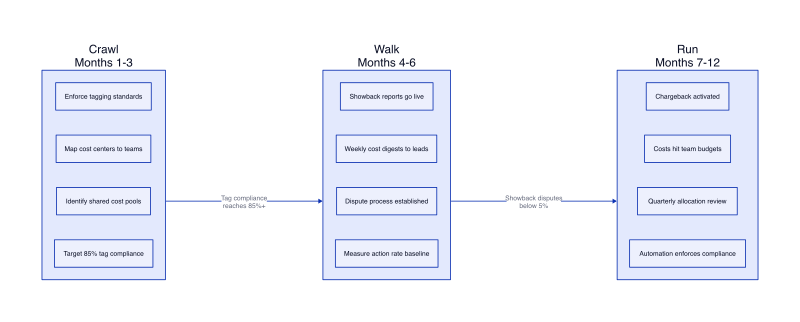
Crawl (months 1-3) focuses on data foundation. Enforce tagging standards using AWS SCPs, Azure Policy, or GCP Organization Policies. Map every cost center to an owning team. Identify which costs are direct, which are shared, and which will remain centrally absorbed. The exit criterion: 85%+ tagging compliance across all accounts.
Walk (months 4-6) activates showback. Teams receive weekly cost reports with line-item visibility. This is where data trust gets tested. Expect disputes. Establish a clear dispute process — a shared channel or ticketing queue where teams can flag allocations they believe are incorrect. Resolve disputes within 48 hours. The exit criterion: dispute rate below 5% of total allocations.
Run (months 7-12) transitions to chargeback. Costs now hit team budgets. Quarterly allocation reviews ensure the model stays accurate as team structures and consumption patterns shift. Automation enforces tagging compliance and flags untagged resources before they enter the billing cycle.
The financial impact compounds. Organizations using mature allocation models report 25% better cost optimization outcomes and 40% more accurate departmental budgeting compared to ad-hoc tracking.
Five Failure Modes That Kill Chargeback Programs
Every failure mode below has appeared in production. Knowing them upfront saves months of organizational friction.
| Failure Mode | Symptom | Fix |
|---|---|---|
| Data trust collapse | Every review meeting starts with "where did this number come from?" | Invest in tagging compliance first; publish methodology documentation; allow 90-day showback period before chargeback |
| Allocation driver gaming | Teams restructure workloads to minimize their allocation metric rather than actual cost | Audit allocation drivers quarterly; use multiple weighted drivers rather than a single metric |
| Surprise bills without buy-in | Business units feel ambushed by charges they never agreed to | Socialize the model 60 days before activation; get VP-level sign-off per business unit |
| Growing unallocated bucket | Shared cost pool increases quarter over quarter as teams dodge attribution | Cap unallocated at 15% of total spend; flag any resource without an owner within 7 days |
| No automation | Manual tagging, manual reports, manual allocation — the model works for 3 months then collapses | Automate tag enforcement via policy engines; automate cost pipeline from export through report delivery |
The most common killer is data trust. When teams cannot trace a charge back to a specific resource, they reject the entire model. This is why the showback phase matters — it builds trust in the allocation methodology before money moves.
Building the Allocation Pipeline on AWS, Azure, and GCP
The allocation pipeline follows four stages regardless of cloud provider: export raw billing data, normalize it into a common schema, apply allocation rules, and post results to financial systems.
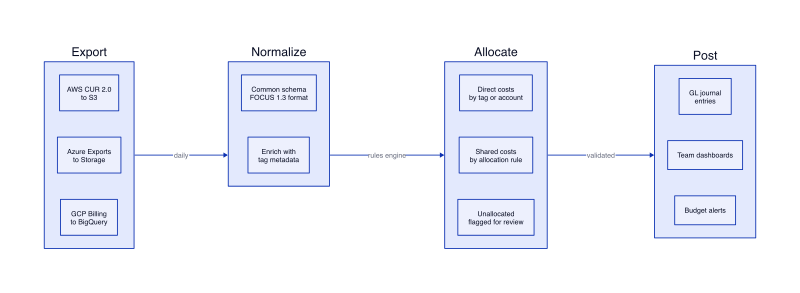
AWS provides Cost Categories for rule-based grouping and the Cost and Usage Report (CUR 2.0) for raw data export to S3. Cost Categories handle direct allocation well but require custom logic for proportional shared cost splits. The CUR is the standard data source for any serious allocation pipeline.
Azure offers Cost Management with a cost allocation feature that can redistribute shared subscription costs to other subscriptions. It handles basic showback natively. For chargeback, you will need Azure Exports to a storage account and downstream processing for complex allocation rules.
GCP exports detailed billing records to BigQuery, which means your allocation logic can run as SQL queries. Labels must be applied at resource creation — there is no retroactive labeling. Budget alerts are per-project or per-label but are alerting-only with no enforcement.
All three providers support the FOCUS 1.3 specification, which introduces allocation-specific columns that standardize how costs are split across workloads. If you operate multi-cloud, normalizing to FOCUS format before applying allocation rules eliminates provider-specific transformation logic.
The gap across all three: none of them solve the shared cost problem natively. Proportional allocation of Kubernetes cluster costs, networking egress, or platform team infrastructure requires custom logic — whether that is SQL in BigQuery, Python processing CUR files, or a dedicated FinOps tool.
Chargeback and showback are not reporting features. They are governance mechanisms that connect cloud spend to the teams that control it. Start with showback to build data trust. Graduate to chargeback when your tagging compliance exceeds 85% and your dispute rate drops below 5%. Automate everything between the cloud bill and the team budget. The organizations that treat cost allocation as an engineering problem — not a finance problem — are the ones that actually change spending behavior.