







I've been a web developer for over a decade — doing everything from frontend to backend, DevOps, and team management. I always wanted to build my own project, but the idea was never good enough, or I had no time, or I just wanted to relax after a long working day.
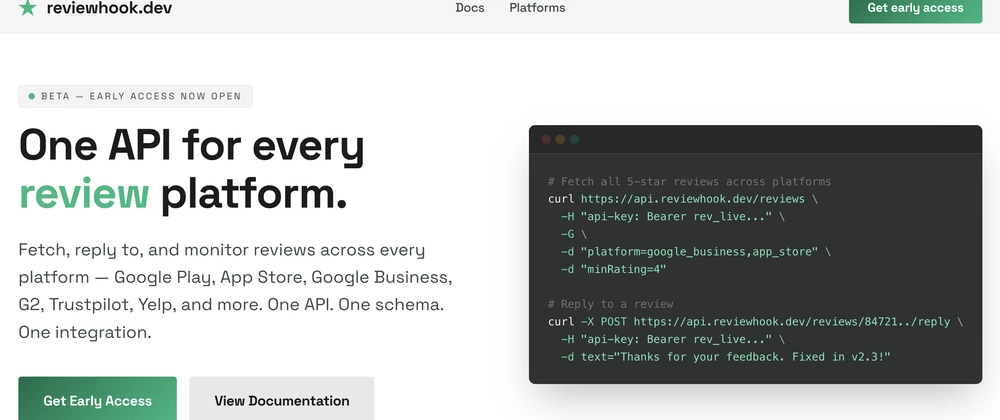
After hours of research, I finally decided to do it. I'm building ReviewHook — a unified API for managing reviews across Google Play, Apple App Store, Google Business Profile, G2, and more.
I'm writing this post because I want to be honest about the journey: why I chose this idea, what I've learned so far, and what I'm still figuring out.
Why review APIs
I picked this niche after hours of research, not because it was the first idea that crossed my mind.
Here's the pattern I noticed: every review management tool on the market is a dashboard. Meanwhile, developers who just need programmatic access to review data are stuck. Either pay enterprise prices for features they'll never use, or spend weeks building separate integrations from scratch.
I ran into this exact problem on another project that used Reviews.io. Their API was missing features we needed, so we had to build a wrapper around it just to download all reviews and run our own logic on top.
That's when I recognized the pattern from another category — Late (now Zernio) hit $98K MRR by doing the same thing for social media: serving developers with a clean API at developer pricing, while everyone else built dashboards for marketing teams.
The exact same gap exists in review management. Nobody serves developers at ~$19/month. So I'm building it.
What ReviewHook does
One API. Multiple platforms. Same schema across all of them.
# Fetch all 1-star reviews across every connected platform
curl https://api.reviewhook.dev/v1/reviews \
  -H "x-api-key: rh_live_..." \
  -d rating_max=1
# Reply to a review — same call regardless of platform
curl -X POST https://api.reviewhook.dev/v1/reviews/84721.../reply \
  -H "x-api-key: rh_live_..." \
  -d text="Thanks for your feedback. Fixed in v2.3!"
No SDKs to install. Just plain REST. Works with curl, fetch, Python requests, Postman, or any HTTP client in any language.
Killer feature: reply via API. Most competitors are read-only — they let you fetch reviews but not respond to them. ReviewHook handles both, including the platform-specific quirks (350 character limits on Google Play, async response handling for Apple, OAuth flows for Google Business Profile).
What I already did wrong
Going from "developer" to "founder" is a different game.
Building too much before talking to users.
My instinct as a developer was to ship an MVP. I got 60-70% of the way there before I realized I had no idea if anyone actually wanted what I was building. It took more time than I expected. I eventually paused and switched to building a landing page, writing docs, and trying to validate the market instead.Marketing is its own job.
I know how to build the product. But getting the first customer requires completely different skills — SEO research, writing landing page copy, posting on Reddit, and figuring out which channels actually work.
It's not harder than coding, but it's different. And every hour spent on marketing is an hour not spent on code. The trade-off is brutal at first.
Where I am right now
- API: ~70% built. Google Play, App Store, Google Business Profile, G2 integrations work.
- Landing page: Live at reviewhook.dev
- Docs: Mostly written, covering the main endpoints
- Beta program: Open
- Customers: Zero so far. That's why I'm here.
What I'm asking for
If you've worked with review APIs before — or you know you will — I'd genuinely value your input.
A few specific questions:
- Have you built review automation before? What broke first?
- Is the reply endpoint actually useful for you, or is monitoring enough?
- Which platforms do you care about most? I'm prioritizing the roadmap based on what beta users ask for.
- What price feels fair? $19/month for the entry tier — too low, too high, or about right?
If you want to try the beta, sign up at reviewhook.dev. First beta users get completely free access.