




TL;DR: Polymarket is a decentralized prediction market on Polygon where real-world events become tradable probability markets. The Polymarket API gives developers programmatic access to market data, trading infrastructure, and on-chain settlement — the foundation for trading bots, analytics dashboards, and prediction market interfaces.
What is Polymarket?
Polymarket is a non-custodial prediction market on Polygon PoS. Users trade binary outcome tokens in USDC.e, priced $0–$1 based on collective market belief, through a hybrid off-chain order book (CLOB) with on-chain settlement via the Conditional Token Framework (ERC-1155). Markets resolve via UMA’s Optimistic Oracle. Markets span elections, major sports, crypto milestones, geopolitical events, and cultural awards — 2.4 million traders, ~$62B in total volume, NYSE’s parent invested $2B at a $9B valuation in 2025.
Polygon PoS: the settlement layer
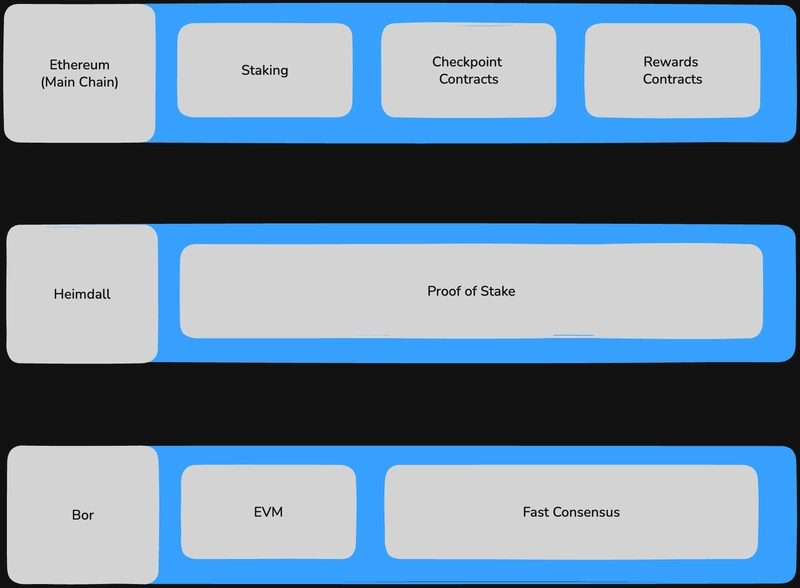
All Polymarket contracts run on Polygon PoS (Chain ID 137) — ~110 TPS, ~$0.002 average tx cost, gas under $0.01 per trade. Polygon’s dual-layer architecture matters for how you handle finality: Heimdall manages validators and commits checkpoints to Ethereum every ~30 minutes (full L1 finality), while Bor handles EVM-compatible block production at 2-second block times (soft finality). Use Bor finality to confirm fills in your bots, Ethereum checkpoints for withdrawals. All Polymarket on-chain events — OrderFilled, PositionsMerged, ConditionResolution — are emitted on Bor. Solidity, ethers.js, viem, and Foundry all work without modification.
The four API layers
Gamma API is the public market discovery layer — no auth, no API key. It exposes Events (top-level questions) and Markets (specific tradable outcomes). Each market’s outcomePrices array maps 1:1 to outcomes and represents implied probabilities — 0.62 means a 62% chance of YES. Filter by active status, 24h volume, tags, open/closed state, and more. Always verify enableOrderBook: true before assuming a market has live CLOB liquidity.
CLOB is the trading engine — hybrid-decentralized with off-chain order matching and on-chain EIP-712 settlement. Available via official SDKs (TypeScript, Python, Rust) or raw REST. Authentication is two-tiered: L1 uses wallet signatures to generate API credentials without spending gas, L2 uses those credentials for fast HMAC-signed requests on every order call. Four order types: GTC (rests on book), GTD (time-bound), FOK (all-or-nothing), FAK (fill what’s available, cancel the rest). Before any order is accepted, the CLOB verifies: valid EIP-712 signature, sufficient USDC.e balance, approved CTF Exchange allowances, and valid L2 credentials.
Data API covers user-level analytics — current positions across markets, full trade history with timestamps and sizes, realized and unrealized P&L, and activity feeds per wallet. This layer becomes important once you move beyond execution and start building dashboards or analyzing strategy performance over time.
WebSocket delivers real-time updates over persistent connections — four channels: market (book snapshots, tick updates, last trade price), user (fills, status changes, cancellations), sports (live sports markets), and RTDS (institutional feed). Critical production detail: Polymarket cancels all open orders when an authenticated session goes inactive — bots must send a heartbeat to stay active.
Integration summary
The integration takes you from a blank directory to a working trading client in 10 steps: set up a Polygon wallet and fund it with POL, deposit USDC.e to your Polymarket profile address, derive L2 API credentials from your wallet, run client.setAllowances()once to approve the CTF Exchange, fetch a market from Gamma, inspect the order book, place a limit order, subscribe to WebSocket channels for real-time fills, and set up an OrderFilled event listener on the CTF Exchange for on-chain confirmation. Once complete, you have the foundation for anything from analytics tools to fully automated trading bots.
💡 Want to see the full step-by-step integration guide? Read the full guide on Chainstack Blog
Builder tools
A range of official and community tools are available: the official clob-client (TypeScript) for order placement and API credentials, real-time-data-client for WebSocket subscriptions with built-in reconnect logic, clob-order-utils for low-level EIP-712 order signing, an rs-clob-client in Rust, Polymarket Agents (Python) as a reference implementation for LLM-based autonomous trading, and Goldsky-powered subgraphs for positions, order book, PnL, and open interest over GraphQL. On the infrastructure side, production-grade Polygon RPC with archive access and WebSocket is available via Chainstack.
Considerations
Before building or trading on Polymarket, understand the key risks: market risk (wrong predictions lose the full committed amount), low liquidity in thin markets, oracle settlement delays if outcomes are disputed, geographic restrictions depending on your region, and smart contract risk inherent to any on-chain platform. Only use funds you are prepared to lose, and verify the legal status of prediction markets in your jurisdiction.
Conclusion
The Polymarket API turns prediction markets into programmable infrastructure — fast, low-cost settlement on Polygon, USDC.e-denominated, with clean primitives across Gamma, CLOB, Data, and WebSocket. The same EVM tooling you already use works without modification. The ecosystem is early and most of the interesting tools haven’t been built yet — whether you’re building a trading bot, a probability dashboard, or an analytics pipeline, the architecture is well-documented, the contracts are audited, and the on-chain history is fully transparent.
💡 Read the full article on Chainstack Blog → https://chainstack.com/polymarket-api-for-developers/