






I was playing with Karpathy's LLM Wiki and realized it could be re-applied to my manual workflow as a PM.
Normally I identify quotes from transcripts, create user stories, group them into features, and prioritize based on effort, impact, dependencies. It's tedious and error-prone, especially across 10+ interviews.
I tried using a wiki instead of my manual process for customer interviews and it worked surprisingly well.
How it works
Before running it, you can edit the prompt to decide what's worth tagging and how user stories should be written. When you re-run it, it does not blindly overwrite your edits or duplicate prior work.
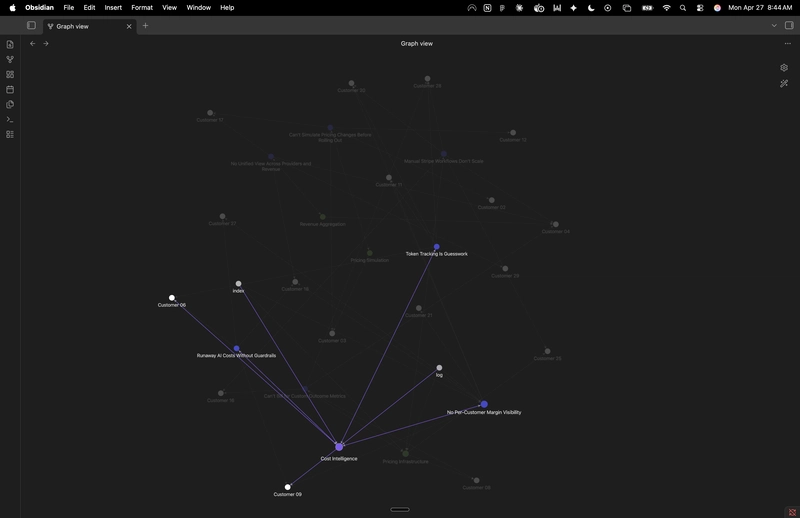
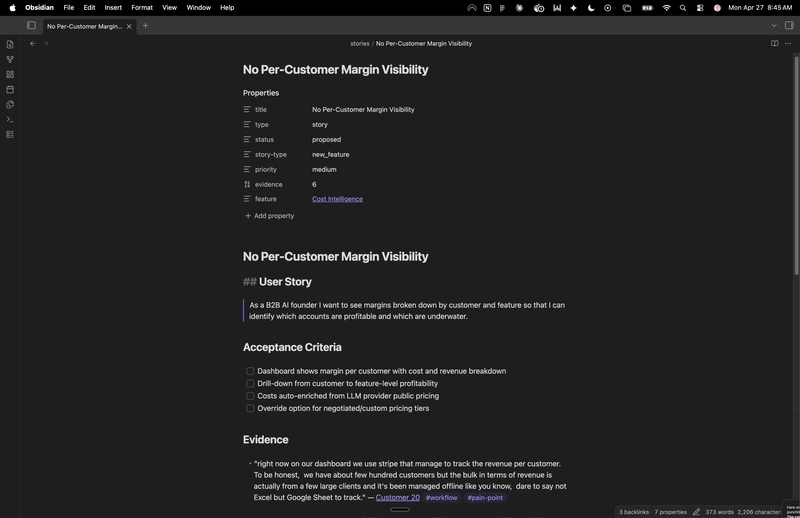
One piece I especially like is the ability to view the connections as a graph and drill down from a user story to the actual customer quotes behind it. And if you're using AI to code, you can feed that evidence in as context. It builds better when it understands why you're building something.
Try it now
The repo ships with 3 fictional transcripts and a pre-built wiki (3 customers, 2 stories, 2 features) so you can explore the output immediately. Open wiki/ in Obsidian to see the graph.
When you're ready to use your own data, drop transcripts into raw/ and ingest. Your data lives alongside the examples. Delete the example files whenever you want. They won't affect your wiki.
Who else this might be useful for
I built this for product discovery, but I imagine it could work for customer success, customer research, or design, anywhere you're trying to surface themes across qualitative data.
If you haven't used Claude Code or Codex before, happy to lend a hand. It's deceptively non-technical.
 katrinalaszlo
/
buildnext-oss
katrinalaszlo
/
buildnext-oss
Karpathy-style evidence wiki for product development. Turn customer signal into grounded user stories. No database, no hosting — just markdown and an LLM.
BuildNext
Turn raw customer signal into evidence-grounded user stories. No database, no hosting — just markdown and an LLM.


How it works
BuildNext is a Karpathy-style LLM wiki for product development. You give it raw customer signal (call transcripts, support tickets, notes). An AI agent reads, extracts, and synthesizes it into a structured knowledge base you can browse in Obsidian or query from any agent.
raw/              # paste transcripts here (input)
wiki/             # agent-maintained output
  customers/      # one page per customer, extracted quotes
  stories/        # synthesized user stories
  features/       # story groupings
  index.md        # catalog of all pages
  log.md          # what changed and when
CLAUDE.md         # schema — rules for how the agent operates
config.md         # internal speakers to filter, evidence tags
Three layers: raw (immutable input), wiki (LLM-maintained output), schema (rules).
Prerequisites
- Git
- An AI coding tool that reads
CLAUDE.md— Claude Code, Cursor, Codex, or…