







Problem to Solve
Most developers' first encounter with AI is a single prompt, a single response. It feels powerful — until the task gets complex. Ask an AI to research three competitors, synthesize the findings, and format them as a report, and a single context window starts to feel very small. This is the problem subagents solve.
Demo
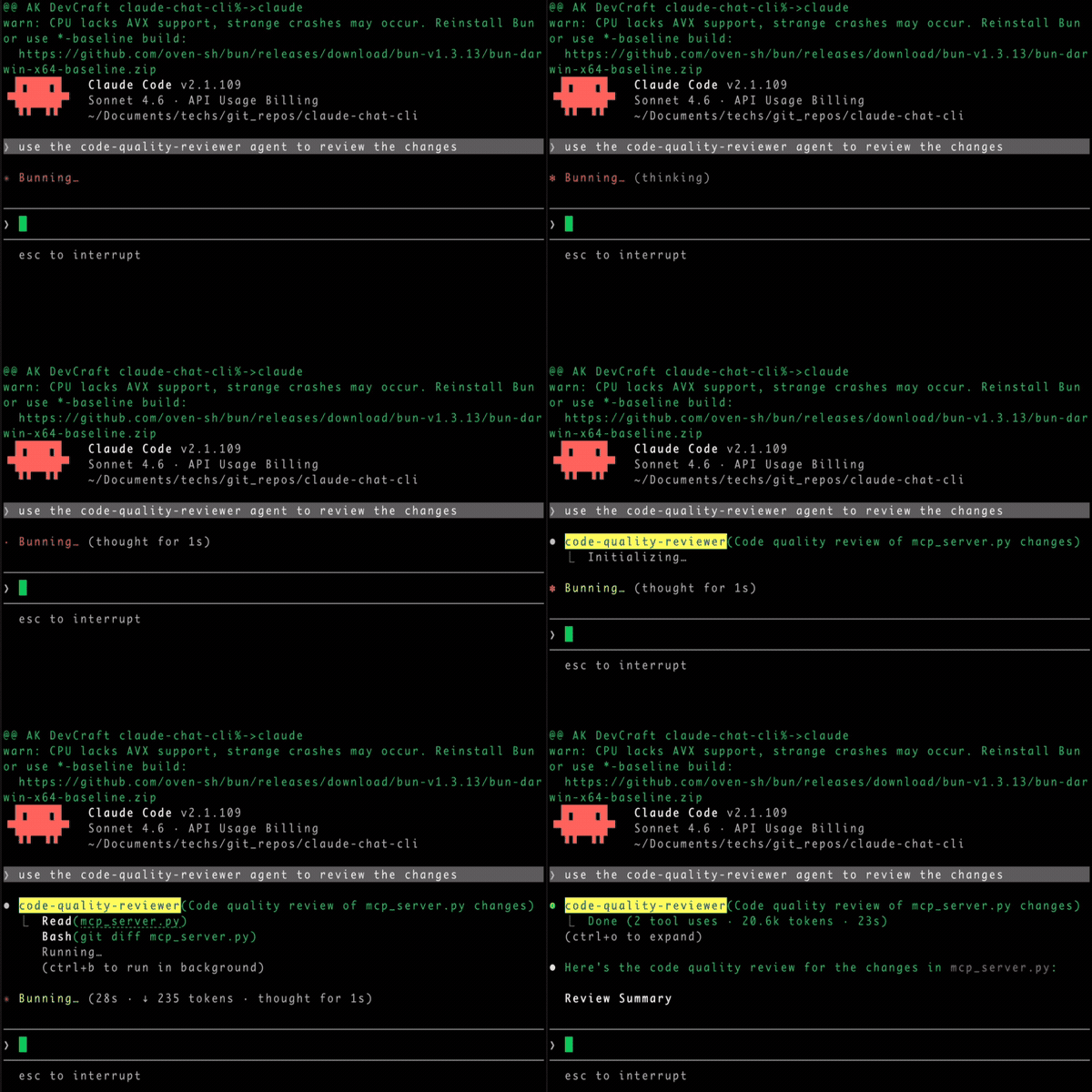
In the demo above, I'm invoking the agent explicitly by name. In orchestrated workflows, Claude can invoke multiple agents like this automatically — in parallel or sequentially — based on the task structure.
Skills GitHub Repo - .claude/agents/code-quality-reviewer.md
What Is a Subagent?
A subagent is an AI instance invoked by an orchestrating AI to handle a specific subtask within a larger workflow. In multi-agent systems broadly — whether built on Claude, GPT, Gemini, or open-source models — the core pattern is the same: rather than a single model doing everything sequentially, an orchestrator breaks work into pieces and delegates them. Much like a technical lead assigning work to specialists rather than writing every function themselves.
According to Anthropic's Claude Agent SDK documentation, subagents serve two core purposes: parallelization (running multiple tasks simultaneously) and context isolation (each subagent uses its own context window, returning only relevant results to the orchestrator rather than its full context).[^1]
Within their assigned scope, subagents are active execution units — they can browse the web, execute code, read and write files, and call external APIs. They don't just reason; they act.
How a Subagent Workflow Works
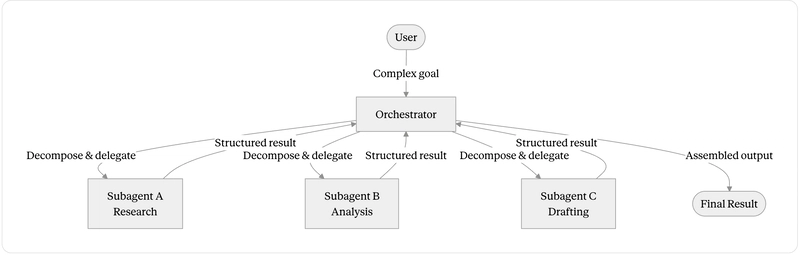
The orchestrator doesn't do the heavy lifting — it coordinates. Each subagent receives a focused prompt with a clear objective, output format, and tool access, then returns a concise result. The orchestrator aggregates those results into the final deliverable.
Anthropic's internal research system uses exactly this pattern: a lead agent spawns subagents to explore different aspects of a query in parallel, then compiles their findings into a coherent answer. Their evaluations found this approach outperformed a single Claude Opus 4 by 90.2% on internal research benchmarks.[^2]
Orchestration Patterns
Not all subagent workflows are structured the same way. Three patterns cover most real-world cases:
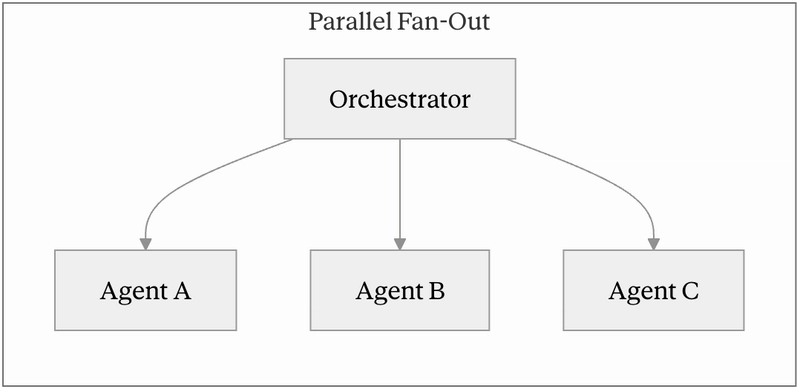
- Parallel fan-out — Independent subtasks launch simultaneously. Best for tasks like analyzing multiple documents at once.
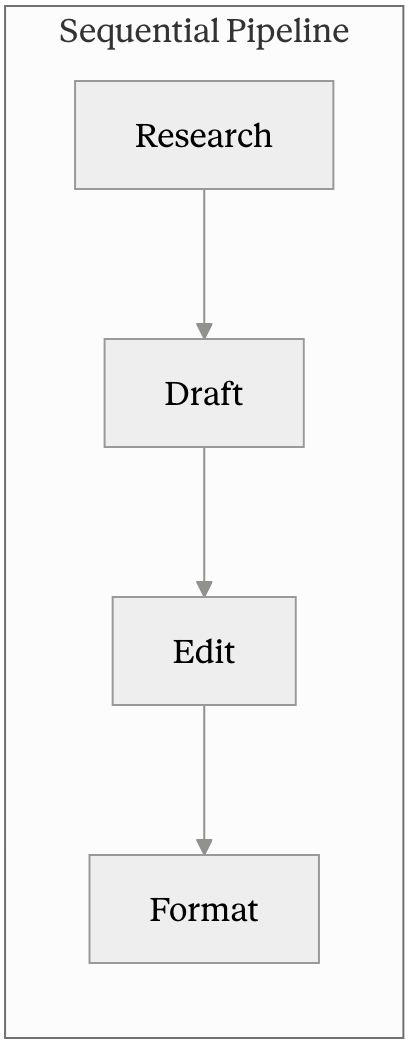
- Sequential pipeline — Each subagent's output feeds the next. Best when there's a dependency chain (research → draft → edit → format).
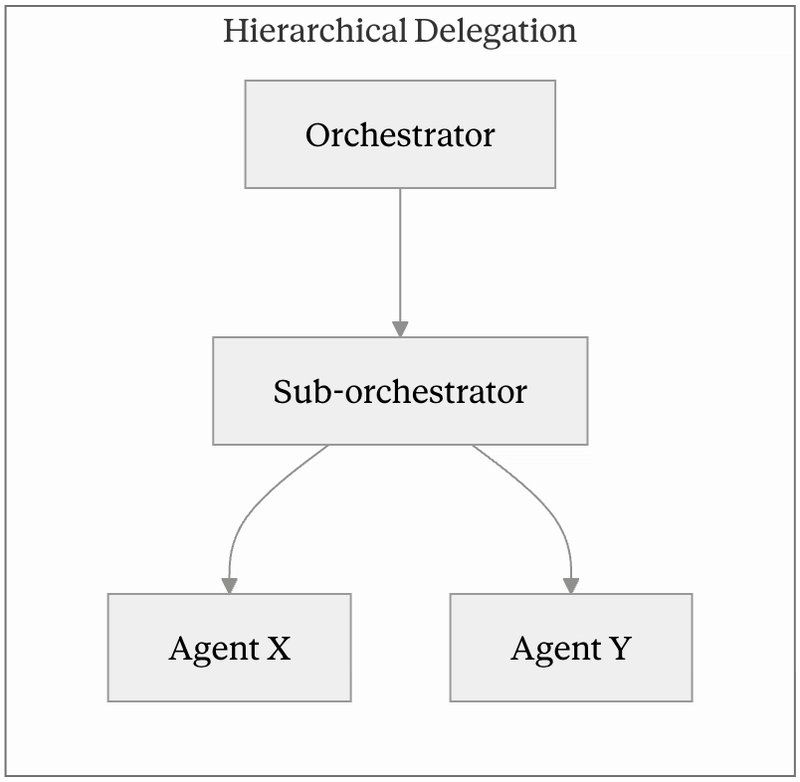
- Hierarchical delegation — A subagent itself becomes an orchestrator for deeper subtasks. Powerful, but adds coordination complexity.
Choosing the wrong pattern is a common mistake. Parallelizing a sequential task adds overhead without benefit; sequentializing an independent task wastes time.
Creating Subagents with Claude Code CLI
Claude Code gives you two ways to create subagents: interactively via the /agents command, or manually as markdown files. Both result in the same thing — a .md file in a .claude/agents/ directory.
The Interactive Way
/agents create
This walks you through a guided setup: name, description, tools, model, and scope. At the end, it saves the file, and the agent is available immediately.
The Manual Way
Create a markdown file directly — the frontmatter defines behavior, the body is the system prompt:
---
name: security-reviewer
description: "Expert security reviewer. Use PROACTIVELY after any changes to auth, data handling, or API endpoints."
tools: Read, Grep, Glob
model: haiku
permissionMode: plan
---

You are a senior security engineer reviewing code for vulnerabilities.
When invoked:
1. Identify recently changed files
2. Analyze for OWASP Top 10 vulnerabilities
3. Check for secrets, SQL injection, and hardcoded credentials
4. Report findings with severity levels and remediation steps
Where the File Lives
Subagent scope is determined by which directory the file is placed in:
| Scope | Path | When to use |
|---|---|---|
| Project |
.claude/agents/ in project root |
Team-shared agents, commit to version control |
| User |
~/.claude/agents/ in home dir |
Personal agents available across all projects |
Project scope is the recommended default — it makes subagent definitions shareable via version control. Use user scope for general-purpose agents you want available everywhere, regardless of which repo you're in.
Best Practices
Write descriptions that trigger correctly. Claude uses the
descriptionfield to decide when to invoke a subagent automatically. Be specific and includePROACTIVELYif you want it auto-triggered — for example: "Use PROACTIVELY after any changes to authentication or data handling."Restrict tools intentionally. The
toolsfield restricts what the agent can do — a security auditor only needsRead,Grep, andGlob, and has no business writing files. That restriction is worth being explicit about.Match model to task complexity. Route subagent exploration to cheaper, faster models like Haiku and reserve Opus for genuine architectural reasoning. A read-only code scanner doesn't need the same model as an agent writing production code.
Keep system prompts focused. A subagent with a narrow, well-defined role outperforms a generalist one. If the prompt starts covering many different concerns, split it into two agents.
The Practical Challenge: Context Management
Each subagent starts fresh with no shared memory. This means:
- The orchestrator must craft every subagent prompt with all the context it needs to succeed
- Subagent outputs must be concise enough to fit back into the orchestrator's context alongside everything else
- If outputs are large, the orchestrator must summarize before aggregating
Good subagent design is largely information architecture: what does each agent need to know, what must it produce, and how does that output flow back into the whole.
Safety Considerations
When subagents can take real-world actions, safety boundaries matter more than in single-agent systems:
- Least privilege — Give each subagent only the tools it actually needs. A research agent doesn't need write access to a production database.
- Output validation — Don't blindly pass subagent outputs downstream. Even lightweight sanity-checking reduces blast radius.
- Prompt injection — Subagents that browse the web or read external files can encounter content designed to manipulate their behavior. This is a real attack surface in agentic systems.
When to Use Subagents
| Use subagents when… | Avoid subagents when… |
|---|---|
| Task has clearly separable subtasks | Task is straightforward for one agent |
| Parallel execution saves meaningful time | Subtasks share too much state to delegate |
| Total work exceeds one context window | Coordination overhead exceeds the benefit |
| Different subtasks need different tools | You're still prototyping — stay simple first |
Start with a single-agent approach and introduce orchestration when it genuinely starts to strain. Complexity has a cost.
Subagents vs. Skills: A Quick Note
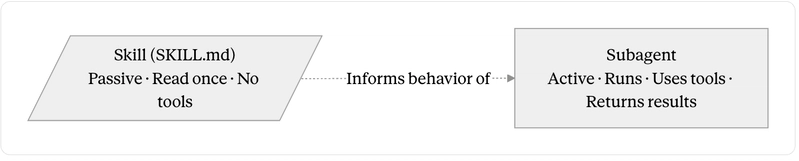
These two terms sometimes get conflated, but they operate at completely different layers. A skill is a passive instruction document — a markdown file Claude reads before a task to understand best practices, available libraries, and output conventions. A subagent is an active execution unit that runs, uses tools, and returns results.
The honest relationship: a subagent might read a skill before doing its work. One shapes knowledge; the other executes.
Final Thoughts
The broader Claude stack can be conceptualized as five layers: MCP for connectivity, Skills for task-specific knowledge, Agent as the primary worker, Subagents as parallel independent workers, and Agent Teams for coordination.[^3] These building blocks are shipping in rapid succession, and the pattern is maturing fast.
For developers just entering this space: don't need to build full orchestration systems on day one. But understanding the pattern — how delegation works, what subagents can and can't do, where the sharp edges are — will shape how you think about AI architecture from the start.
Subagents aren't a feature. There's a shift in how we think about what AI can be tasked with doing.
References
- [^1]: Anthropic Engineering. Building agents with the Claude Agent SDK. -> https://www.anthropic.com/engineering/building-agents-with-the-claude-agent-sdk
- [^2]: Anthropic Engineering. How we built our multi-agent research system. -> https://www.anthropic.com/engineering/multi-agent-research-system
- [^3]: Winbuzzer. Anthropic Shows How to Scale Claude Code with Subagents and MCP. -> https://winbuzzer.com/2026/03/24/anthropic-claude-code-subagent-mcp-advanced-patterns-xcxwbn/
- [^4]: Anthropic. Create custom subagents — Claude Code Docs. -> https://code.claude.com/docs/en/sub-agents
If you have reached this point, I have made a satisfactory effort to keep you reading. Please be kind enough to leave any comments or share any corrections.
My Other Blogs:
- “Skills” in Claude Aren’t About Prompts — They’re About Context Design
- Practical Tips When Working with AI Coding Assistants
- Trying MCP for the First Time — What Stood Out
- To Avoid Performance Impact Never Use Spring RestClient Default Implementation in Production
- Modern DevSecOps Needs More Than One Tool: A Practical Secure SDLC Strategy
- When Resilience Backfires: Retry and Circuit Breaker in Spring Boot