


惯性聚合 高效追踪和阅读你感兴趣的博客、新闻、科技资讯
阅读原文 在惯性聚合中打开

推荐订阅源

V
Visual Studio Blog
爱范儿
爱范儿
GbyAI
GbyAI
博客园 - 叶小钗
Last Week in AI
Last Week in AI
Jina AI
Jina AI
Microsoft Security Blog
云风的 BLOG
云风的 BLOG
C
Check Point Blog
H
Help Net Security
P
Proofpoint News Feed
酷 壳 – CoolShell
酷 壳 – CoolShell
让小产品的独立变现更简单 - ezindie.com
大猫的无限游戏
大猫的无限游戏
H
Hackread – Cybersecurity News, Data Breaches, AI and More
B
Blog RSS Feed
Y
Y Combinator Blog
U
Unit 42
T
Tailwind CSS Blog
MyScale Blog
MyScale Blog
N
Netflix TechBlog - Medium
S
SegmentFault 最新的问题
J
Java Code Geeks
钛媒体:引领未来商业与生活新知
钛媒体:引领未来商业与生活新知

DEV Community

Authentication Security Deep Dive: From Brute Force to Salted Hashing (With Java Examples) Why AI Systems Don’t Fail — They Drift Spilling beans for how i learn for exam😁"Reinforcement Learning Cheat Sheet" I Replaced Chrome with Safari for AI Browser Automation. Here's What Broke (and What Finally Worked) How Python Borrows Other People's Work The $40 Architecture: Processing 1 Billion API Requests with 99.99% Uptime Vibe Coding: A Workflow Guide (From Zero to SaaS) Most webhook security guides protect the wrong side. The scary part is delivery. Headless CMS for TanStack Start: Build a Blog with Cosmic EU Age Verification App "Hacked in 2 Minutes" — What Actually Happened Comfy Cloud’s delete function does not actually remove files Running AI Models on GPU Cloud Servers: A Beginner Guide Event-driven media intelligence with AWS Step Functions and Bedrock I scored 500 AI prompts across 8 quality dimensions — here's what broke How to Call Google Gemini API from Next.js (Free Tier, No Backend Needed) The Portal Protocol: Reclaiming Human Connection in the Age of AI How to Fix Your Team's Scattered Knowledge Problem With a Self-Hosted Forum Intro to tc Cloud Functors: A Graph-First Mental Model for the Modern Cloud Designing Multi-Tenant Backends With Both Ownership and Team Access I Built a Neumorphic CSS Library with 77+ Components — Here's What I Learned PostgreSQL Performance Optimization: Why Connection Pooling Is Critical at Scale Cómo construí un SaaS multi-rubro para gestionar expensas en Argentina con FastAPI + Vue 3 🚀 I Built an Ethical Hacking Scanner Tool – Open Source Project I Replaced /usage and /context in Claude Code With a Single Statusline A Pythonic Way to Handle Emails (IMAP/SMTP) with Auto-Discovery and AI-Ready Design I Collected 8.9 Million Polymarket Price Points — Here's What I Found About How Markets Really Move EcoTrack AI — Carbon Footprint Tracker & Dashboard Everyone's Using AI. No One Agrees How. 5 self-hosted ebook managers worth trying in 2026 Building Your First AI Agent with LangChain: From Chatbot to Autonomous Assistant
AI Agents in Production Are Flying Blind — AgentLens Fixe...
Farzan Hossa · 2026-04-29 · via DEV Community
Cover image for AI Agents in Production Are Flying Blind — AgentLens Fixes That

Farzan Hossan Shaikat

The Visibility Problem

Running an AI agent in production means dealing with a problem most developers hit quickly.

The agent makes 15–20 LLM calls per session — chained, conditional, sometimes parallel. Something goes wrong. The output is bad, the cost spiked, or the agent looped. And there's no answer to any of these questions:

  • Which specific call failed?
  • What did the model actually receive?
  • What did it return?
  • How much did this session cost?
  • Where in the run did it break?

Why Existing Tools Don't Solve It

LangSmith only works if you're using LangChain. Custom agents are unsupported.

Helicone proxies individual LLM API calls. Useful for per-request cost tracking, but it has no concept of agent structure — no parent/child spans, no session grouping, no multi-step trace.

Langfuse is the closest alternative but requires meaningful code instrumentation to get meaningful traces.

Datadog is built for enterprise infrastructure teams, not a developer running their first production agent.

The AgentLens Approach

AgentLens is an open-source observability platform built specifically for AI agent runs.

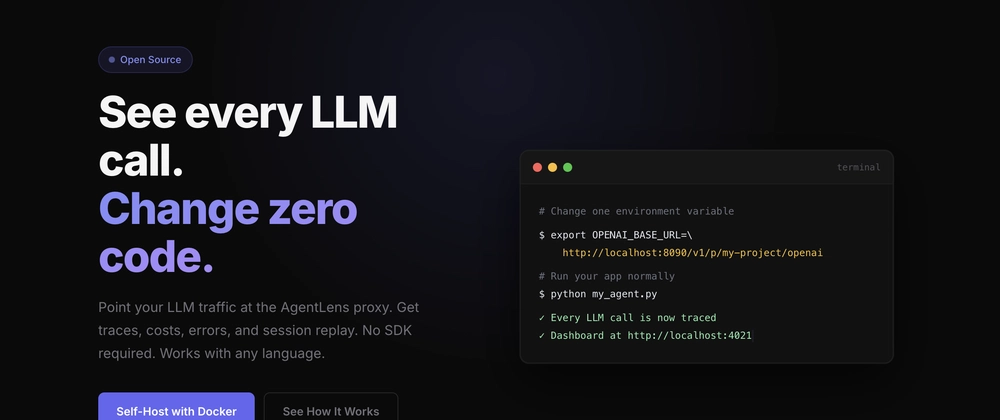
Option 1: Zero code changes (proxy)

# Before
OPENAI_BASE_URL=https://api.openai.com

# After — one change, full observability
OPENAI_BASE_URL=http://localhost:8090/v1/p/{projectId}/openai

Enter fullscreen mode Exit fullscreen mode

Every LLM call flows through AgentLens. It forwards to OpenAI transparently and captures the full trace — tokens, cost, latency, model, full prompt and completion. Works with any language and any framework.

Option 2: TypeScript SDK

import '@farzanhossans/agentlens-openai'
// auto-patches the OpenAI SDK — every call is traced

Enter fullscreen mode Exit fullscreen mode

Option 3: Python SDK

import agentlens.patchers.openai
# same — all calls auto-traced

Enter fullscreen mode Exit fullscreen mode

Self-Host in 3 Minutes

git clone https://github.com/farzanhossan/agentlens
cd agentlens/infra
cp .env.prod.example .env
docker compose -f docker-compose.prod.yml up -d

Enter fullscreen mode Exit fullscreen mode

Dashboard at localhost:4021. API at localhost:4020.

The Stack

  • NestJS + BullMQ — async span processor
  • Cloudflare Workers — edge ingest endpoint
  • Elasticsearch — trace storage, full-text search, error clustering
  • PostgreSQL — metadata, users, projects, alerts
  • React dashboard — real-time updates via WebSocket

What's Next

Phase 2 is the AI intelligence layer — using Claude API to automatically analyze traces, explain why agent conversations fail, and surface prompt improvement suggestions. The shift from "see what happened" to "understand why."

Try It

Landing: https://agentlens.techmatbd.com
GitHub: https://github.com/farzanhossan/agentlens
MIT licensed.