惯性聚合 高效追踪和阅读你感兴趣的博客、新闻、科技资讯
阅读原文 在惯性聚合中打开

推荐订阅源

阮一峰的网络日志
阮一峰的网络日志
The GitHub Blog
The GitHub Blog
酷 壳 – CoolShell
酷 壳 – CoolShell
雷峰网
雷峰网
U
Unit 42
Y
Y Combinator Blog
I
InfoQ
P
Proofpoint News Feed
Engineering at Meta
Engineering at Meta
量子位
Microsoft Security Blog
B
Blog
The Cloudflare Blog
F
Fortinet All Blogs
Google DeepMind News
MyScale Blog
MyScale Blog
C
Check Point Blog
S
SegmentFault 最新的问题
爱范儿
爱范儿
博客园 - 叶小钗
奇客Solidot–传递最新科技情报
奇客Solidot–传递最新科技情报
Hugging Face - Blog
Hugging Face - Blog
罗磊的独立博客
T
Tailwind CSS Blog

DEV Community

Authentication Security Deep Dive: From Brute Force to Salted Hashing (With Java Examples) Why AI Systems Don’t Fail — They Drift Spilling beans for how i learn for exam😁"Reinforcement Learning Cheat Sheet" I Replaced Chrome with Safari for AI Browser Automation. Here's What Broke (and What Finally Worked) How Python Borrows Other People's Work The $40 Architecture: Processing 1 Billion API Requests with 99.99% Uptime Vibe Coding: A Workflow Guide (From Zero to SaaS) Most webhook security guides protect the wrong side. The scary part is delivery. Headless CMS for TanStack Start: Build a Blog with Cosmic EU Age Verification App "Hacked in 2 Minutes" — What Actually Happened Comfy Cloud’s delete function does not actually remove files Running AI Models on GPU Cloud Servers: A Beginner Guide Event-driven media intelligence with AWS Step Functions and Bedrock I scored 500 AI prompts across 8 quality dimensions — here's what broke How to Call Google Gemini API from Next.js (Free Tier, No Backend Needed) The Portal Protocol: Reclaiming Human Connection in the Age of AI How to Fix Your Team's Scattered Knowledge Problem With a Self-Hosted Forum Intro to tc Cloud Functors: A Graph-First Mental Model for the Modern Cloud Designing Multi-Tenant Backends With Both Ownership and Team Access I Built a Neumorphic CSS Library with 77+ Components — Here's What I Learned PostgreSQL Performance Optimization: Why Connection Pooling Is Critical at Scale Cómo construí un SaaS multi-rubro para gestionar expensas en Argentina con FastAPI + Vue 3 🚀 I Built an Ethical Hacking Scanner Tool – Open Source Project I Replaced /usage and /context in Claude Code With a Single Statusline A Pythonic Way to Handle Emails (IMAP/SMTP) with Auto-Discovery and AI-Ready Design I Collected 8.9 Million Polymarket Price Points — Here's What I Found About How Markets Really Move EcoTrack AI — Carbon Footprint Tracker & Dashboard Everyone's Using AI. No One Agrees How. 5 self-hosted ebook managers worth trying in 2026 Building Your First AI Agent with LangChain: From Chatbot to Autonomous Assistant
Making Python CLIs Simple Again with Klix
Arjun M · 2026-04-24 · via DEV Community

Arjun M

Most Python CLI tools do not start messy.

They become messy.

You begin with a command or two. Then you add prompts. Then state. Then output formatting. Then navigation. Then lifecycle logic. Then suddenly your “small CLI tool” looks like five different ideas stitched together.

So instead of pretending that’s fine, I built Klix.

Klix is a Python framework for building structured, interactive CLI applications without turning everything into a patchwork of libraries.


Why Klix Exists

CLI development today is fragmented.

You typically end up combining:

  • a command parser
  • a prompt/input library
  • something for formatting
  • custom state management
  • and glue code everywhere

It works.

But it doesn’t stay clean.

Klix brings all of that into a single, consistent system so your CLI grows without turning into chaos.


What Klix Gives You

Klix is designed as a command-first framework with built-in structure.

It includes:

  • Command routing
  • Typed session state
  • Prompt-driven interaction
  • Rich terminal rendering
  • Middleware & lifecycle events
  • Layout primitives
  • UI helpers like forms, tables, and panels

Instead of assembling tools, you build on one framework.


Getting Started

Install Klix:

pip install klix

Enter fullscreen mode Exit fullscreen mode

Create a new app:

klix init my-app
cd my-app
python main.py

Enter fullscreen mode Exit fullscreen mode


Minimal Example

from dataclasses import dataclass
from klix import App

@dataclass
class SessionState:
    name: str = "Guest"

app = App(state=SessionState)

@app.command()
def greet(state: SessionState):
    print(f"Hello, {state.name}!")

if __name__ == "__main__":
    app.run()

Enter fullscreen mode Exit fullscreen mode

No boilerplate chaos. Just define state, register commands, and run.


What Makes It Different

Command-First Design

Your app structure is built around commands, not hidden wiring.

Built-in State Management

Typed session state keeps your data structured and predictable.

Interactive by Default

Prompts and flows are part of the system, not an afterthought.

Rich Output

Tables, panels, and structured output without extra libraries.

Scales Cleanly

Start small. Grow without rewriting everything.


Demo Gallery

Klix Interface
Klix Interface Example

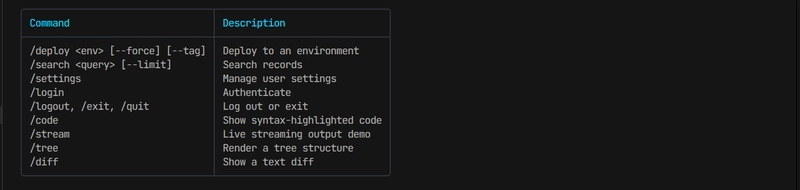
Help Table

Help Table

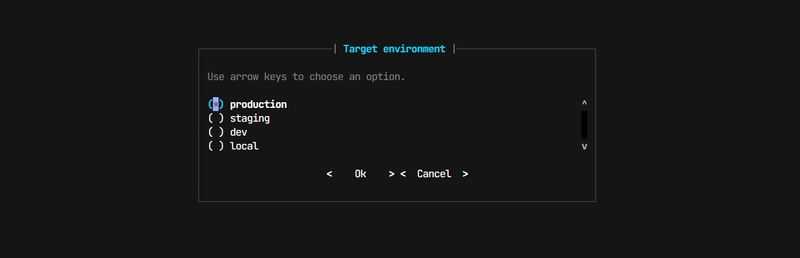
Interactive Select

Select Dialog

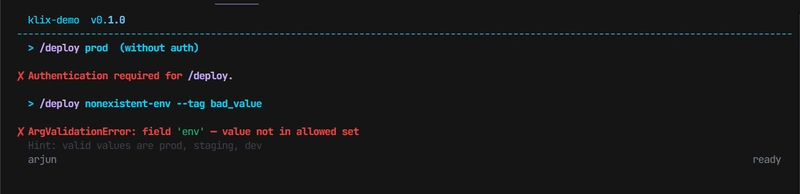
Error Display

Error Display

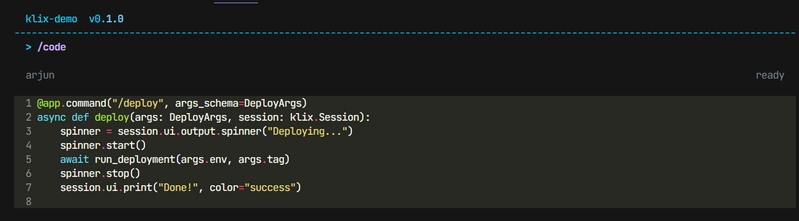
Syntax Highlighting

Syntax Highlighted Code

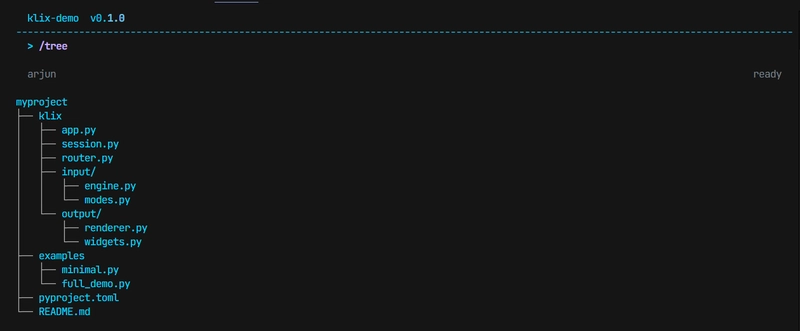
Tree View

Tree View

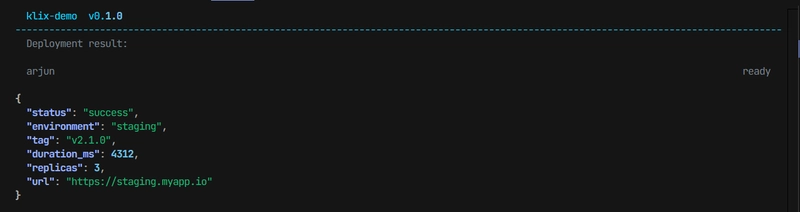
Deployment Result JSON

Deployment Result JSON

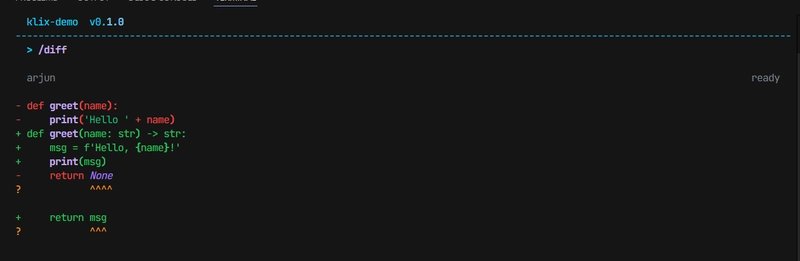
Diff View

Diff View

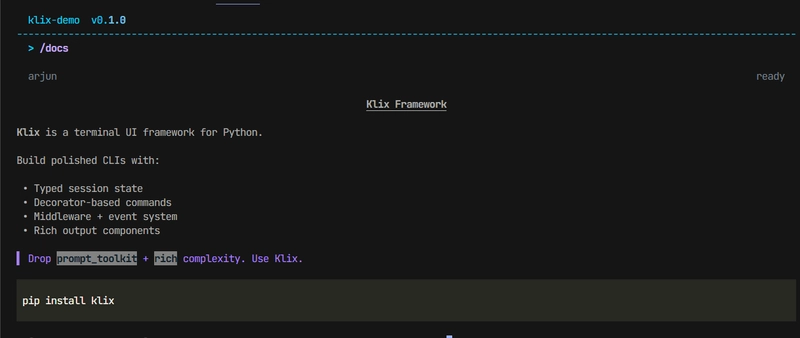
Markdown Rendering

Markdown Rendering

Deployment Config Panel
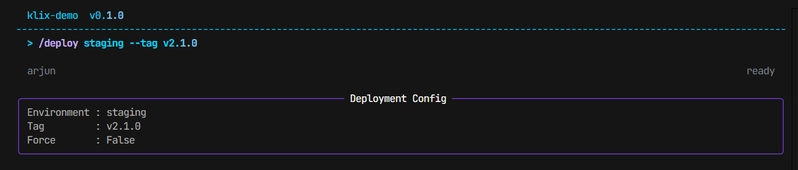
Deployment Config Panel


Where Klix Fits

Klix works best for:

  • Developer tools
  • Internal CLIs
  • Setup wizards
  • Workflow tools
  • Terminal-based apps

If your CLI has interaction and more than one command, this helps.


Links


Final Thought

Klix is built to keep CLI apps simple, structured, and maintainable.

If your current CLI feels like multiple tools pretending to be one, Klix is the cleaner approach.


Tags

#Python #CLI #DeveloperTools #OpenSource #Productivity #Terminal #PythonProjects #DevTools #SoftwareDevelopment #Programming #BuildInPublic #IndieDev #Automation #CommandLine #Tech