


Episode 3: The Autonomous QA Loop
In the previous episodes, we explored how Agentic AI transforms enterprise delivery. Episode 1 focused on the shift from isolated tools to intelligent systems. Episode 2 examined how agents can strengthen the Product Ownership layer by translating business needs into actionable user stories.
Now, we move into one of the most critical governance layers in the software lifecycle: Quality Assurance.
Once a user story is defined, the real challenge begins: ensuring that the implementation truly reflects the original business intent. Traditional QA often suffers from context leakage, where the tester, automation script, or validation process lacks the full nuance of the requirement.
This is where a Multi-Agent QA System changes the model.
Instead of treating QA as a reactive checkpoint, Agentic AI turns it into an autonomous, reasoning-driven ecosystem. The objective is no longer just to automate test execution. The real goal is to automate the intelligence behind the testing strategy.
The Agentic QA Triad: Generation, Execution, and Reporting
In traditional enterprise environments, QA is often seen as a bottleneck: a rigid phase of “checking” that happens after development is complete. Even with modern automation, teams frequently end up maintaining brittle scripts that break whenever the UI, selectors, or workflows change.
An Agentic QA model changes this by creating a closed-loop system where agents generate tests, execute them intelligently, and report results with business context.
This loop is built around three core agents:
The Architect Agent — Test Generation
The Executor Agent — Autonomous Validation
The Secretary Agent — Reporting and Feedback
Together, these agents form an autonomous QA lifecycle that continuously validates software against the original user story.
Phase 1: The Architect Agent
Test Generation Through Contextual Grounding
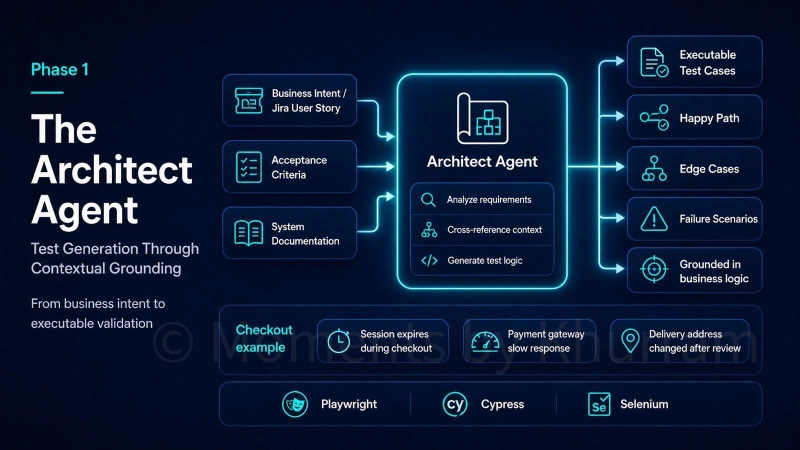
The Architect Agent acts as the bridge between business intent and executable validation.
Instead of relying on a human to manually translate a Jira ticket into test cases, the Architect Agent reads the user story, analyzes the acceptance criteria, and cross-references the requirement with existing system documentation.
Its role is not limited to producing a basic happy-path test. It reasons through the user story and identifies multiple validation paths, including edge cases and failure scenarios.
For example, if the story describes a checkout flow, the agent does not only test whether the user can complete a purchase. It also considers questions such as:
What happens if the user’s session expires during checkout? What if the payment gateway responds slowly? What if the user changes the delivery address after reviewing the order?
The output is a set of high-fidelity, executable test scripts using tools such as Playwright, Cypress, or Selenium. More importantly, these scripts are grounded in the business logic of the original user story, not just the technical implementation.The Architect AgentThe Architect Agent
Phase 2: The Executor Agent
Autonomous Validation Beyond Brittle Scripts
Traditional automation often fails for shallow reasons. A CSS selector changes. A button ID is renamed. A label moves slightly on the page. The script breaks, even though the business functionality still works.
The Executor Agent introduces agentic reasoning into test execution.
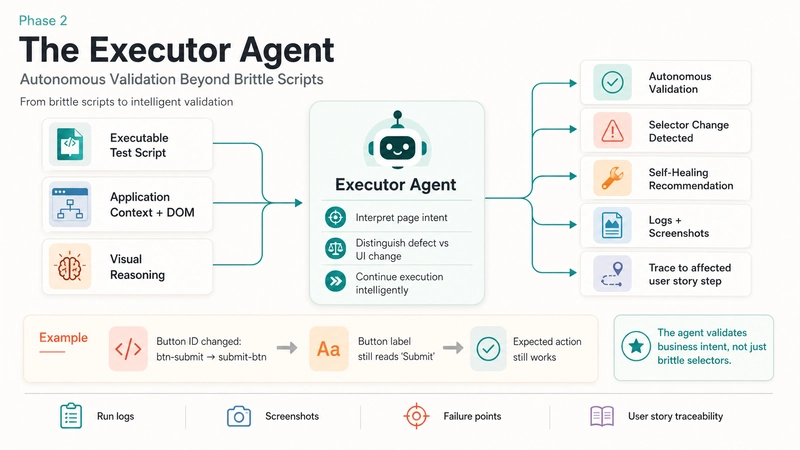
Rather than blindly following a brittle script, it uses application context, DOM analysis, and visual reasoning to determine whether a change is a true defect or simply a UI evolution.
For example, if a button ID changes from btn-submit to submit-btn, the agent does not immediately fail the test. It reasons through the intent:
The user story requires a submit action. The page still contains a button labeled “Submit.” The button performs the expected action.
In this case, the agent can continue execution, flag the selector change, and recommend a self-healing update to the test script.
This shifts automation from passive execution to intelligent validation. The agent does not simply ask, “Did the script pass?” It asks, “Did the implementation satisfy the business intent?”
The Executor Agent also captures rich metadata for every run, including logs, screenshots, The Executer Agent failure points, and the specific user story step that was affected.
Phase 3: The Secretary Agent
Closing the Feedback Loop Through Direct Reporting
A production-ready QA system does not stop at test execution. It must also close the feedback loop.
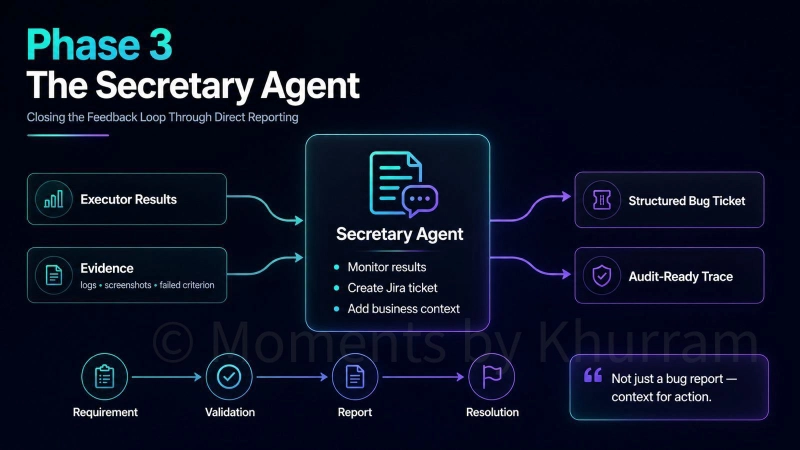
The Secretary Agent monitors the Executor Agent’s results and turns failures into actionable development feedback. If a defect is detected, it does not wait for manual triage or a status meeting. It creates a structured Jira ticket directly in the development backlog.
But this is not just a generic bug report.
The ticket includes the original user story link, the failed acceptance criterion, screenshots, logs, CI/CD context, and a natural-language explanation of why the implementation failed to meet the business requirement.
Where traditional QA often produces disconnected bug reports, the Secretary Agent injects context back into the delivery workflow.
This creates an audit-ready trail from requirement to validation to defect resolution.
Expanding the Agentic QA Squad
A mature Agentic QA ecosystem can include additional specialized agents beyond the core triad.
The Impact Analyzer Agent monitors pull requests, code commits, and CI/CD activity. It determines which business flows are likely affected by a code change, so teams do not waste time running irrelevant test suites.
The Observability and Red-Teaming Agent acts as the critic. It explores edge cases, race conditions, security vulnerabilities, and unexpected user behaviors that may not have been explicitly defined in the original requirement.
Together, these agents move QA away from repetitive validation and toward strategic quality engineering.
Fuzzy Verification: Testing Beyond Binary Assertions
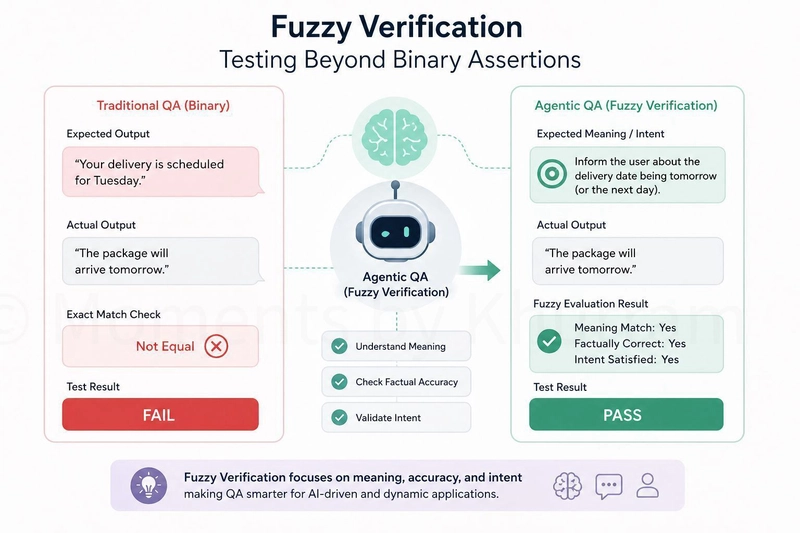
Traditional QA is usually binary: expected value equals actual value. If the exact output differs, the test fails.
But modern systems are increasingly dynamic, especially when AI-generated responses, conversational interfaces, or personalized experiences are involved.
Agentic QA introduces fuzzy verification, where agents validate the meaning, accuracy, and intent of an output rather than only checking for exact text matches.
For example, a traditional script might fail if a chatbot says:
“The package will arrive tomorrow.”
instead of:
“Your delivery is scheduled for Tuesday.”
An Agentic QA system can evaluate whether both responses carry the same meaning, are factually correct, and satisfy the user’s request.
Off course NOT FOR FINANCIAL VERIFICATION number would remains absolute to be verified.
This makes QA more suitable for modern applications where outputs are not always deterministic.
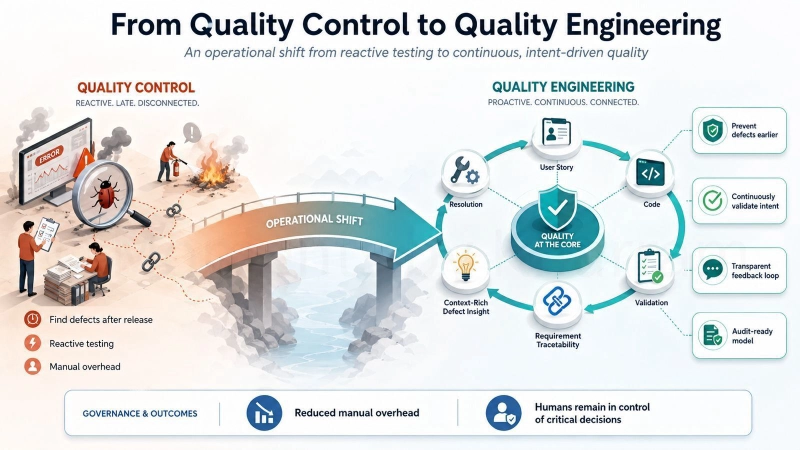
From Quality Control to Quality Engineering
The biggest shift is not technical. It is operational. Traditional QA focuses on quality control: finding mistakes after they happen.
Agentic QA moves the enterprise toward quality engineering: preventing defects, validating intent continuously, and creating a transparent feedback loop across product, engineering, and QA.
Every line of code can be measured against the original user story. Every failed test can be traced back to a requirement. Every defect can be reported with enough context for developers to act quickly.
The result is an audit-ready enterprise QA model where agents reduce manual overhead while humans remain in control of critical decisions.
The Human-in-the-Loop Guardrail
Agentic QA does not mean giving agents unrestricted autonomy.
The QA Lead remains the governor of the system. Agents can propose test plans, identify risks, generate scripts, execute validations, cluster defects, and recommend fixes. However, high-risk decisions, production releases, and business-critical approvals remain under human supervision.
This balance is essential for enterprise adoption. Agents bring speed, reasoning, and scale. Humans bring judgment, accountability, and governance.
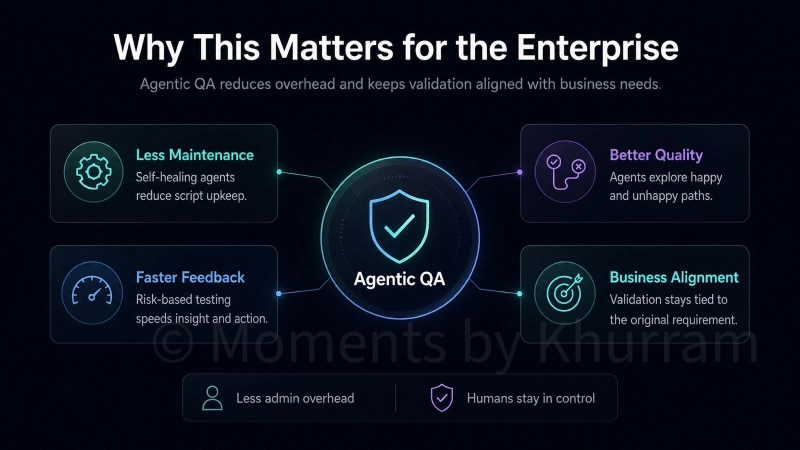
Why This Matters for the Enterprise
The value of Agentic QA becomes clear in three areas.
First, it reduces maintenance. Self-healing agents can eliminate a large portion of manual script updates caused by minor UI or selector changes.
Second, it accelerates feedback. Tests can be prioritized by business risk and code impact rather than being executed in a fixed, inefficient order.
Third, it improves quality. Agents can explore both happy paths and unhappy paths, identifying issues that rigid automation may miss.
Most importantly, Agentic QA keeps validation aligned with the original business requirement. That alignment is what enterprises need most.
What’s Next?
In the next episode, we will explore The Dev-Agent Loop: how agents can support real-time debugging, code hardening, and self-healing pipelines during the development process itself.
As enterprise teams continue to modernize QA, one question becomes unavoidable:
How much of your current QA bottleneck comes from actual testing, and how much comes from administrative overhead such as writing tickets, updating statuses, and maintaining brittle scripts?
Lear More -> Tech Sprinter
khurram bilal