

惯性聚合 高效追踪和阅读你感兴趣的博客、新闻、科技资讯
阅读原文 在惯性聚合中打开

推荐订阅源

G
Google Developers Blog
博客园 - 司徒正美
Last Week in AI
Last Week in AI
Recent Announcements
Y
Y Combinator Blog
博客园 - 聂微东
M
MIT News - Artificial intelligence
博客园_首页
Jina AI
Jina AI
博客园 - 叶小钗
酷 壳 – CoolShell
酷 壳 – CoolShell
H
Hackread – Cybersecurity News, Data Breaches, AI and More
J
Java Code Geeks
F
Fortinet All Blogs
aimingoo的专栏
aimingoo的专栏
小众软件
小众软件
Vercel News
Vercel News
The Cloudflare Blog
钛媒体:引领未来商业与生活新知
钛媒体:引领未来商业与生活新知
云风的 BLOG
云风的 BLOG
N
Netflix TechBlog - Medium
B
Blog
Google DeepMind News
freeCodeCamp Programming Tutorials: Python, JavaScript, Git & More

DEV Community

Authentication Security Deep Dive: From Brute Force to Salted Hashing (With Java Examples) Why AI Systems Don’t Fail — They Drift Spilling beans for how i learn for exam😁"Reinforcement Learning Cheat Sheet" I Replaced Chrome with Safari for AI Browser Automation. Here's What Broke (and What Finally Worked) How Python Borrows Other People's Work The $40 Architecture: Processing 1 Billion API Requests with 99.99% Uptime Vibe Coding: A Workflow Guide (From Zero to SaaS) Most webhook security guides protect the wrong side. The scary part is delivery. Headless CMS for TanStack Start: Build a Blog with Cosmic EU Age Verification App "Hacked in 2 Minutes" — What Actually Happened Comfy Cloud’s delete function does not actually remove files Running AI Models on GPU Cloud Servers: A Beginner Guide Event-driven media intelligence with AWS Step Functions and Bedrock I scored 500 AI prompts across 8 quality dimensions — here's what broke How to Call Google Gemini API from Next.js (Free Tier, No Backend Needed) The Portal Protocol: Reclaiming Human Connection in the Age of AI How to Fix Your Team's Scattered Knowledge Problem With a Self-Hosted Forum Intro to tc Cloud Functors: A Graph-First Mental Model for the Modern Cloud Designing Multi-Tenant Backends With Both Ownership and Team Access I Built a Neumorphic CSS Library with 77+ Components — Here's What I Learned PostgreSQL Performance Optimization: Why Connection Pooling Is Critical at Scale Cómo construí un SaaS multi-rubro para gestionar expensas en Argentina con FastAPI + Vue 3 🚀 I Built an Ethical Hacking Scanner Tool – Open Source Project I Replaced /usage and /context in Claude Code With a Single Statusline A Pythonic Way to Handle Emails (IMAP/SMTP) with Auto-Discovery and AI-Ready Design I Collected 8.9 Million Polymarket Price Points — Here's What I Found About How Markets Really Move EcoTrack AI — Carbon Footprint Tracker & Dashboard Everyone's Using AI. No One Agrees How. 5 self-hosted ebook managers worth trying in 2026 Building Your First AI Agent with LangChain: From Chatbot to Autonomous Assistant
Debugging Voice Agents: How to Know if Your STT, LLM, or ...
Shagufta Ahm · 2026-04-24 · via DEV Community
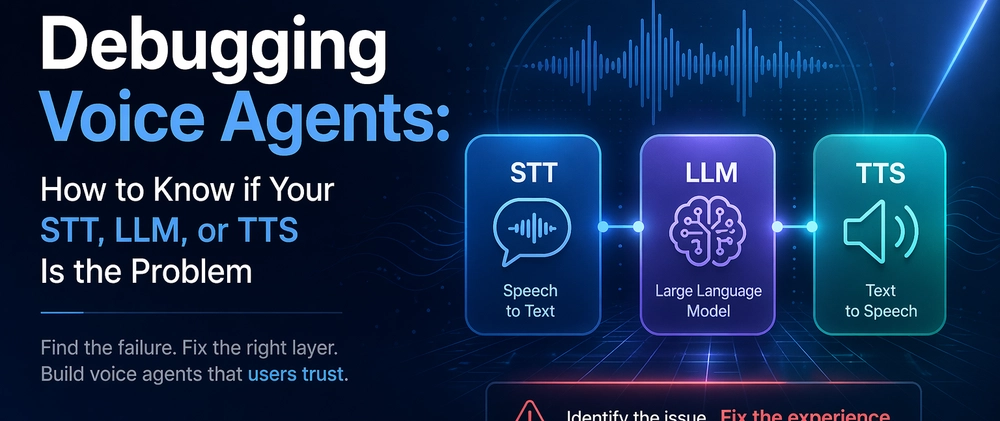
Cover image for Debugging Voice Agents: How to Know if Your STT, LLM, or TTS Is the Problem

Something went wrong. The agent said something bizarre, or paused for three seconds, or completely misunderstood the user. The real question is: which layer broke? The answer isn't obvious, and guessing is expensive.

Here is the thing about debugging a voice agent that nobody warns you about upfront: failures are almost never where you think they are.
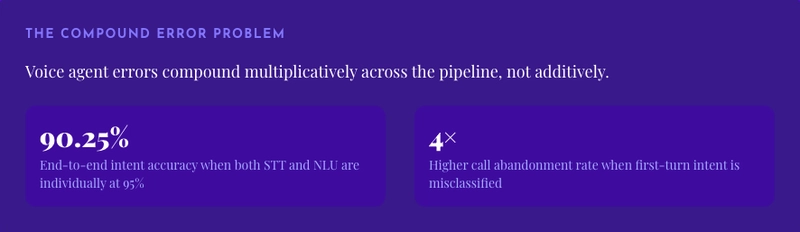
A voice agent that gives a wrong answer isn't necessarily an LLM problem. A voice agent that sounds robotic isn't necessarily a TTS problem. A voice agent that seems to "mishear" users isn't always an STT problem.

The pipeline is sequential and each stage feeds the next, which means a failure at layer one looks, to the user, like a failure everywhere.

Read the Pipeline Before You Touch Anything
The first instinct when something breaks in production is to change something. Resist that. The first move should always be to trace the call end-to-end and identify which stage produced the failure.

  1. Is the STT transcript accurate?
    If NO: STT is the problem. Check background noise, accents, or domain jargon. Fixes include fine-tuning or switching providers.

  2. Is the LLM response correct given the transcript?
    If NO: LLM is the problem. Check system prompts, context window, or RAG failures (missing context).

  3. Does the audio output sound natural?
    If NO: TTS is the issue. Check latency-to-first-audio, phonetic overrides, or pronunciation models
    .

STT: The Failure That Poisons Everything
Speech-to-text is where most voice agent failures originate. Real environments include car noise, accents, and bad phone connections which can shift accuracy by more than 10 points.

The Jargon Problem: Deepgram Nova-3 leads benchmarks, but in specialized domains like healthcare, performance deteriorates without domain fine-tuning. Fine-tuning is not optional in production.

LLM: Usually Not the Problem
Modern models like GPT-4o, Claude, or Gemini perform similarly. Failures here usually come from ambiguous prompts, context window overflow, or hallucinations caused by poor retrieval.

"The real issues are almost always upstream from bad transcripts or downstream from weird TTS artifacts. The LLM sitting in the middle gets blamed for a lot of sins it didn't commit."
TTS: Latency vs Quality
Confusing latency failures with quality failures wastes time. Streaming TTS (beginning synthesis as soon as the first sentence token arrives) is the solution for response time issues.
