惯性聚合 高效追踪和阅读你感兴趣的博客、新闻、科技资讯
阅读原文 在惯性聚合中打开

推荐订阅源

H
Help Net Security
Cyber Security Advisories - MS-ISAC
博客园 - 【当耐特】
Microsoft Azure Blog
Google DeepMind News
Apple Machine Learning Research
有赞技术团队
有赞技术团队
Y
Y Combinator Blog
H
Hackread – Cybersecurity News, Data Breaches, AI and More
爱范儿
爱范儿
L
LangChain Blog
IT之家
IT之家
酷 壳 – CoolShell
酷 壳 – CoolShell
MongoDB | Blog
MongoDB | Blog
Hugging Face - Blog
Hugging Face - Blog
G
Google Developers Blog
T
Tailwind CSS Blog
Engineering at Meta
Engineering at Meta
奇客Solidot–传递最新科技情报
奇客Solidot–传递最新科技情报
宝玉的分享
宝玉的分享
博客园 - 三生石上(FineUI控件)
D
DataBreaches.Net
Recent Announcements
freeCodeCamp Programming Tutorials: Python, JavaScript, Git & More

DEV Community

Authentication Security Deep Dive: From Brute Force to Salted Hashing (With Java Examples) Why AI Systems Don’t Fail — They Drift Spilling beans for how i learn for exam😁"Reinforcement Learning Cheat Sheet" I Replaced Chrome with Safari for AI Browser Automation. Here's What Broke (and What Finally Worked) How Python Borrows Other People's Work The $40 Architecture: Processing 1 Billion API Requests with 99.99% Uptime Vibe Coding: A Workflow Guide (From Zero to SaaS) Most webhook security guides protect the wrong side. The scary part is delivery. Headless CMS for TanStack Start: Build a Blog with Cosmic EU Age Verification App "Hacked in 2 Minutes" — What Actually Happened Comfy Cloud’s delete function does not actually remove files Running AI Models on GPU Cloud Servers: A Beginner Guide Event-driven media intelligence with AWS Step Functions and Bedrock I scored 500 AI prompts across 8 quality dimensions — here's what broke How to Call Google Gemini API from Next.js (Free Tier, No Backend Needed) The Portal Protocol: Reclaiming Human Connection in the Age of AI How to Fix Your Team's Scattered Knowledge Problem With a Self-Hosted Forum Intro to tc Cloud Functors: A Graph-First Mental Model for the Modern Cloud Designing Multi-Tenant Backends With Both Ownership and Team Access I Built a Neumorphic CSS Library with 77+ Components — Here's What I Learned PostgreSQL Performance Optimization: Why Connection Pooling Is Critical at Scale Cómo construí un SaaS multi-rubro para gestionar expensas en Argentina con FastAPI + Vue 3 🚀 I Built an Ethical Hacking Scanner Tool – Open Source Project I Replaced /usage and /context in Claude Code With a Single Statusline A Pythonic Way to Handle Emails (IMAP/SMTP) with Auto-Discovery and AI-Ready Design I Collected 8.9 Million Polymarket Price Points — Here's What I Found About How Markets Really Move EcoTrack AI — Carbon Footprint Tracker & Dashboard Everyone's Using AI. No One Agrees How. 5 self-hosted ebook managers worth trying in 2026 Building Your First AI Agent with LangChain: From Chatbot to Autonomous Assistant
QuecPython + USBNET: Implement USB Network Adapter Functi...
QuecPython · 2026-04-24 · via DEV Community

USBNET Overview

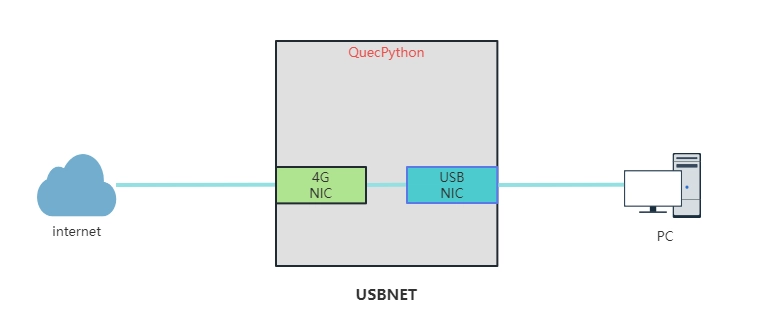
USBNET (USB Networking) is a technology that enables network communication via a USB interface. It allows devices to emulate Ethernet over a USB connection (Ethernet over USB) or directly transmit network data through USB links. It is widely used in scenarios such as embedded devices, industrial control, virtual machines, and portable devices.

Core Features of USBNET

USB Interface Based: Implements network communication using the USB physical layer, eliminating the need for traditional network cables (such as RJ45).

High-Speed Transmission: Supports USB 2.0 (480 Mbps), USB 3.0 (5 Gbps), and even USB4 (40 Gbps).

Low Latency: Delivers lower latency than wireless networks (Wi-Fi), making it suitable for real-time data transmission.

Plug and Play: Supports hot swapping, with automatic device recognition and network configuration upon connection.

Common Working Types of USBNET

ECM Mode (Ethernet Control Model)

Protocol: Standard USB protocol with strong compatibility (natively supported by Linux/Android/macOS).

Applicable Scenarios: Embedded Linux devices, industrial controllers.

RNDIS Mode (Remote NDIS)

Protocol: Microsoft-led USB network protocol, natively supported by Windows by default.

Applicable Scenarios: Windows device debugging (e.g., Android USB network tethering).

NCM Mode (Network Control Model)

Protocol: USB-IF standard protocol, more efficient than ECM.

Applicable Scenarios: 5G modules, high-performance embedded devices.

Functional Overview

This article mainly describes how to implement the USBNET function with a QuecPython development board and provide network access for connected devices. The typical programming workflow is divided into the following parts:

  1. Import the USBNET package

  2. Set the working type of the USB network adapter

  3. Enable the USB network adapter

Import the USBNET Package

First, import the USBNET package from misc.

Set the Working Type

This method is used to set the working type of the USB network adapter.

For API details, please refer to USBNET.set_worktype.

Enable the USB Network Adapter

This method is used to turn on the USB network adapter function.

For API details, please refer to USBNET.open.

Application Example

Taking the EC600MCNLE QuecPython development board as an example, this example creates a USB network adapter to provide network access for a PC. The sample code is as follows:
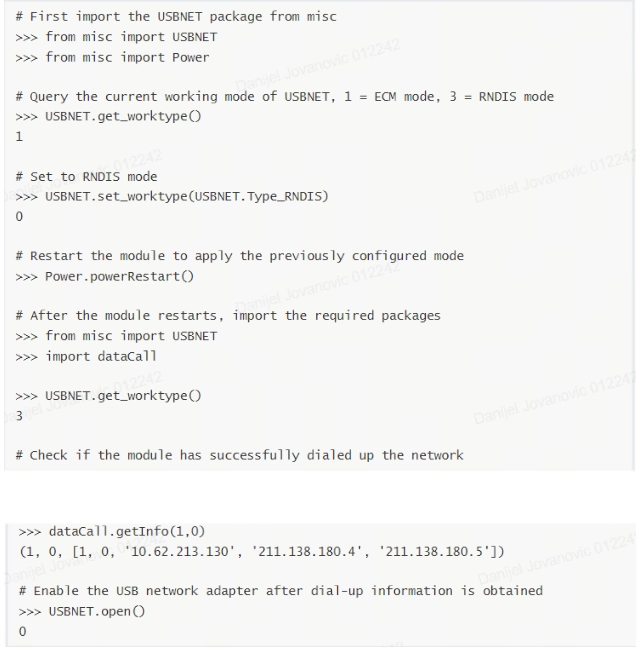
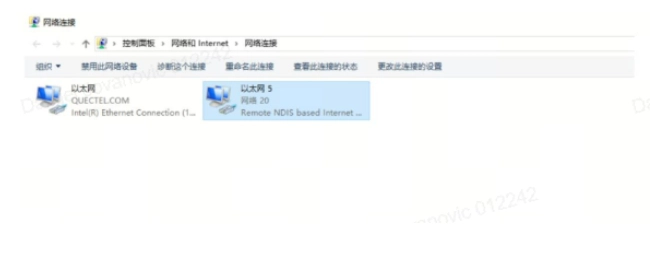
After entering the above code via QPYcom, the USB network adapter is enabled. When you check the network connection interface on the PC, you will see an additional available network.
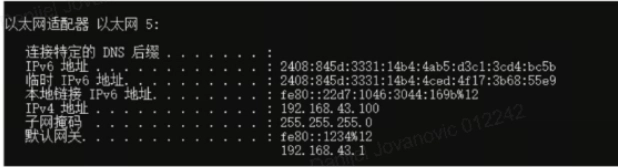
Open Command Prompt (cmd) and enter ipconfig, you can see that the basic network information has been obtained. At this point, if you disable all other network interfaces and only keep the USB network adapter interface, the computer can still access the Internet normally.
You can then access web pages through your computer's browser. For example, enter https://python.quectel.com in the browser address bar to access the site normally.