





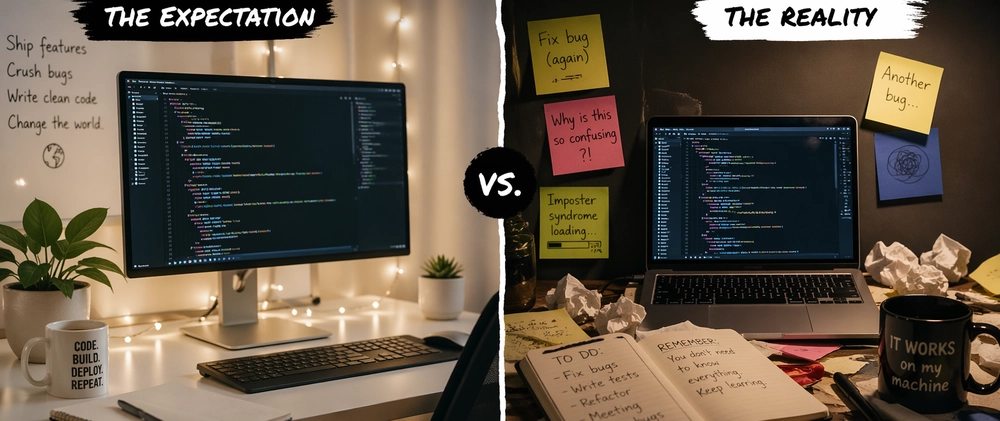

I've been a software developer for 2 years now and going by the "day in the life" videos on TikTok, you'd think I should feel confident by now.
I don't. Yet.
Most days still involve second guessing my technical decisions, worrying I'm not progressing fast enough, and quietly hoping nobody notices.
The Reality
It's easy to spiral into overthinking and let the imposter syndrome take over.
- Is this actually a good way to code this?
- Will the next person think “what idiot wrote this”?
- Am I too slow? Other developers seem to finish tasks faster than me.
- Should I know more than I do at this point?
That constant background noise can get loud. Sometimes it's hard to think about anything other than mistakes I've made.
Are people keeping track of how many bugs I've released to production? Do they think I'm bad at my job?
The paranoid part of my brain says yes.
The pragmatic part knows that every developer creates bugs. Being “good” at this job isn’t about never getting things wrong. It’s about how you deal with it when you do.
I'm still learning, and most of that learning has come from messing things up and figuring out how to fix it. Every bug or mistake is something to look back on and ask what would I do differently next time?
What I'm starting to realise is confidence doesn’t just show up when you hit a certain number of years or tick off a specific goal. It’s something you have to build on purpose.
I'm not going to wake up one random Tuesday and suddenly feel confident in my abilities. If I want that, I have to actually practice it.
What I'm trying
I'm trying to be more vocal.
In meetings, if I have an answer or an idea, I say it - even if I’m not 100% sure, even if my instinct is to stay quiet and wait for someone else to speak first. Half the time, someone ends up saying what I was thinking anyway, so I may as well be the one to say it.
I've started tracking a “Win of the Week”.
I've made a Trello board with a list dedicated to this. Some weeks the wins might be big, like doing well in a performance review. Other weeks might be something smaller, like speaking up in a meeting or suggesting an idea for a feature.
Normally I’d brush those off, thinking they are insignificant and don't deserve recognition. But writing them down makes it harder to ignore or dismiss them. It’s proof that I am making progress, even if it doesn’t always feel like it. And even if they are small steps forward - a small step forward is still closer to the end destination than if I had stayed still the whole time.
I'm also trying to be more intentional with my goals. Breaking things down into smaller milestones that feel more manageable, means I have a roadmap of my journey to the goal that I can tick off on my way. This helps me with staying motivated, and, honestly it feels good to see things moving forward instead of feeling stuck.
Key Takeaways
- I need to stop using other people as my benchmark. Someone being better than me at something doesn’t automatically mean I’m bad at it. It usually just means they’ve had more time or experience with it. Instead of letting that spiral, I’m trying to see it as a chance to learn from them.
- If nothing changes, nothing changes. I’ve spent a lot of time waiting and hoping to feel more confident, like it would just come with time. And while I am learning more as I go, I wouldn't say that I feel anymore confident than when I knew a fraction of what I do now. Something needs to change, which is what I'm doing now.
So, no, my experience isn't like the polished, aesthetic “day in the life” version you see online. It’s messier, more internal, and a lot more about getting out of your own head than I expected.
But I’m starting to realise that’s probably a normal part of it. And perhaps I'm not the only one having these kinds of realisations.