


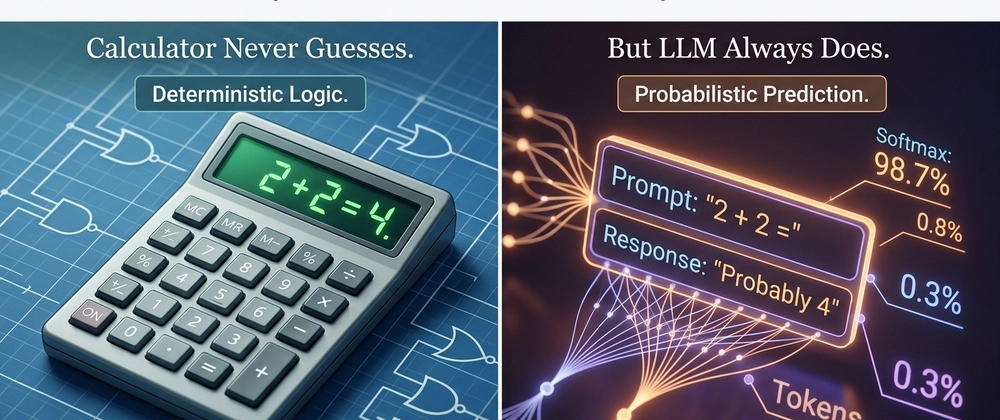

The LLM:Probabilistic Predictor
An LLM (Large Language Model) does not have a math engine. It is a Next-Token Predictor. When you ask it a question, it is performing a high-speed search through a high-dimensional space of text patterns.
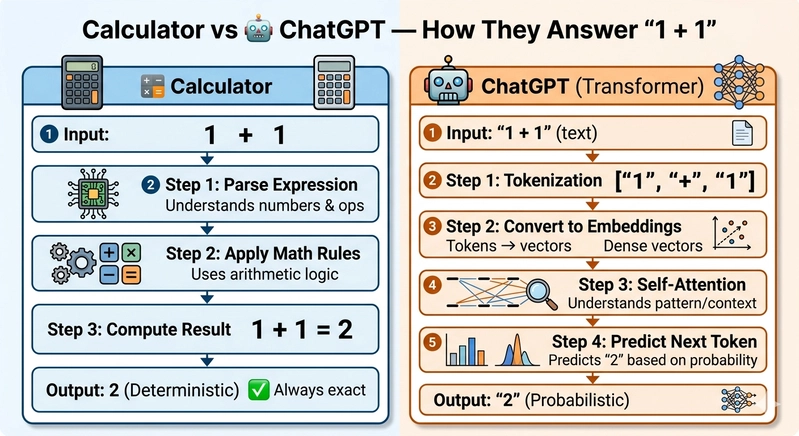
The process: It views your query as a sequence of tokens, converts them into vectors, and uses Self-Attention to weigh the importance of those tokens.
The outcome: It is always calculating probability. When it produces 2 as the answer to 1 + 1=, it isn't "adding"; it is identifying the highest-probability next token based on billions of instances of that pattern in its training data.
The Calculator: Deterministic Engine
A calculator is built using a hardware-level Arithmetic Logic Unit (ALU). It operates on deterministic logic. When you press 1, then +, then 1, the hardware executes a pre-wired sequence of digital logic gates.
The process: It converts these numbers into binary, performs the exact Boolean operation for addition, and outputs the result.
The outcome: It is always exact. It doesn't "know" what 1 is; it simply follows the physical laws of its circuit design. It does not possess, nor does it need, training data.
Why LLMs Struggle with Arithmetic
1. The Tokenization "Blind Spot"
LLMs break text into sub-word units called tokens. For common numbers, this is fine. But for large or unconventional numbers, the model might split them into arbitrary, non-numerical fragments (e.g., 123,456 might become [123, 456]). Because the model sees these as linguistic tokens rather than singular values, it loses the concept of place value. It cannot "carry" a one or manage a decimal point because it doesn't see a number—it sees a string of text.
2. Pattern Matching vs. Algorithmic Reasoning
When an LLM gets a math problem right, it is essentially "recalling" a pattern from its training data. If you ask a common question like 15 * 15, it likely has that specific sequence in its training set and produces the right answer. But if you ask it a rare, large-scale multiplication problem, it has no "ground truth" to rely on. It begins to hallucinate because it is attempting to predict the structure of a mathematical response rather than executing the algorithm of the math itself.
3. The Limits of Self-Attention
Self-attention is an incredible tool for natural language; it helps the model understand that in the sentence "The animal didn't cross the street because it was too tired," the word "it" refers to the animal. However, self-attention is not designed to maintain state in a sequential calculation. Without "Chain of Thought" (asking the model to write out the steps), the model is trying to solve the problem in a single pass—a task for which it has no internal memory or scratchpad.
The "Pro" Takeaway: The Hybrid Future
LLMs are brilliant at intent, context, and reasoning, but they are fundamentally flawed as computation engines.
If you want to build a reliable AI agent, stop asking the LLM to do the math. The industry standard is to treat the LLM as a Coordinator that detects when math is required, extracts the relevant variables, and hands them off to a Deterministic Tool (like a Python script, an API, or a calculator function).
In short: Let the LLM do the thinking, but let your traditional code do the calculating. That is the secret to building AI that doesn't guess.