





This is a submission for the OpenClaw Challenge.
What I Built
I built a practical personal AI workflow around OpenClaw that does more than answer messages.
The goal was simple: make it useful in real life, not just impressive in a demo.
That meant building a system that could:
- remember important context over time
- summarize noisy days into something readable
- help curate durable lessons into long-term memory
- monitor AI news and turn strong topics into post-ready drafts
- keep the whole workflow sustainable while I was also building AI Optimizer to reduce model waste and cost
The core problem I wanted to solve was this: most AI assistants feel smart in the moment, but they fall apart over time. They forget what matters, lose continuity, and create more noise than follow-through.
I wanted something better. OpenClaw gave me a way to actually build it.
How I Used OpenClaw
OpenClaw became the operating layer for the whole workflow.
Here is what I set up and refined:
1) Memory that could be tested instead of assumed
I verified OpenClaw memory end to end instead of trusting a health check blindly. That included confirming embeddings were working, proving recall with a fresh test memory, and checking the local LanceDB files on disk.
That changed the whole project, because once memory was real, the assistant could start acting more like a system and less like a stateless chatbot.

Figure 1: Verifying OpenClaw memory end-to-end — embeddings working, LanceDB files present on disk.
2) Daily digest + weekly memory curation
I installed and improved a daily digest workflow so each day could be compressed into something actually readable.
From there, I used a second layer: weekly curation into MEMORY.md.
That gave me a simple but powerful structure:
- raw daily notes
- daily digest as a compression layer
- weekly curated memory for durable wins, lessons, decisions, and insights
This ended up being one of the biggest practical upgrades in the whole setup.

Figure 2: Left: Daily digest output compressing a raw day into structured wins, lessons, and decisions. Right: Weekly MEMORY.md curation showing durable insights.
3) AI news scouting and content workflow testing
I used OpenClaw to investigate AI news workflows and then used that output to test a LinkedIn drafting pipeline.
I evaluated linkedin-drafter and humanizer, cleaned up output leakage, and built a drafter -> humanizer pass so the content came out cleaner and more believable.
That let me turn real topics into post-ready drafts, including one of my favorite test runs based on the Stanford HAI AI Index and the jump in agent performance on OSWorld.
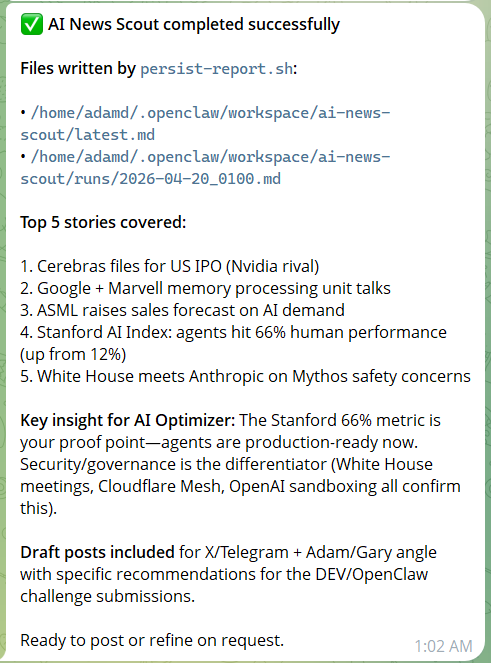
Figure 3: Top: AI News Scout Telegram report delivering fresh AI topics.
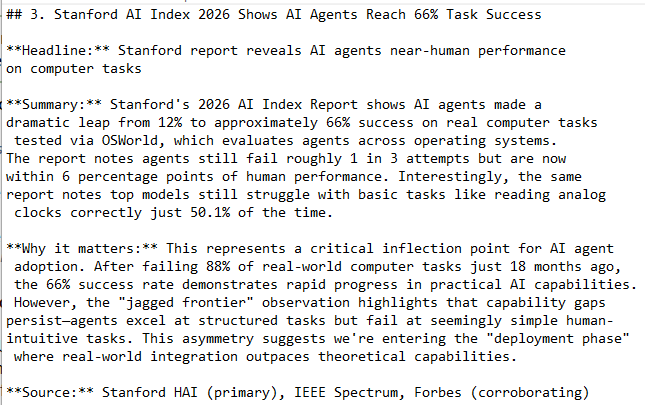
Figure 3b: Bottom: Humanized LinkedIn draft ready for posting.
4) Reminders and follow-through
I added a daily reminder cron for digest review instead of automating blindly too early.
That mattered because the lesson from this whole build was not "automate everything immediately."
It was "automate what you trust, and add review where quality still matters."
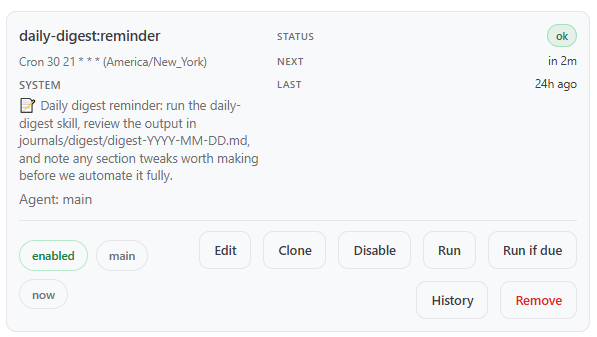
Figure 4: Cron job list showing the 9:30 PM ET daily digest reminder — automation with a review loop.
5) AI Optimizer as a supporting layer
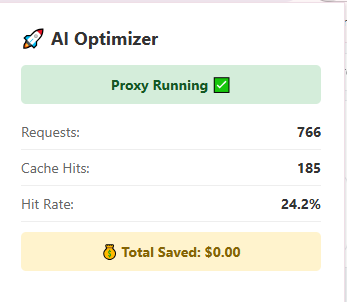
While building these workflows, I was also building AI Optimizer to reduce waste and cost in real model usage.
It was not the main point of this OpenClaw build, but it became part of the system thinking: once AI stops being a toy and becomes part of daily work, cost discipline matters too.
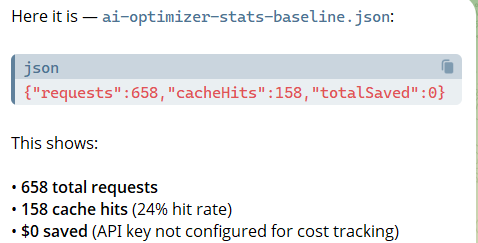
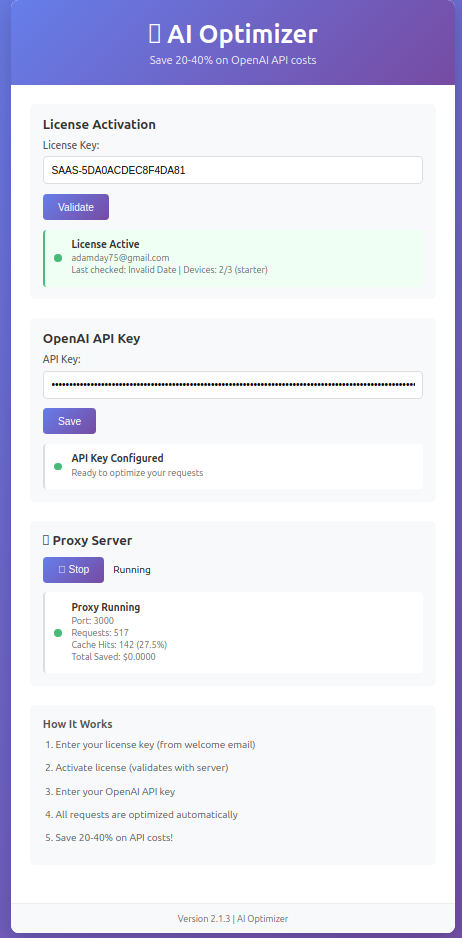
Figure 5: AI Optimizer proxy /health and /stats endpoints showing cache hits and version v2.1.3.
Demo
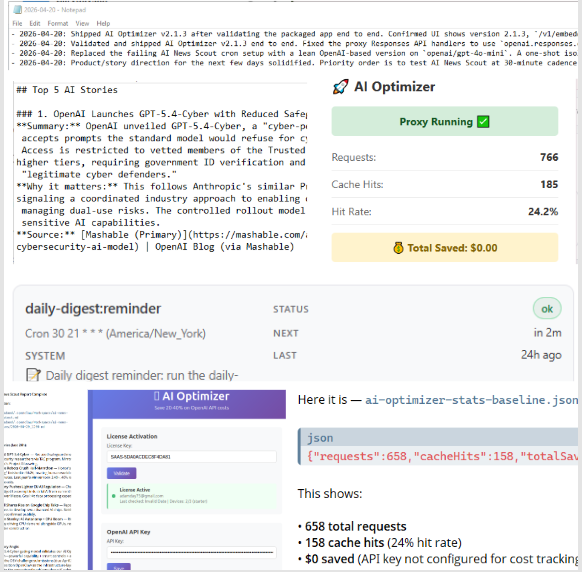
The screenshots above show the workflow in action. Here's the full flow:
- Raw memory file — Daily notes captured automatically
- Daily digest output — Compressed, structured summary delivered to Telegram
- Curated MEMORY.md — Weekly rollup of durable wins, lessons, decisions, insights
- AI News Scout → polished draft — Real topics turned into humanized content
- Reminder/automation layer — Cron jobs keeping the system alive without blind automation
What I Learned
The biggest lesson was that personal AI becomes useful when it stops acting like a single prompt and starts acting like a system.
A few things mattered much more than I expected:
- memory quality matters more than flashy responses
- digesting and curation matter more than dumping raw context into the model
- reminders and review loops matter more than blind automation
- cost and waste matter once the workflow becomes real
- the best builds are usually the ones that stay honest about failure modes
I also learned that "status: ok" is not enough for automation. I had to verify persistence on disk, not just trust logs or cron success states.
That mindset carried through the whole build: prove it, then trust it.
ClawCon Michigan
I did not attend ClawCon Michigan.