
惯性聚合 高效追踪和阅读你感兴趣的博客、新闻、科技资讯
阅读原文 在惯性聚合中打开

推荐订阅源

博客园 - 司徒正美
大猫的无限游戏
大猫的无限游戏
腾讯CDC
J
Java Code Geeks
博客园 - 【当耐特】
Microsoft Azure Blog
V
Visual Studio Blog
人人都是产品经理
人人都是产品经理
博客园 - Franky
博客园 - 聂微东
阮一峰的网络日志
阮一峰的网络日志
美团技术团队
云风的 BLOG
云风的 BLOG
freeCodeCamp Programming Tutorials: Python, JavaScript, Git & More
U
Unit 42
雷峰网
雷峰网
B
Blog RSS Feed
博客园_首页
量子位
F
Fortinet All Blogs
罗磊的独立博客
H
Hackread – Cybersecurity News, Data Breaches, AI and More
酷 壳 – CoolShell
酷 壳 – CoolShell
C
Check Point Blog

DEV Community

Authentication Security Deep Dive: From Brute Force to Salted Hashing (With Java Examples) Why AI Systems Don’t Fail — They Drift Spilling beans for how i learn for exam😁"Reinforcement Learning Cheat Sheet" I Replaced Chrome with Safari for AI Browser Automation. Here's What Broke (and What Finally Worked) How Python Borrows Other People's Work The $40 Architecture: Processing 1 Billion API Requests with 99.99% Uptime Vibe Coding: A Workflow Guide (From Zero to SaaS) Most webhook security guides protect the wrong side. The scary part is delivery. Headless CMS for TanStack Start: Build a Blog with Cosmic EU Age Verification App "Hacked in 2 Minutes" — What Actually Happened Comfy Cloud’s delete function does not actually remove files Running AI Models on GPU Cloud Servers: A Beginner Guide Event-driven media intelligence with AWS Step Functions and Bedrock I scored 500 AI prompts across 8 quality dimensions — here's what broke How to Call Google Gemini API from Next.js (Free Tier, No Backend Needed) The Portal Protocol: Reclaiming Human Connection in the Age of AI How to Fix Your Team's Scattered Knowledge Problem With a Self-Hosted Forum Intro to tc Cloud Functors: A Graph-First Mental Model for the Modern Cloud Designing Multi-Tenant Backends With Both Ownership and Team Access I Built a Neumorphic CSS Library with 77+ Components — Here's What I Learned PostgreSQL Performance Optimization: Why Connection Pooling Is Critical at Scale Cómo construí un SaaS multi-rubro para gestionar expensas en Argentina con FastAPI + Vue 3 🚀 I Built an Ethical Hacking Scanner Tool – Open Source Project I Replaced /usage and /context in Claude Code With a Single Statusline A Pythonic Way to Handle Emails (IMAP/SMTP) with Auto-Discovery and AI-Ready Design I Collected 8.9 Million Polymarket Price Points — Here's What I Found About How Markets Really Move EcoTrack AI — Carbon Footprint Tracker & Dashboard Everyone's Using AI. No One Agrees How. 5 self-hosted ebook managers worth trying in 2026 Building Your First AI Agent with LangChain: From Chatbot to Autonomous Assistant
How to Migrate a Legacy System Without Breaking Production
ziad hatem · 2026-04-23 · via DEV Community
Cover image for How to Migrate a Legacy System Without Breaking Production

ziad hatem

This is a submission for the Google Cloud NEXT Writing Challenge

How do you change an entire production system… without a single minute of downtime? 🤔

There’s a common mistake many teams fall into:
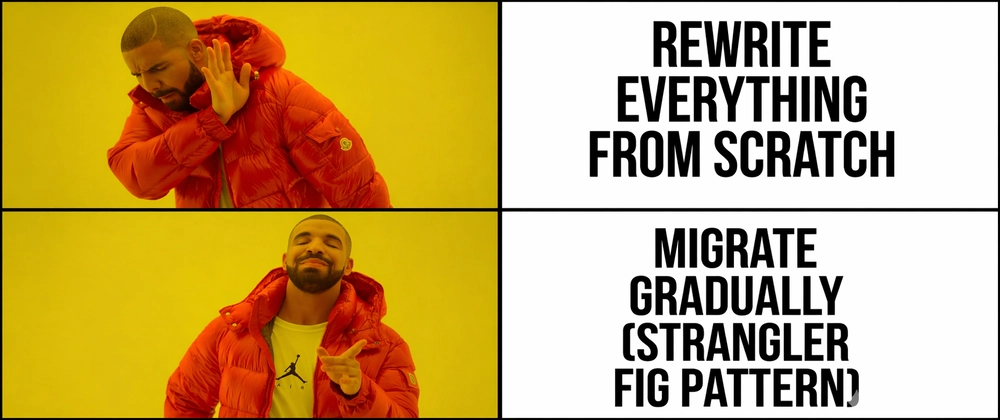
“Let’s throw away the old system and rewrite everything from scratch.”
That’s the classic Big Bang Rewrite.

And the usual result?

🔥 Delays
🔥 Bugs
🔥 Production issues
🔥 And in the end… crawling back to the old system 😅

💡 The smarter approach: Strangler Fig Pattern

The idea is simple:
Instead of killing the old system all at once…
you slowly “strangle” it until it disappears completely 👀

🧠 How does it work?

1- Keep the legacy system running as usual
2- Start building new parts feature by feature
3- Put a proxy / routing layer in front of the system
4- Route some requests to the new system
5- Keep the rest going to the old one
6- Repeat until the legacy system is fully gone

🎯 Practical example:

/products → still handled by Legacy Laravel
/checkout → handled by Next.js (the new system)

The proxy is what decides where each request goes.

👍 Why is this smarter?

Lower risk
You can deploy while still developing
Rollback is easier
The team keeps moving without stopping the business

⚠️ But here’s the catch:

If you don’t have discipline,
you may end up with:

❌ A broken old system
❌ And a new system that still isn’t ready

= a double disaster 😅

🧨 The most important rule:

Every migrated part must be:

✔️ Isolated
✔️ Clear
✔️ Owned by someone

And most importantly:
👉 Kill the old system fast. Don’t let it live forever.

🧭 Final takeaway:

Strangler Fig Pattern = migrating a legacy system gradually using a routing layer until the old system is fully replaced.

If you’re working with a monolith and thinking about moving to microservices — or even just rewriting your frontend — this is often the smartest strategic move you can make.