





This article was originally published on Medium.
Two years ago, if you asked an AI to design a menu for a Mexican restaurant, you’d get a beautiful layout of “enchuita” and “churiros.” It looked like food, and the font looked like letters, but it was essentially a visual fever dream. The “burrto” became a classic meme in dev circles — a reminder that while AI could paint like Caravaggio, it had the literacy of a toddler.
Yesterday, OpenAI launched ChatGPT Images 2.0 (gpt-image-2). I ran the same test. The menu was perfect. Not just the spelling, but the hierarchy, the prices, and the specialized diacritics. It is no longer just “generating pixels.” It is communicating.
This isn’t a minor version bump or a better training set. It’s a total architectural pivot that signals the end of an era. If you’ve spent the last three years building workflows around diffusion models, it’s time to rethink your pipeline.
1. Why text was broken (and how they fixed it)
To understand why gpt-image-2 works, you have to understand why DALL-E 3 failed at spelling. Diffusion models — the tech behind almost every major generator until now — work by denoising. They start with static and try to “find” an image. Because text pixels make up a tiny fraction of a training image, the model learned the texture of text rather than the logic of characters. To a diffusion model, an “A” is just a specific arrangement of lines, not a semantic unit.
OpenAI has quietly abandoned diffusion. While they won’t officially confirm the guts of the system, the PNG metadata and the model’s behavior tell the story: this is an autoregressive model.
It generates images the same way GPT-4 generates code — by predicting the next token. By integrating image generation directly into the language model pipeline, the model isn’t “drawing” a word; it’s “writing” an image. When the architecture treats a pixel and a letter as parts of the same conceptual stream, the “enchuita” problem simply vanishes.
2. The end of the CSS overlay hack
For those of us in agency work or product dev, AI images have always been a “background only” tool. If a client wanted a marketing banner with a specific CTA, we’d generate the art, then use a graphics library or CSS to overlay the text. It was the only way to ensure the brand name wasn’t spelled “Gooogle.”
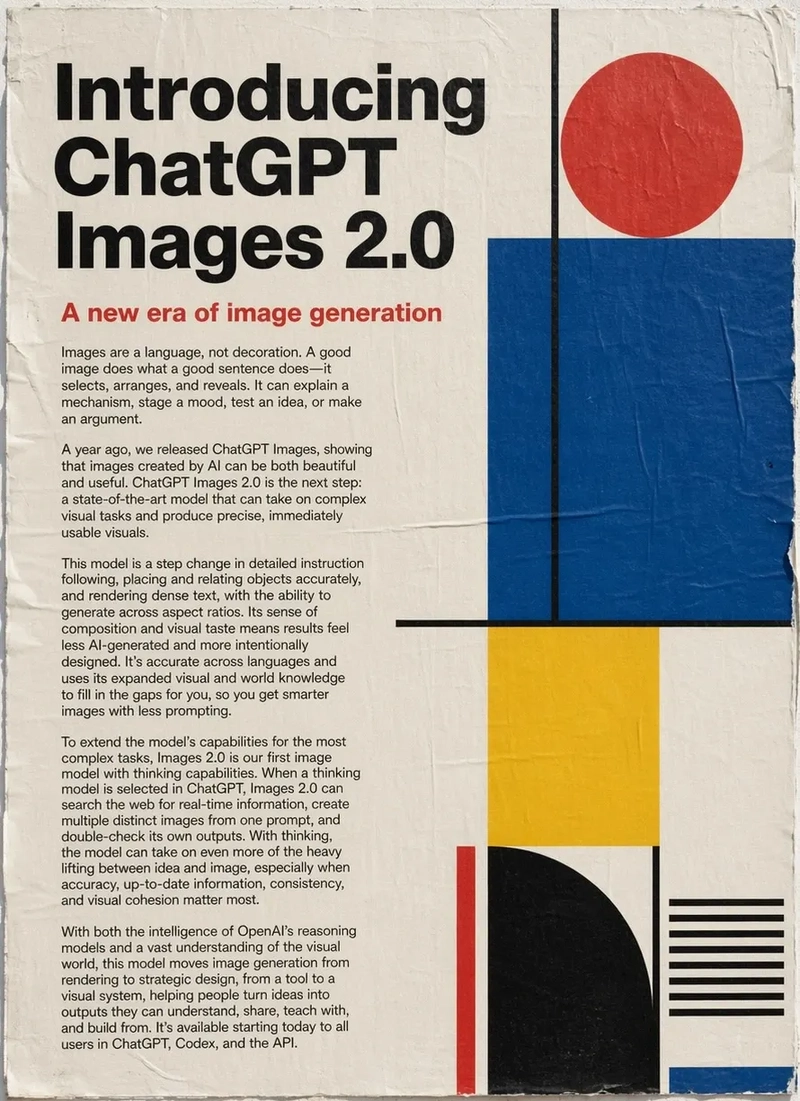
Gpt-image-2 changes that calculus. With near-perfect rendering of Latin, Kanji, and Hindi scripts, the “post-processing” stage of the workflow is suddenly on the chopping block. You can now generate multi-paneled assets or social media posts where the text is baked into the composition with proper lighting and perspective.
But there’s a catch for your budget. At approximately $0.21 per high-quality 1024x1024 render, this is roughly 60% more expensive than the previous generation. If you’re at a high-volume startup, that’s a significant line item.
3. Thinking before rendering
The most impressive part of the new model isn’t the resolution — it’s the “thinking mode.” Borrowed from reasoning models like o3, the generator now spends compute time planning the layout before it touches a single pixel.
I watched it handle a prompt for “a grid of six distinct objects, each with a label in a different language.” Previous models would lose count by object four and turn the labels into Sanskrit-flavored gibberish. Gpt-image-2 paused, “thought” (generating reasoning tokens), and then executed. It can count. It can follow layout constraints.
This moves AI generation from “creative toy” to “reliable infrastructure.” Reliability is what we actually need in production. I’d much rather pay more for a single correct image than spend credits on ten “cheap” re-rolls.
4. The DALL-E eulogy
OpenAI is shutting down DALL-E 2 and 3 on May 12, 2026. Not moving them to a legacy tier — shutting them down.
This is a massive signal. It’s an admission that the diffusion approach hit a ceiling that no amount of fine-tuning could break. By retiring the DALL-E brand in favor of a unified ChatGPT Image model, OpenAI is betting that the future of Multimodality is a single, unified architecture.
The wall between “thinking” and “seeing” is being torn down. We used to have a brain (LLM) that sent instructions to a hand (Diffusion model). Now, the brain is doing the drawing itself.
5. What I’m still worried about
Despite the polish, there are gaps. The knowledge cutoff is December 2025. If you need a render involving a trend or news event from early 2026, you’re reliant on the web search tool, which adds latency and even more cost.
Furthermore, the pricing model is now “tokenized” for images. Thinking mode adds a variable cost based on how many reasoning tokens the model uses to plan the composition. This makes it incredibly hard to predict API costs for complex apps. You aren’t just paying for an image; you’re paying for the “brain power” required to frame it.
6. The 2026 reality check
If you are building a simple placeholder tool, stick to cheaper, older models. But for any workflow where the image is the content — marketing, UI prototyping, or localized assets — the shift to autoregressive generation is a one-way door.
We’re entering a phase where the term “image model” feels dated. We just have models. They happen to output pixels sometimes and Python code others. The fact that it can finally spell “Burrito” is just the first sign that the gap between human intent and machine execution has finally closed.