

惯性聚合 高效追踪和阅读你感兴趣的博客、新闻、科技资讯
阅读原文 在惯性聚合中打开

推荐订阅源

J
Java Code Geeks
Last Week in AI
Last Week in AI
T
Tailwind CSS Blog
WordPress大学
WordPress大学
B
Blog RSS Feed
T
The Blog of Author Tim Ferriss
F
Fortinet All Blogs
aimingoo的专栏
aimingoo的专栏
MongoDB | Blog
MongoDB | Blog
博客园 - Franky
C
Check Point Blog
P
Proofpoint News Feed
H
Help Net Security
月光博客
月光博客
博客园_首页
Stack Overflow Blog
Stack Overflow Blog
博客园 - 三生石上(FineUI控件)
Martin Fowler
Martin Fowler
Recent Announcements
人人都是产品经理
人人都是产品经理
U
Unit 42
美团技术团队
I
InfoQ
A
About on SuperTechFans

DEV Community

Authentication Security Deep Dive: From Brute Force to Salted Hashing (With Java Examples) Why AI Systems Don’t Fail — They Drift Spilling beans for how i learn for exam😁"Reinforcement Learning Cheat Sheet" I Replaced Chrome with Safari for AI Browser Automation. Here's What Broke (and What Finally Worked) How Python Borrows Other People's Work The $40 Architecture: Processing 1 Billion API Requests with 99.99% Uptime Vibe Coding: A Workflow Guide (From Zero to SaaS) Most webhook security guides protect the wrong side. The scary part is delivery. Headless CMS for TanStack Start: Build a Blog with Cosmic EU Age Verification App "Hacked in 2 Minutes" — What Actually Happened Comfy Cloud’s delete function does not actually remove files Running AI Models on GPU Cloud Servers: A Beginner Guide Event-driven media intelligence with AWS Step Functions and Bedrock I scored 500 AI prompts across 8 quality dimensions — here's what broke How to Call Google Gemini API from Next.js (Free Tier, No Backend Needed) The Portal Protocol: Reclaiming Human Connection in the Age of AI How to Fix Your Team's Scattered Knowledge Problem With a Self-Hosted Forum Intro to tc Cloud Functors: A Graph-First Mental Model for the Modern Cloud Designing Multi-Tenant Backends With Both Ownership and Team Access I Built a Neumorphic CSS Library with 77+ Components — Here's What I Learned PostgreSQL Performance Optimization: Why Connection Pooling Is Critical at Scale Cómo construí un SaaS multi-rubro para gestionar expensas en Argentina con FastAPI + Vue 3 🚀 I Built an Ethical Hacking Scanner Tool – Open Source Project I Replaced /usage and /context in Claude Code With a Single Statusline A Pythonic Way to Handle Emails (IMAP/SMTP) with Auto-Discovery and AI-Ready Design I Collected 8.9 Million Polymarket Price Points — Here's What I Found About How Markets Really Move EcoTrack AI — Carbon Footprint Tracker & Dashboard Everyone's Using AI. No One Agrees How. 5 self-hosted ebook managers worth trying in 2026 Building Your First AI Agent with LangChain: From Chatbot to Autonomous Assistant
How we quantified SaaS Lock-In and LLM Costs
Alex Rivera · 2026-04-28 · via DEV Community

Alex Rivera

The "Contact Sales" button is a technical debt indicator. Every time a vendor hides their pricing behind a form, they are adding friction to your stack's scalability.

We spent months building a pipeline that tracks hundreds of SaaS pricing pages daily. But raw data is just noise. To make it actionable, we built a dashboard that treats software procurement like engineering: with logic, formulas, and daily data pipelines.

Here is the technical breakdown of the three core engines we’ve just deployed at comparedge.com.


1. The Vendor Lock-In Score: Quantifying the "Exit Cost"

Most teams choose software based on features. Smart teams choose based on how hard it is to leave.

We developed the Vendor Lock-In Score to measure this. It’s not a gut feeling. It’s a weight-based matrix looking at:

  • Data Portability: Does the API allow full bulk exports?
  • Integration Depth: How many proprietary hooks are you forced to use?
  • Contractual Friction: Auto-renewal clauses and seat minimums.

The Logic: If a tool scores an 8/10 on Lock-In, your "cheap" $50/mo starter plan is actually a high-risk liability. We’ve mapped this for hundreds of tools (on our roadmap to cross the 1,000+ mark), so you can see the trap before you step in it.
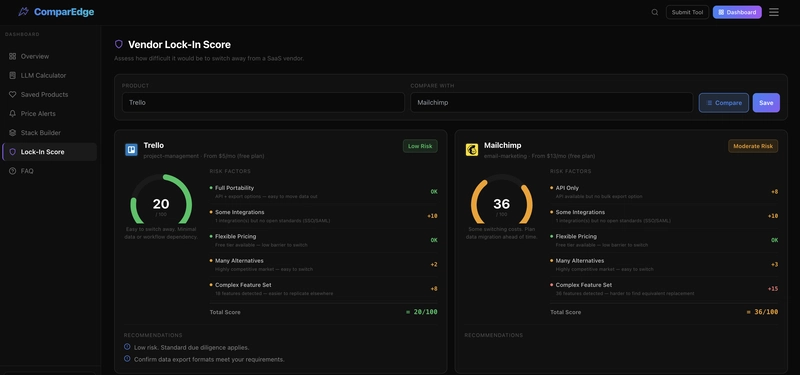
Vendor Lock-In Score dashboard featuring a color-coded risk gauge for SaaS switching difficulty based on API depth and data portability.


2. Stack Builder: Moving Beyond the Spreadsheet

Procurement usually happens in a messy Excel sheet. It breaks. It’s never updated.

The Stack Builder is our solution for "Infrastructure as a Budget."

  • You select tools across 28+ growing categories (CRMs, Hosting, Security).
  • The engine pulls daily-synced prices (no more stale data).
  • It calculates the total monthly and annual burn, accounting for per-seat vs. flat-rate scaling.

It’s essentially a sandbox for your CFO. You can swap a $200/mo CRM for a $50/mo alternative and instantly see the ripple effect on your total stack cost.
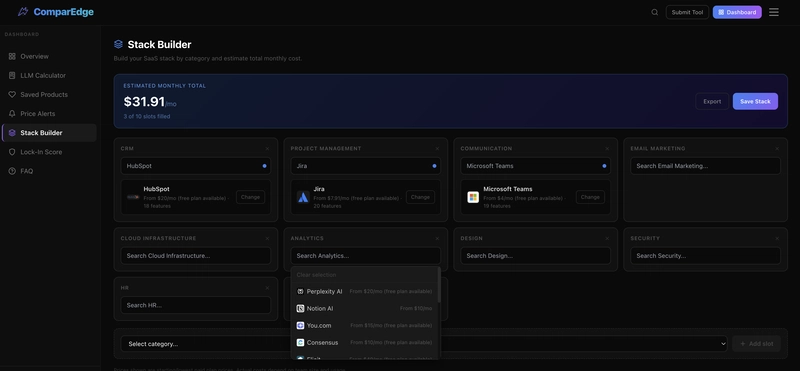
SaaS Stack Builder interface showing real-time monthly burn calculation and multi-category tool selection for infrastructure planning.


3. LLM Price Calculator: The 2026 Margin Saver

LLM pricing is a moving target. With 6 providers and 25+ models (from GPT-4o to Llama 3 on Groq), calculating token costs for a production app is a nightmare.

Our LLM Calculator normalizes this. Input your expected monthly tokens (Input/Output), and it spits out a side-by-side comparison.

  • Why it matters: We found that switching providers for the same model can save up to 40% in margins.
  • Data Freshness: Since we sync daily, we catch those "stealth" price drops the moment they hit the docs.
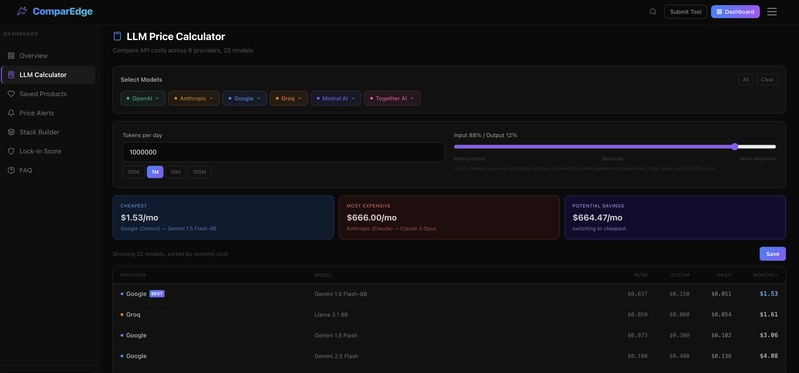
API cost comparison table for 25+ LLM models across 6 providers, normalizing input and output token costs for AI margin optimization.


The Infrastructure of Transparency

Everything we do is Open Data.

  • GitHub: Fork the logic.
  • Kaggle: Use the raw SQLite/CSV dumps for your own models.
  • Railway API: Hit our public end-points (no auth required) to pipe these prices directly into your internal tools.

We are building a public utility. Software is the biggest line item for modern companies after payroll. It shouldn't be a black box.

Try the dashboard: comparedge.com/dashboard
Code & Data: comparedge.com/open-data

No "Contact Sales" buttons were harmed in the making of this project.