







On April 27, DeepSeek released its V4 model family and open-sourced the weights. The flagship V4-Pro Base has 1.6 trillion parameters (862B active), while V4-Flash comes in at 158B (Base 292B). Both use a Mixture of Experts (MoE) architecture. Within 48 hours of landing on HuggingFace, V4-Pro had already racked up 3,000+ likes and 174K downloads.
It's an impressive milestone for open-source AI. But it also crystallizes a question that's been brewing for a while: Is "bigger" the only direction AI models can go?
The case for Scaling Up
Let's be clear — Scaling Up works, and DeepSeek V4 is the latest proof.
The logic behind bigger models traces back to the Scaling Laws paper (Kaplan et al., 2020): model performance scales predictably with parameter count, dataset size, and compute. From GPT-3 (175B) to DeepSeek V3 to V4 (1.6T), each generation has pushed the ceiling higher on general reasoning, code generation, and mathematical problem-solving.
The engineering has matured too. MoE architecture is key — V4-Pro's 1.6T total parameters don't all activate at once. A routing mechanism selects which expert networks fire for each input, keeping per-inference compute manageable while retaining the knowledge capacity of a massive model. Combined with distributed inference, mixed precision, and optimized serving stacks (V4-Pro is already available on Together, Novita, Fireworks, and others), trillion-parameter models are becoming practically accessible.
None of this is hype. The results are real. For general-purpose tasks — open-ended reasoning, multilingual generation, complex code synthesis — larger models consistently outperform smaller ones.
But not every problem needs a trillion parameters
Here's where the story gets more interesting.
Running V4-Pro requires a multi-GPU cluster. Even using it through an inference API costs money per call. For high-frequency use cases — real-time interaction, continuous agent workflows, batch processing — that cost adds up fast. And for individual developers or small teams, the economics don't always work.
There are also structural constraints:
- Data privacy. Cloud inference means your input data leaves your machine. For AI agent scenarios where the model needs to see your entire screen — emails, chat messages, bank statements — that's a non-trivial compliance issue.
- Latency. Network round trips add delay. For agent workflows involving dozens of sequential steps (screenshot → understand → act → repeat), every millisecond of latency compounds.
- Availability. No internet, no AI. But real-world use cases on airplanes, in secure facilities, or on unstable connections require AI that works offline.
These aren't criticisms of Scaling Up. They're boundary conditions that define where a different approach makes more sense.
The other direction: Scaling Out
If Scaling Up means making one model as large as possible, Scaling Out means distributing multiple smaller, specialized AI models closer to where they're actually needed — and having them collaborate.
This isn't a theoretical alternative. Several converging technical trends make it practical:
Model compression is real
Techniques like mixed-precision quantization (e.g., w4a16), visual token pruning, and knowledge distillation can shrink billion-parameter models to run on consumer hardware. On an Apple M4 chip, a 4B-parameter quantized model achieves 476 tokens/s prefill and 76 tokens/s decode, with a peak memory footprint of just 4.3GB.
Specialized models can beat general ones — in their domain
A general-purpose trillion-parameter model spreads its capacity across every conceivable task. A specialized model focuses all its parameters on one domain. In GUI automation specifically, a 4B-parameter model trained for this task has achieved #1 scores on domain benchmarks, outperforming models hundreds of times its size on the same tests.
Data sovereignty matters
When the model runs on the user's device, the data never leaves. No cloud upload, no network transmission, no third-party processing. For enterprise compliance, personal privacy, and regulated industries, this is a structural advantage that cloud-only models can't match.
Multi-agent collaboration
Instead of one giant model doing everything, multiple specialized agents can divide work — each running on different devices or nodes, communicating through standardized protocols. This architecture naturally fits the Scaling Out paradigm.
A concrete example: GUI agents on the edge
Let's make this concrete with a specific domain: GUI automation.
The task is straightforward in concept but demanding in practice: an AI agent looks at a screen, understands the interface elements, and performs operations — clicking buttons, filling forms, navigating menus — just like a human user would.
This is a natural fit for Scaling Out because:
- Screen captures contain sensitive personal data — better processed locally
- GUI tasks involve many sequential steps — latency accumulates
- The task requires precise visual grounding and action planning, not broad general knowledge
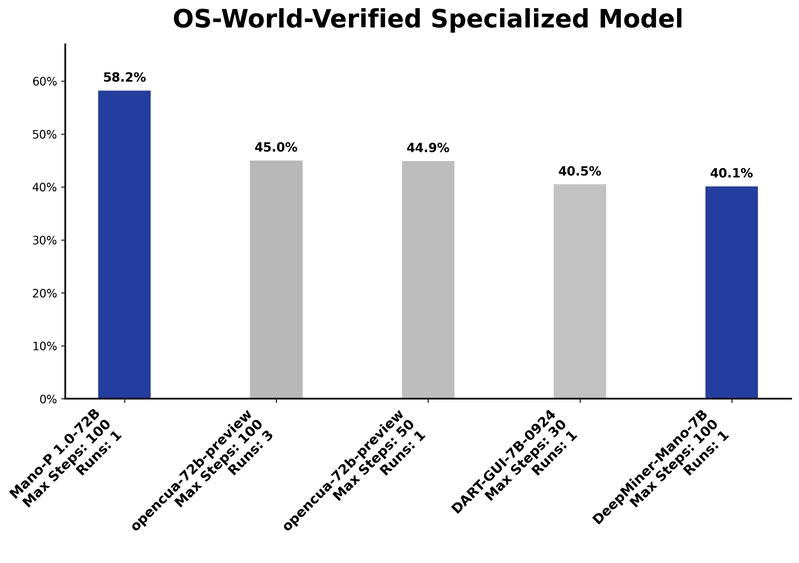
Mano-P is an open-source project (Apache 2.0) by Mininglamp Technology that takes this approach. It's a GUI-VLA (Vision-Language-Action) agent designed for edge devices — specifically, it runs entirely on a Mac, with all data staying on the local machine.
The architecture integrates visual understanding, language reasoning, and action generation in a single end-to-end model, trained through a three-stage pipeline (SFT → offline RL → online RL) with a think-act-verify inference loop and GS-Pruning for visual token efficiency.
Published benchmark results (with evaluation framework and model specification noted):
- OSWorld (72B model): 58.2% accuracy — ranked #1 (2nd place: 45.0%, a 13.2 percentage point gap)
- WebRetriever Protocol I (72B model): 41.7 NavEval — ranked #1 (Gemini 2.5 Pro: 40.9, Claude 4.5: 31.3)
- Edge deployment (4B quantized, w4a16): 476 tokens/s prefill, 76 tokens/s decode, 4.3GB peak memory on Apple M4
Hardware requirement: Mac with Apple M4 chip + 32GB RAM (or Mano-P Compute Stick via USB 4.0+).
The takeaway: a 4B-parameter model running locally on a Mac can achieve state-of-the-art results in its domain. Not because small models are universally better, but because the right model for the right task, deployed in the right place, can outperform a general-purpose giant.
Two tracks, one ecosystem
DeepSeek V4 pushing to 1.6 trillion parameters and a 4B model hitting #1 on GUI benchmarks are not contradictory developments. They're two sides of the same evolution in AI:
- Scaling Up provides the general intelligence foundation — broad reasoning, complex generation, cross-domain capabilities
- Scaling Out provides the execution layer — privacy-preserving, low-latency, offline-capable, specialized for specific tasks
The two can work together: edge models handle local tasks, and when something exceeds their scope, they call out to cloud models. This layered architecture may be closer to how AI actually gets deployed in the real world than any single-model paradigm.
For developers choosing a direction: it's not about picking the model with the most parameters. It's about picking the model that fits your constraints — compute budget, latency requirements, data sensitivity, deployment environment.
The trillion-parameter era is here. And so is the era of AI that runs on your machine.
Resources:
- Mano-P (Apache 2.0): github.com/Mininglamp-AI/Mano-P