








🎭 The Moment of Choice
You’ve read the series so far:
- Article 1 – Every Software Architecture Is a Lie. Here’s Why That’s OK.
- Article 2 – How AWS Secretly Breaks the Laws of Software Physics (And You Can Too)
- Article 3 – Microservices Destroyed Our Startup. Yours Could Be Next.
- Article 4 – The $15 Million Mistake That Killed a Bank (And What It Teaches You)
- Article 5 – Your “Perfect” Decision Today Is a Nightmare Waiting to Happen.
Now comes the hard part: How do you actually make decisions in the face of these paradoxes?
This article is about practical tools and mindsets – not silver bullets, but battle‑tested techniques to make trade‑offs visible, reversible, and survivable.
“The goal is not to avoid mistakes. The goal is to make mistakes that you can recover from.”
🧰 The Architect’s Toolkit for Living With Paradox
We’ll cover six core techniques, each with real‑world examples:
| Technique | What It Solves | Article Reference |
|---|---|---|
| 1. Architecture Decision Records (ADRs) | Hidden assumptions & forgotten rationale | Articles 1–5 |
| 2. Fitness Functions | Preventing architectural drift | Article 3 (microservices sprawl) |
| 3. Bulkheads | Containing failure blast radius | Article 2 (AWS cells) & Article 4 (ESB) |
| 4. Two‑Way Door Decisions | Keeping reversibility alive | Article 5 (Stripe versioning) |
| 5. Delayed Decision‑Making | Avoiding premature lock‑in | Article 3 (modular monolith first) |
| 6. Chaos Engineering | Testing your trade‑offs to destruction | Article 4 (bank ESB would have survived) |
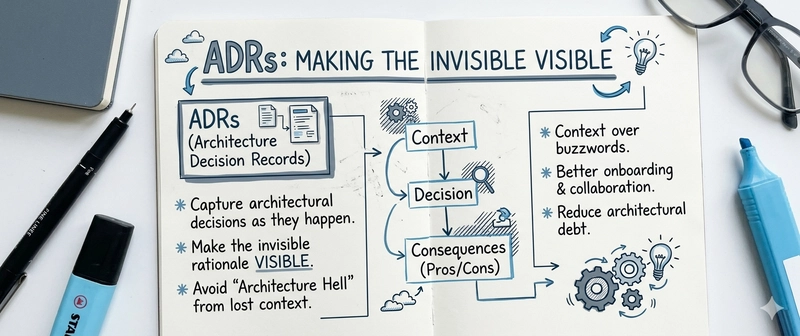
1️⃣ Architecture Decision Records (ADRs) – Making the Invisible Visible
The Problem
Teams make architectural decisions every day. Six months later, no one remembers why. A new engineer asks, “Why do we use Kafka instead of SQS?” The answer: “I don’t know – it’s always been that way.”
Hidden assumptions fossilise. The bank’s ESB team never wrote down: “We assume failover will preserve in‑flight state. We have not tested split‑brain scenarios.” That assumption killed them.
The Solution: ADRs
An Architecture Decision Record is a short text file (Markdown) that captures a single decision, its context, and its trade‑offs.
Minimal ADR template:
# ADR-012: Use PostgreSQL for the transaction log

## Status
Accepted (2024-01-15)

## Context
We need durable storage for financial transactions. Requirements: ACID, high write throughput, familiar to the team.

## Decision
We will use PostgreSQL with logical replication to a read replica for reporting.

## Consequences (Trade‑offs)
- ✅ Strong consistency, ACID transactions.
- ✅ Team already knows PostgreSQL.
- ❌ Horizontal scaling is limited – we’ll need to shard manually if we exceed 10TB.
- ❌ Cross‑shard queries will be impossible.

## Reversibility
We can migrate to CockroachDB or a distributed SQL database if we outgrow PostgreSQL. Estimated effort: 3 months.

## Assumptions (Explicit)
- Transaction volume will stay under 50,000 TPS for the next 2 years.
- We do not need cross‑region active‑active writes.
Why ADRs Tame the Paradox
- Forces explicit trade‑offs – you cannot write an ADR without listing what you lose.
- Documents assumptions – future you will know what you bet on.
- Makes reversibility a first‑class concern – the “Reversibility” section is mandatory.
- Creates a decision log – new team members can read history, not reverse‑engineer it.
Real‑Time Example: Fintech “LedgerHub”
LedgerHub adopted ADRs after a near‑disaster (similar to FastPay in Article 3). Their first ADR was:
“We will keep the transaction processing logic in a modular monolith until we reach 100 engineers OR need to scale processing separately. This decision will be reviewed every 6 months.”
Two years later, they still haven’t split into microservices – but the ADR reminds them why and when they should reconsider.
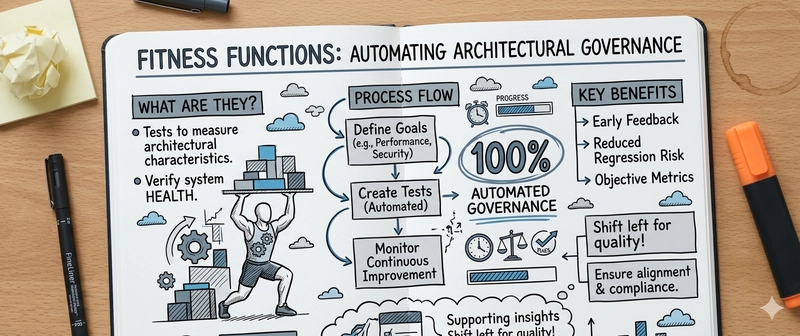
2️⃣ Fitness Functions – Automating Architectural Governance
The Problem
You designed a beautiful modular monolith with strict boundaries. Then, under deadline pressure, a developer imports payment module directly into notification module – bypassing the API. Architectural drift begins.
Manual code reviews miss these violations. The architecture decays.
The Solution: Fitness Functions
A fitness function is an automated test that validates an architectural characteristic. Think of it as unit tests for architecture.
Examples:
| Architectural Requirement | Fitness Function |
|---|---|
| No direct database access from the web module | Static analysis rule (e.g., ArchUnit) that fails the build |
| All services must have a circuit breaker | Integration test that simulates a downstream failure |
| API version header is mandatory | HTTP middleware test that rejects requests without version |
| P95 latency < 100ms | Performance test that runs on every PR |
Real‑Time Example: Uber’s “Dependency Rules”
Uber (after their own microservices chaos) introduced fitness functions that enforce:
- No cycles between service packages.
- No direct database access from API layers.
- All RPC calls must go through the service mesh (no “short‑circuiting”).
When a developer violates a rule, the CI pipeline fails with a message: “You are breaking architectural rule #42 – see ADR-042 for rationale.”
Why Fitness Functions Tame the Paradox
- Prevents silent debt accumulation – violations are caught immediately.
- Makes trade‑offs enforceable – if you decided “no shared database”, you can enforce it.
- Reduces review burden – machines check rules; humans review intent.
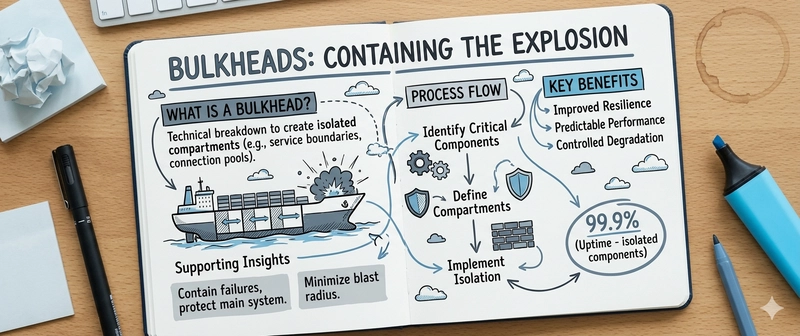
3️⃣ Bulkheads – Containing the Explosion
The Problem
In Article 4, the bank’s ESB failed globally because there were no bulkheads – every channel shared the same critical path. A failure in one area consumed all resources and took down everything.
The Solution: Bulkheads (Physical or Logical)
In ship design, a bulkhead is a watertight compartment. If the hull is breached, only one compartment floods – the ship stays afloat.
Software bulkheads:
- Separate thread pools – so a slow dependency doesn’t starve other requests.
- Separate deployment units – so a crash in one service doesn’t crash others.
- Separate databases – so a lock storm in one table doesn’t freeze everything.
- Separate clusters / cells – as AWS does (Article 2).
Real‑Time Example: Netflix’s “Hystrix” (Now Resilience4j)
Netflix built Hystrix (later succeeded by Resilience4j) to implement bulkheading at the thread pool level. Each downstream dependency gets its own thread pool. If the recommendations service slows down, it fills its own thread pool – but billing and playback continue unaffected.
Code example (pseudo):
// Without bulkheads – one pool for everything
ExecutorService sharedPool = Executors.newFixedThreadPool(100);

// With bulkheads
ExecutorService billingPool = Executors.newFixedThreadPool(20);
ExecutorService recsPool = Executors.newFixedThreadPool(10);
ExecutorService playbackPool = Executors.newFixedThreadPool(70);
Why Bulkheads Tame the Paradox
- Limits blast radius – failure stays in its compartment.
- Preserves partial availability – 90% of the system can work even if 10% fails.
- Makes trade‑offs visible – you must decide how many threads to allocate to each bulkhead.
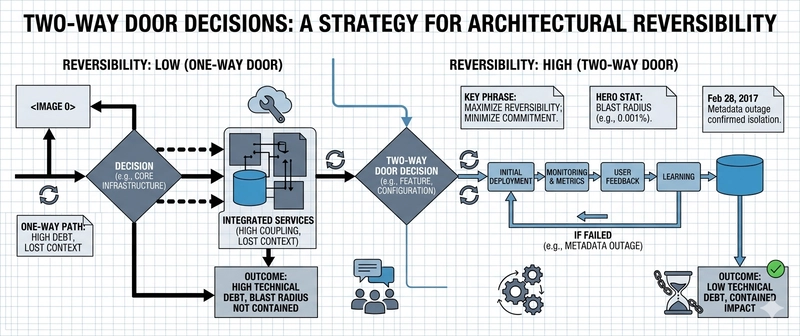
4️⃣ Two‑Way Door Decisions – Keeping Reversibility Alive
The Problem
Many architectural decisions feel permanent. But Jeff Bezos (Amazon) famously distinguishes between two‑way doors (reversible) and one‑way doors (irreversible). Most decisions are two‑way doors – but we treat them as one‑way because of fear.
The Solution: Design for Reversibility
Before making a decision, ask: “If we’re wrong, how hard is it to change?”
If the answer is “very hard”, invest in making it less hard before committing.
Examples of reversible design:
| Decision | Irreversible Approach | Reversible Approach |
|---|---|---|
| Database choice | Write core logic directly to PostgreSQL API | Write a repository abstraction – swapping databases requires changing only the adapter |
| Cloud provider | Use AWS DynamoDB SDK everywhere | Use a thin wrapper (e.g., KeyValueStore interface) – DynamoDB is one implementation |
| Authentication | Hardcode session cookies | Use a pluggable auth middleware – swap sessions for OAuth with config change |
| API versioning | No versioning (clients break on changes) | Version header from day one (Stripe model) |
Real‑Time Example: Airbnb’s “Repository Pattern”
Airbnb started with a monolithic Rails app using PostgreSQL. They knew they might need to shard or move to a different database. Instead of waiting, they built a repository layer early – every database query went through a UserRepository, BookingRepository, etc.
When they eventually needed to move some tables to Cassandra, the change was localised – they rewrote only the repository implementations. The rest of the code never knew.
Why Two‑Way Doors Tame the Paradox
- Reduces fear of making decisions – you know you can reverse.
- Preserves optionality – you don’t get locked into a dead end.
- Encourages experimentation – try a pattern; if it fails, revert.
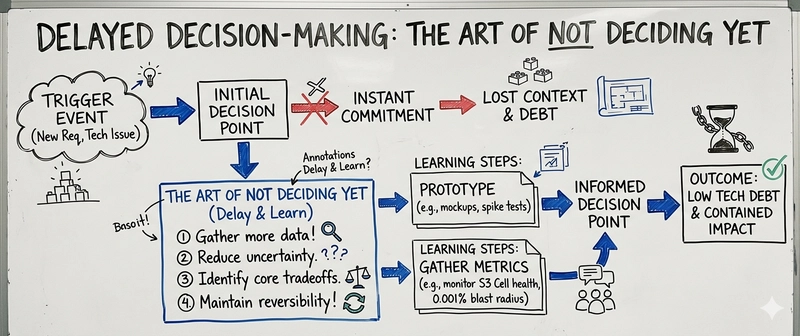
5️⃣ Delayed Decision‑Making – The Art of Not Deciding Yet
The Problem
Architects often feel pressure to “decide everything upfront”. But many decisions are better made later, when you have more data.
The Solution: Delay Until the Last Responsible Moment
Ask: “Does this decision need to be made now, or can we wait?”
If waiting costs little and gives you more information, wait.
Decisions to delay:
- Exact instance sizes (use auto‑scaling with conservative guesses first)
- Specific NoSQL database (start with PostgreSQL, measure, then migrate if needed)
- Microservice boundaries (start modular monolith, split only when pain is real)
Decisions NOT to delay:
- Authentication scheme (hard to add later)
- API versioning strategy (impossible to add after clients exist)
- Data partitioning key (changing later means migrating all data)
Real‑Time Example: Etsy’s “Monolith First, Ask Questions Later”
Etsy ran on a monolith for years, even as they grew to millions of users and hundreds of engineers. They delayed splitting into services until the pain of the monolith (deployment conflicts, slow tests) exceeded the pain of distributed systems. When they finally split, they had clear data on which boundaries made sense.
Why Delayed Decisions Tame the Paradox
- Avoids premature optimisation – solving problems you don’t yet have.
- Reduces architectural debt – decisions made with more data are less likely to be wrong.
- Preserves energy for real problems – don’t boil the ocean.
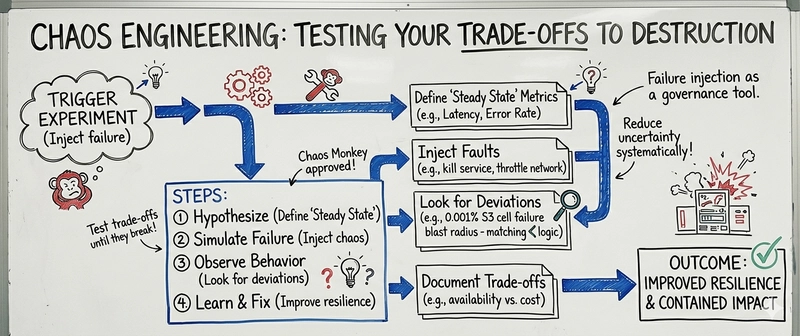
6️⃣ Chaos Engineering – Testing Your Trade‑Offs to Destruction
The Problem
You think your architecture is resilient. You think your bulkheads work. You think failover preserves state. But you’ve never actually tested it under real failure conditions.
The bank’s ESB team thought their failover worked. They were wrong.
The Solution: Chaos Engineering
Chaos engineering is the practice of running experiments that inject failures into a production‑like system to verify its resilience.
Principles:
- Define a steady state (e.g., “95% of requests succeed within 200ms”).
- Inject a real‑world failure (kill a node, corrupt a cache, slow a network).
- Observe if the steady state holds.
- If it doesn’t, you have a gap – fix it.
Real‑Time Example: Netflix’s “Simian Army”
Netflix runs Chaos Monkey – a service that randomly terminates production instances during business hours. This forces every team to build systems that survive instance death. They also have:
- Latency Monkey – injects artificial delays.
- Conformity Monkey – finds instances that don’t follow best practices.
- Doctor Monkey – detects unhealthy instances (e.g., high CPU, disk full).
Practical Chaos for the Rest of Us
You don’t need Netflix scale. Start small:
| Failure Injection | How to Test |
|---|---|
| Kill a database replica | In staging, stop the replica – does read traffic still work? |
| Slow a downstream service | Add a 5‑second delay to a third‑party API call – does your circuit breaker trip? |
| Crash a service instance | In Kubernetes, kubectl delete pod – does the service recover? |
| Corrupt a cache | Manually delete a Redis key – does the system fall back to the database? |
| Exhaust a connection pool | Simulate many concurrent requests – does the pool correctly reject or queue? |
Why Chaos Engineering Tames the Paradox
- Reveals hidden assumptions – the ones that kill you in production.
- Builds confidence in trade‑offs – you know your bulkheads work because you’ve seen them work.
- Makes failure boring – when failures happen regularly in testing, they’re less scary in production.
📋 Putting It All Together: A Decision‑Making Framework
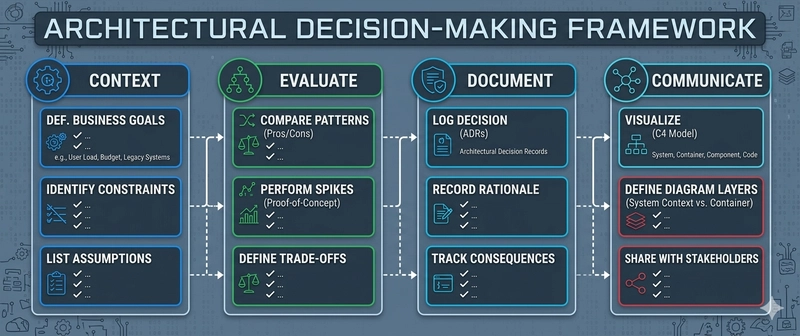
When facing an architectural decision, run this checklist:
| Step | Action | Tool |
|---|---|---|
| 1 | Is this a two‑way door? | If yes, decide quickly. If no, proceed. |
| 2 | Can we delay this decision? | If yes, set a calendar reminder for review. If no, proceed. |
| 3 | Document the decision | Write an ADR with trade‑offs and reversibility plan. |
| 4 | Enforce the decision | Write a fitness function to prevent drift. |
| 5 | Add bulkheads | Limit blast radius if the decision turns out wrong. |
| 6 | Test the decision | Write a chaos experiment that verifies the decision’s assumptions. |
🧠 Real‑Time Example: Applying the Framework to a Real Choice
Scenario: Your team must choose a message queue for a new order processing system.
| Step | Action Taken |
|---|---|
| Two‑way door? | Yes – you can change queues later if you use an abstraction. |
| Delay? | No – you need it now for the MVP. |
| ADR | Written: “Use RabbitMQ because the team knows it, but we’ll wrap it with a MessageQueue interface.” |
| Fitness function | Test that no code directly imports the RabbitMQ client – only the wrapper. |
| Bulkheads | Separate queues per order type (standard vs. express) so one doesn’t starve the other. |
| Chaos | In staging, kill RabbitMQ nodes – does the system degrade gracefully? Does it replay unacked messages? |
The decision is made confidently because the framework forces you to think about failure modes and reversibility – not just happy paths.
📌 Article 6 Summary
“The paradox doesn’t go away. But with ADRs, fitness functions, bulkheads, two‑way doors, delayed decisions, and chaos engineering, you can live with it – and even thrive.”
The six tools are not a silver bullet. They won’t eliminate trade‑offs. But they will:
- Make trade‑offs visible (ADRs)
- Prevent silent decay (fitness functions)
- Limit damage when you’re wrong (bulkheads)
- Keep options open (two‑way doors, delayed decisions)
- Reveal hidden assumptions before they kill you (chaos engineering)
The best architects are not the ones who are never wrong. They are the ones who fail safely, learn quickly, and adapt gracefully.
👀 Next in the Series… (The Grand Finale)
You’ve seen the paradox, the disasters, the tools. Now comes the hardest part: changing your mindset.
Article 7 (Coming Tuesday – Series Finale): “Stop Trying to Build the Perfect System. Do This Instead.”
Spoiler: The 7 mindset shifts that separate great architects from burnt‑out ones – and why “good enough” is the only sustainable goal.
This is the Zen of Architectural Pragmatism. Don’t miss it. ☯️
Found this useful? Share it with a team that’s about to make an irreversible decision without a reversibility plan.
Have a tool we missed? The paradox loves new weapons – reply.