
惯性聚合 高效追踪和阅读你感兴趣的博客、新闻、科技资讯
阅读原文 在惯性聚合中打开

推荐订阅源

M
MIT News - Artificial intelligence
罗磊的独立博客
Hugging Face - Blog
Hugging Face - Blog
Apple Machine Learning Research
Last Week in AI
Last Week in AI
S
SegmentFault 最新的问题
让小产品的独立变现更简单 - ezindie.com
美团技术团队
人人都是产品经理
人人都是产品经理
WordPress大学
WordPress大学
The Cloudflare Blog
IT之家
IT之家
雷峰网
雷峰网
小众软件
小众软件
博客园 - 叶小钗
博客园 - 聂微东
爱范儿
爱范儿
博客园 - 司徒正美
博客园 - 三生石上(FineUI控件)
V
Visual Studio Blog
博客园 - 【当耐特】
V
V2EX
博客园_首页
T
Tailwind CSS Blog

DEV Community

Authentication Security Deep Dive: From Brute Force to Salted Hashing (With Java Examples) Why AI Systems Don’t Fail — They Drift Spilling beans for how i learn for exam😁"Reinforcement Learning Cheat Sheet" I Replaced Chrome with Safari for AI Browser Automation. Here's What Broke (and What Finally Worked) How Python Borrows Other People's Work The $40 Architecture: Processing 1 Billion API Requests with 99.99% Uptime Vibe Coding: A Workflow Guide (From Zero to SaaS) Most webhook security guides protect the wrong side. The scary part is delivery. Headless CMS for TanStack Start: Build a Blog with Cosmic EU Age Verification App "Hacked in 2 Minutes" — What Actually Happened Comfy Cloud’s delete function does not actually remove files Running AI Models on GPU Cloud Servers: A Beginner Guide Event-driven media intelligence with AWS Step Functions and Bedrock I scored 500 AI prompts across 8 quality dimensions — here's what broke How to Call Google Gemini API from Next.js (Free Tier, No Backend Needed) The Portal Protocol: Reclaiming Human Connection in the Age of AI How to Fix Your Team's Scattered Knowledge Problem With a Self-Hosted Forum Intro to tc Cloud Functors: A Graph-First Mental Model for the Modern Cloud Designing Multi-Tenant Backends With Both Ownership and Team Access I Built a Neumorphic CSS Library with 77+ Components — Here's What I Learned PostgreSQL Performance Optimization: Why Connection Pooling Is Critical at Scale Cómo construí un SaaS multi-rubro para gestionar expensas en Argentina con FastAPI + Vue 3 🚀 I Built an Ethical Hacking Scanner Tool – Open Source Project I Replaced /usage and /context in Claude Code With a Single Statusline A Pythonic Way to Handle Emails (IMAP/SMTP) with Auto-Discovery and AI-Ready Design I Collected 8.9 Million Polymarket Price Points — Here's What I Found About How Markets Really Move EcoTrack AI — Carbon Footprint Tracker & Dashboard Everyone's Using AI. No One Agrees How. 5 self-hosted ebook managers worth trying in 2026 Building Your First AI Agent with LangChain: From Chatbot to Autonomous Assistant
We Built Multica to Make Multi-Agent AI Useful for Real W...
dengkui yang · 2026-04-29 · via DEV Community

AI is getting better fast, but the way most people use it still feels fragmented.

You open one chat, try one prompt, get one answer, and then start over somewhere else. That works for simple tasks, but it quickly becomes limiting when real work requires comparison, coordination, and iteration across multiple models.

That gap is what led us to build Multica.

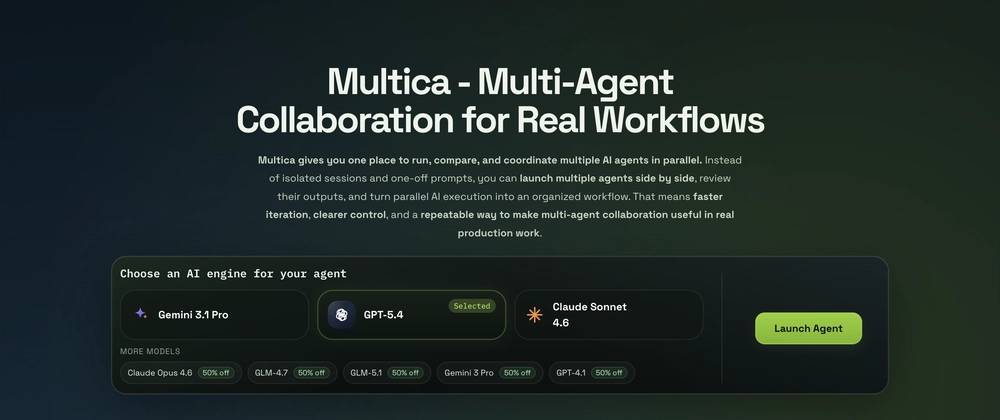
Multica is a multi-agent collaboration platform designed for real workflows. Instead of treating AI like a series of isolated conversations, Multica gives you one place to run, compare, and coordinate multiple AI agents in parallel. You can review outputs side by side, test different reasoning styles, and turn parallel AI execution into a more structured and repeatable process.

We built it around a simple belief: the future of AI is not just better models. It is better workflow.

In practice, real work is rarely solved by a single prompt or a single model. One model may be better at reasoning. Another may be better at speed. A third may produce a stronger draft, better structure, or a more useful perspective for the task. But switching across tools and trying to manage that process manually is slow, messy, and difficult to scale.

Multica was created to solve that problem.

With Multica, teams can work across models like GPT, Claude, Gemini, and others in one workflow instead of scattering tasks across separate tabs and disconnected chats. The goal is not just to generate more output. It is to create clearer decisions, faster iteration loops, and a more reliable way to use AI in production work.

That matters because multi-agent collaboration only becomes valuable when it is usable. It needs structure. It needs visibility. It needs a workflow that helps people compare outputs, make decisions, and move forward without losing context.

This is the direction we believe AI tools need to go.

Not just chat interfaces. Not just one-off prompts. Not just isolated answers.

But systems that help people coordinate intelligence in a way that fits real work.

That is what we are building with Multica.

If you are exploring how to make multi-agent AI more practical, organized, and useful for real workflows, you can learn more here:https://www.multica.uk/