


If you blinked over the last four weeks, you missed the moment the AI coding industry quietly stopped pretending.
On April 4, Anthropic banned third-party agent frameworks like OpenClaw from piping through Claude Pro and Max subscriptions. Five days later, OpenAI slid a brand-new $100 ChatGPT Pro tier into the gap between Plus and the original $200 Pro. Google had spent March quietly migrating Antigravity to a credits model with a free tier that keeps shrinking. And on April 27, GitHub dropped the announcement that turns June 1, 2026 into a hard line in the calendar for every developer running Copilot: flat-rate premium requests are dead, replaced by token-based AI Credits.
Four moves, four companies, one direction. The all-you-can-eat era of AI coding is over. The 2026 thesis writes itself: this is the year the real economics of inference finally reached the end user.
This piece walks through what actually changed, why it's happening now, and what it means if you ship code for a living.
The four moves of the last four weeks
1. GitHub Copilot: flat-rate dies on June 1
The biggest news is GitHub's announcement that all Copilot plans transition to usage-based billing on June 1, 2026.
The mechanic: premium request units are replaced by GitHub AI Credits, where 1 AI Credit equals $0.01 USD. Every chat turn, every agent step, every Spaces query consumes tokens at each model’s API rate, and that consumption converts to credits. Sticker prices stay flat, but what you receive now maps exactly to dollar usage.
What also disappears is the free fallback. Once your credits hit zero, you either pay more or stop. There is no cheaper safety net.
The core complaint isn’t price, it’s the collapse of simplicity. Copilot’s value was not thinking about tokens. Now it behaves like every other API wrapper.
2. Anthropic: the third-party agent ban and weekly limits
On April 4, Anthropic blocked Claude Pro and Max from being used via third-party agents like OpenClaw.
Heavy users had been consuming far more than they paid for. Some estimates put the gap at 5x or more. After the change, costs for those workflows can increase up to 50x.
At the same time, Anthropic has been tightening limits since 2025 with weekly caps and dynamic throttling. The most intensive users are the ones affected, even if officially it’s a small percentage.
3. OpenAI: filling the gap with a $100 tier
On April 9, OpenAI introduced a $100/month tier between Plus and Pro.
It offers similar model access as the higher tier but with lower limits. The timing clearly targets users affected by Anthropic’s changes. Same price point, same segment, immediate alternative.
4. Google: credits and quiet constraints
Google moved Antigravity to a credits system and has been reducing the free tier steadily.
Gemini pricing is already token-based, and higher limits are tied to paid plans. The pattern is consistent: casual use fits in the plan, serious use spills into paid consumption.
Bonus: the rest already moved
Other tools followed the same direction:
Windsurf shifted to quota-based usage
Cursor charges directly per token
Replit added tiered credits
There are no real flat-rate tools left for serious usage.
Why now? The economics caught up
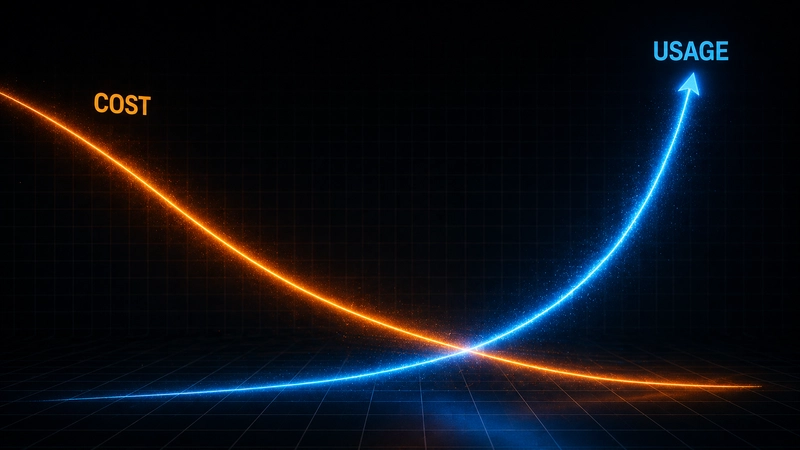
The key isn’t just pricing changes, it’s the underlying math.
Inference got cheaper per token, but usage exploded per task.
Agent workflows now consume far more tokens than simple chat. A single task can involve dozens of steps, large context windows, and repeated processing. Context accumulation alone drives massive overhead, with many tokens effectively wasted.
Flat-rate pricing breaks when heavy users consume vastly more than average users. That gap became too large to subsidize.
The thesis
For years, AI tools hid the meter. Now the meter is visible.
Developers need a new mental model:
Work is measured in tokens
Cost is part of design decisions
Model selection becomes a real skill
Prompt and context optimization directly affect budgets
This is similar to how cloud computing evolved from unlimited assumptions to metered reality.
What changes for developers
The differentiation between tools is no longer access to models, but the experience built around them.
The key questions now are:
What are you really paying for?
How do you manage cost variability?
Teams that build discipline around token usage will avoid surprises. Those who don’t will feel it quickly once billing reflects real consumption.
Closing thought
The all-you-can-eat era helped adoption, but it wasn’t sustainable.
Now the economics are visible, and developers need to adapt.
The buffet is closed. The menu just opened.
Sources
GitHub Copilot is moving to usage-based billing
Announcement & FAQ: Changes to GitHub Copilot Individual Plans
Devs Sound Off on Usage-Based Copilot Pricing Change
GitHub Copilot switches to token-based billing in June 2026
Microsoft's GitHub shifts to metered AI billing
Anthropic cuts off Claude subscriptions for OpenClaw and third-party agents
Anthropic tweaks Claude usage limits to manage capacity
ChatGPT finally offers $100/month Pro plan
Google Antigravity Pricing 2026
Windsurf Pricing Update in 2026
The Hidden Cost Driver in Agentic Coding Sessions
AI Inference Cost Crisis 2026