









The phrase "AI-powered CMS" has become meaningless. Every headless CMS vendor is using it. The real question is: what does the AI actually do?
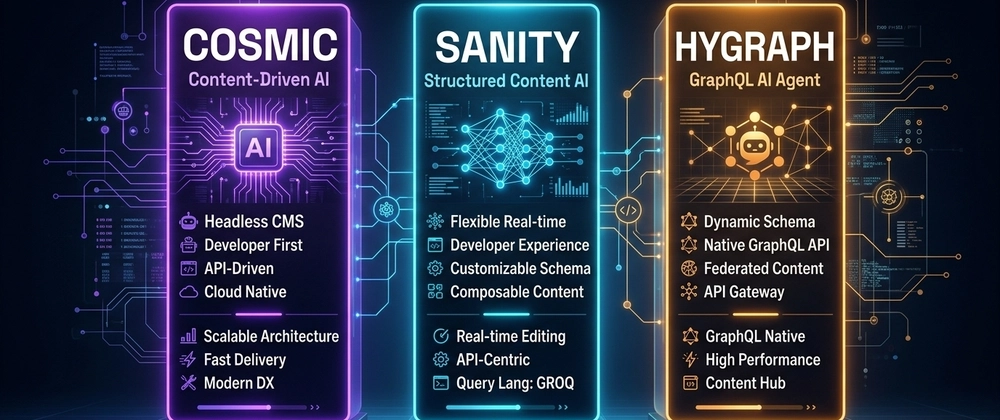
Cosmic, Sanity, and Hygraph are three of the most actively developed headless CMS platforms in 2026. All three are investing in AI. But their approaches are categorically different, and the distinction matters for how you build.
This comparison looks at what each platform's AI actually does, where it stops, and which approach fits what kind of team.
What We're Comparing
- Cosmic: Four distinct agent types (Team, Content, Code, Computer Use) that operate across your entire stack
- Sanity Agent Context: A structured content delivery layer for external AI agents, plus the Content Agent for content operations
- Hygraph: AI-assisted content features (generation, translation, enrichment) built into the editorial workflow, with no native agent product
These are not equivalent products doing the same thing at different price points. They represent three distinct philosophies about where AI belongs in a content platform.
Cosmic: Agents That Work Across Your Stack
Cosmic ships four agent types that operate at different layers of your development workflow:
Team Agents
Live in Slack, WhatsApp, and Telegram. They have persistent memory, custom personas, and configurable goals. A Team Agent can be your content lead, a growth assistant, a support agent, or anything else your team needs. They participate in your actual communication channels, receive messages, respond to them, and maintain context across conversations.
Content Agents
Generate and manage CMS content: blog posts, landing pages, AI images, AI video. They run on schedules, respond to webhooks, and chain into multi-step workflows. A Content Agent can publish a weekly roundup, generate product descriptions at scale, or update metadata across hundreds of objects.
Code Agents
Connect directly to GitHub repositories. They create branches, commit code, build features, fix bugs, and open pull requests. A Code Agent can receive a feature request in Slack and deliver a working pull request to your repository. This is not a content tool. It is a software development tool built into a CMS platform.
Computer Use Agents
Control browsers using visual AI. They record demo videos, extract data from web pages, cross-post media, and automate any browser-based workflow.
All four agent types chain together in Workflows. A single workflow can: generate content with a Content Agent, build a feature in GitHub with a Code Agent, and test the result with a Computer Use Agent.
The key distinction: Cosmic agents are not features inside a CMS dashboard. They are autonomous team members that operate across your content, codebase, and communication channels.
Sanity: Agent Context + Content Agent
Sanity's AI story has two distinct parts worth separating.
Agent Context
Agent Context is Sanity's framework for making your CMS content available to external AI agents via MCP. It provides semantic search, GROQ + semantic query combination, editorial access controls, and real-time sync.
Agent Context is infrastructure for other people's agents to use your Sanity content. It is not Sanity building agents that act on your behalf.
Content Agent
Sanity's Content Agent is focused on content operations inside the CMS: bulk edits across thousands of documents, content audits, bulk replace across large document sets, and web search to identify content gaps.
The scope: Sanity's Content Agent stays inside the CMS. It does not write application code, touch your GitHub repository, create branches, open pull requests, or deploy software.
Hygraph: AI Features, Not AI Agents
Hygraph offers AI-assisted content features built into the editorial and content operations workflow. There is no dedicated Hygraph AI agent product.
What Hygraph does with AI:
- Content enhancement: AI writing assistance, SEO optimization, metadata generation
- Translation and localization: AI-powered translation with integrations like DeepL
- Workflow automation: AI enrichment triggered by content changes via Agent Actions
- Content auditing: Find stale pages, missing metadata, terminology drift
- Federation: Query distributed content sources in real time
What Hygraph does not have:
- Native AI agents that act autonomously on your behalf
- Code agents that work in GitHub
- Team agents that live in Slack or messaging channels
- Multi-agent workflows that chain content, code, and browser automation
Side-by-Side: What Each Platform's AI Actually Does
Cosmic
- Team agents in Slack, WhatsApp, Telegram: Yes
- Content generation and management agents: Yes
- Code agents (GitHub branches, PRs, commits): Yes
- Computer Use / browser automation agents: Yes
- Multi-agent chained Workflows: Yes
- MCP Server: Yes (17 tools)
- Agent Skills for Cursor, Claude Code, Copilot: Yes (16+ integrations)
- Bulk content operations via AI: Yes
- AI image generation: Yes
- AI video generation: Yes
Sanity
- Team agents in messaging channels: Slack only (via Content Agent)
- Content generation and management agents: Yes (Content Agent)
- Code agents (GitHub branches, PRs, commits): No
- Computer Use / browser automation agents: No
- Multi-agent chained Workflows: No
- MCP Server: Yes
- Bulk content operations via AI: Yes (Content Agent's core strength)
- AI image generation: Yes (via Content Agent)
- AI video generation: No
- Structured content delivery for external agents (Agent Context): Yes
Hygraph
- Team agents in messaging channels: No
- Content generation and management agents: No (AI-assisted features, not agents)
- Code agents (GitHub branches, PRs, commits): No
- Computer Use / browser automation agents: No
- Multi-agent chained Workflows: No
- MCP Server: No dedicated product
- Bulk content operations via AI: Yes (via Agent Actions, event-driven)
- AI translation (field-by-field): Yes
- AI content auditing: Yes
- Content federation for AI use cases: Yes (a genuine differentiator)
The Practical Question: What Layer Do You Need AI to Operate In?
Choose Cosmic if:
- You want AI that operates across your full stack: content, code, browser, and communication channels
- Your team needs Code Agents creating branches and opening pull requests automatically
- You want AI team members living in Slack, WhatsApp, or Telegram with persistent memory
- Multi-agent Workflows that chain content generation, code deployment, and browser testing matter to you
- You use Cursor, Claude Code, or GitHub Copilot and want your CMS context built into your IDE's AI assistant
Choose Sanity if:
- Your primary AI use case is managing large volumes of existing content through conversation
- You need bulk editing, content audits, and gap analysis across thousands of documents
- Your team is editorial-first and the bottleneck is content operations, not engineering
Choose Hygraph if:
- Your priority is AI-assisted content workflows inside a governed, enterprise content platform
- Federation across distributed content sources is a real architectural need
- You need field-level AI translation with schema integrity for a global content operation
- You prefer AI that stays in an assisted, human-reviewed loop
Pricing Comparison (Verified April 2026)
Cosmic
- Free: $0/month, 1 Bucket, 2 Team members, 1,000 Objects, 1 Team agent
- Builder: $49/month, 2 Buckets, 3 Team members, 5,000 Objects, 3 Team agents
- Team: $299/month, 3 Buckets, 5 Team members, 20,000 Objects, 10 Team agents
- Business: $499/month, 5 Buckets, 10 Team members, 50,000 Objects, 25 Team agents
- Additional users: $29/user/month
- Free plan is genuinely free forever, no credit card required
Sanity
- Free: $0/month, up to 20 seats, 10,000 documents
- Growth: $15/seat/month, up to 50 seats, 25,000 documents
- Enterprise: Custom
- Notable: Dedicated support is a $799/month add-on. SSO is $1,399/month.
Hygraph
- Free tier available
- Scale and Enterprise tiers (contact for pricing)
- Federation and advanced AI features are enterprise-tier
The Deeper Distinction: Infrastructure vs. Agents
Sanity's Agent Context takes a real infrastructure play: instead of building agents, they are making Sanity the best content source for whatever agents you or your users are building.
Cosmic's bet is different. The agents are not features on top of the CMS. They are the product. Cosmic's position is that the CMS of 2026 is not a place where humans store content and developers build on top of it. It is an agentic platform where AI team members participate in the full development and content lifecycle.
As FINN co-founder Maximilian Wuhr put it: "Cosmic is: us never having to ask a developer to change anything on the backend of our website."
That is one version of what agents unlock. The ceiling is much higher.
Frequently Asked Questions
Does Hygraph have AI agents?
Not in the autonomous sense. Hygraph offers AI-assisted content features and event-driven AI enrichment via Agent Actions. There is no Hygraph agent that acts independently across your stack.
What is Sanity Agent Context?
Agent Context is Sanity's infrastructure layer that makes your Sanity content available to external AI agents via MCP. It is not Sanity building agents on your behalf.
Can Cosmic agents write code?
Yes. Cosmic Code Agents connect to GitHub repositories, create branches, commit changes, and open pull requests. This is one of the core distinctions from both Sanity's and Hygraph's AI offerings.
Is Cosmic free?
Yes. Cosmic's Free plan is $0/month forever, no credit card required. It includes 1 Bucket, 2 Team members, 1,000 Objects, and 1 Team agent.