







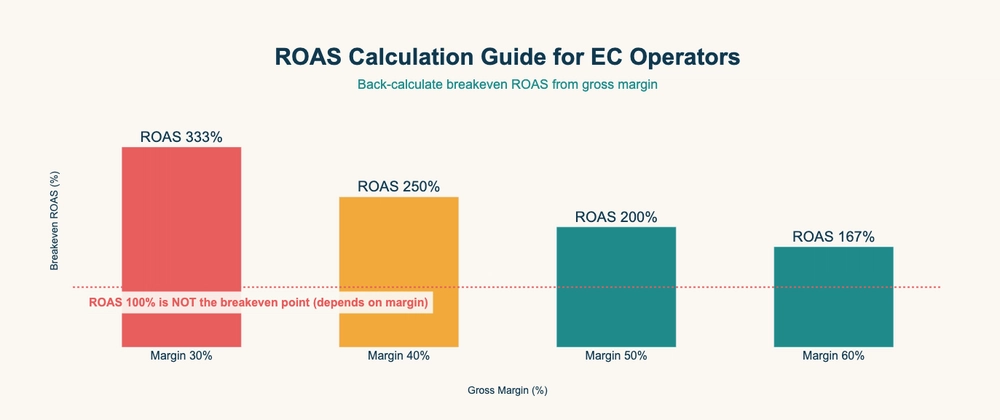

I keep hearing this line in marketing reviews: "Our ad ROAS is 300%, so we're profitable." For a 50% gross margin product, that's true. For a 20% gross margin product, that's a loss. The same line, the same number, opposite conclusions.
This isn't an exotic edge case. ROAS alone tells you nothing about whether you're profitable. The math is small but it almost never gets put on the same slide as the ROAS number itself.
ROAS 100% is not the breakeven point
ROAS divides ad-attributed revenue (pre-margin) by ad spend:
ROAS (%) = ad-attributed revenue ÷ ad spend × 100
When the right side equals 100%, you've recovered your ad spend in revenue, not in gross profit. If your gross margin is 30%, that ¥1 of revenue brought in ¥0.30 of gross profit — versus the ¥1 of ad spend you put in. Net: −¥0.70.
The actual breakeven sits at:
Breakeven ROAS (%) = 1 ÷ gross margin × 100
So:
| Gross margin | Breakeven ROAS | Profit-target ROAS (× 1.3) |
|---|---|---|
| 20% | 500% | 650% |
| 30% | 333% | 433% |
| 40% | 250% | 325% |
| 50% | 200% | 260% |
| 60% | 167% | 217% |
For a 40% margin product, ROAS 250% is the breakeven and 325% is roughly where ad-driven profit starts accumulating. "ROAS 300% so we're safe" is a wrong call for any sub-40% margin product.
If LTV matters (subscription cosmetics, health food, anything with high repeat rates), the right comparison is LTV ÷ CAC at n purchases, not first-purchase ROAS. Subscription brands routinely run profitable on first-purchase ROAS as low as 100–150% because the LTV catches up.
ROAS vs ROI — silent confusion in budget decisions
Quick aside that costs teams real money: ROAS and ROI get swapped silently in slide decks. Same shape, different denominator and numerator:
| Metric | Numerator | Denominator | Use case |
|---|---|---|---|
| ROAS | Revenue (pre-margin) | Ad spend | Per-campaign ad efficiency |
| ROI | Profit (gross or operating) | Total investment | Investment-return assessment |
When someone says "our ROI on this campaign is 300%," it's worth asking whether they mean the ROAS number from the ad platform, or actual profit-based ROI. For a 25% margin product, ROAS 300% maps to roughly ROI −25% — a loss. The two metrics agreeing on direction is not a guarantee.
In practice the split tends to be:
- Per-campaign efficiency → ROAS, fast to compare
- Channel-mix decisions → margin-adjusted ROAS (the breakeven framework above)
- Whole-marketing investment review → ROI, including non-ad costs (people, creative)
If your team mixes ROAS and ROI in the same conversation, the easiest fix is to write the breakeven ROAS number on every internal report and stop using "100%" as the implied threshold.
When ROAS misses the target, "cut spend" usually beats "add spend"
When ROAS is below your target (say breakeven × 1.3), the levers split into four. In my experience these are roughly in order of speed-to-impact:
- Cut. Pause the bottom 20% of campaigns by ROAS. Total ROAS commonly improves 20–30% from this single move
- Lift LP CVR. Going from 1.0% to 1.5% multiplies ROAS by 1.5x at the same ad spend
- Lift AOV. Cross-sell, bundles, free-shipping thresholds. Same CVR, more revenue per click
- Fix the measurement leak. UTM loss and Direct / (none) inflation often cause ROAS to be understated by 10–20%
That last one bites people. If GA4's Direct / (none) is over 30% of sessions, somewhere between 10–20% of ad-driven conversions are typically hiding there. You'll cut campaigns that are actually fine because the numerator of ROAS leaked. Fix the measurement first, then optimize the ads.
What ROAS doesn't see
Here's the part that gets less airtime: ROAS divides ad-attributed revenue by ad spend. Everything outside ad — organic search, SNS, email, direct traffic — sits in neither the numerator nor the denominator.
For most EC sites, ad-driven revenue is 30–50% of total revenue. ROAS shows you the efficiency of that slice. It tells you nothing about how the other 50–70% of revenue is performing per session, per channel, per visitor.
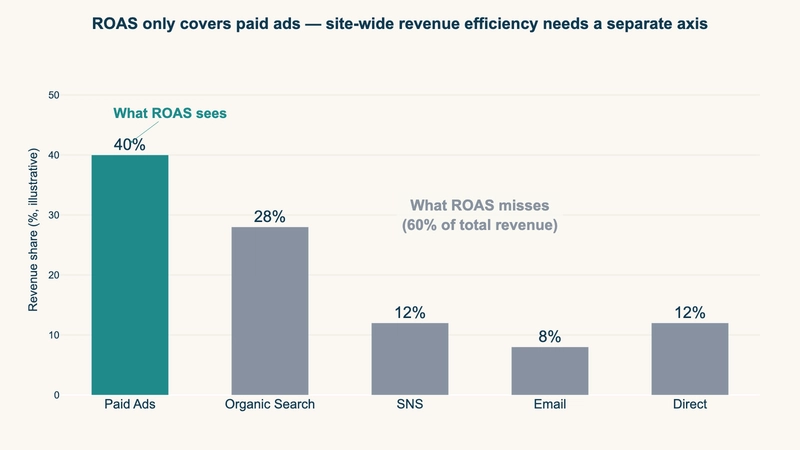
A few questions ROAS alone can't answer:
- If the same budget went to blog SEO instead of paid, how does long-term revenue efficiency change?
- For a paid session vs an SNS session, which produces more revenue per session?
- Did the LP improvement help paid traffic or organic traffic more?
These need a session-level efficiency metric — revenue per session across all channels — sitting next to ROAS. I've started calling that RPS (Revenue Per Session) in my own work, and it's the second axis I always wanted next to ROAS but never had cleanly in GA4. ROAS for ad-platform efficiency, RPS for whole-site efficiency. Two axes, much more confident budget decisions.
That said, this post is about ROAS. The takeaway here is just: ROAS measures one axis (ad spend), and the rest of your revenue needs a second axis if you want to make budget decisions across channels.
TL;DR
- ROAS is revenue ÷ ad spend, not profit ÷ ad spend. Don't treat 100% as breakeven
- Breakeven ROAS = 1 ÷ gross margin. Profit-target ROAS ≈ breakeven × 1.3
- Pin your own breakeven ROAS in internal reports. Stop arguing about generic 100%
- To miss-target ROAS: cut bottom 20% > lift CVR > lift AOV > fix measurement leak. Usually in that order
- ROAS only sees ads. Use a session-level metric (RPS) for whole-site revenue efficiency
What I'd love to hear in the comments: what gross margin bracket are you operating in, and what's your current breakeven ROAS target? Most teams I talk to never write this number down anywhere.