





Few things are as alarming for an ecommerce agency owner as the dreaded phrase, "Our client's checkout isn't working!" In the competitive realm of online retail, a disruption in the payment process is more than a mere inconvenience; it directly impacts your client's revenue and can harm your agency's standing. For agencies overseeing numerous client storefronts, establishing robust and resilient payment systems is absolutely crucial.
A recent candid discussion within a community forum perfectly illustrated this common struggle. The original poster, managing a WooCommerce store, recounted a "short issue recently where our main payment method started failing for some customers." This unexpected hiccup resulted in numerous abandoned carts and posed a critical question: How can we construct a more resilient checkout system? Their goal was to integrate backup payment methods, facilitate easy gateway switching, support diverse payment types, leverage payment links for urgent situations, maintain a swift checkout experience, and ultimately, minimize failed payments and cart abandonment.
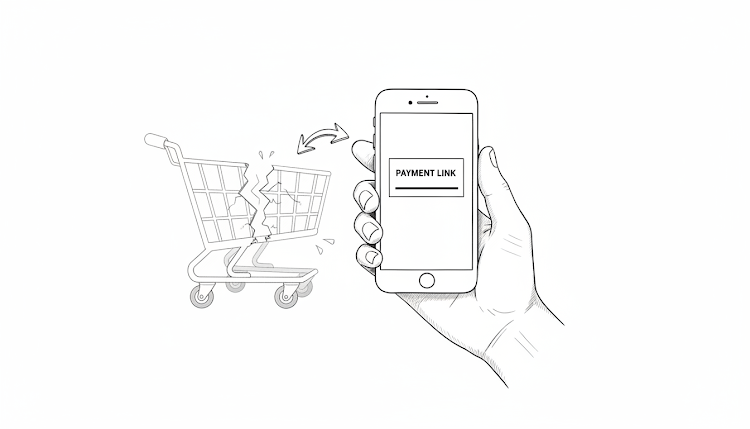 Black-and-white sketch of a hand holding a phone with a payment link, representing a lifeline for abandoned carts.## The Non-Negotiable: Baseline Payment Gateway Redundancy
The community's consensus was unequivocal: depending solely on a single payment gateway represents an unacceptable risk for any serious ecommerce store. Numerous respondents highlighted Stripe and PayPal as the established industry standard for achieving baseline redundancy. These two platforms can operate concurrently without interference, providing a robust and essential safety net that many agencies wisely integrate for their clientele.
What is frequently overlooked, as one community member pointed out, is that fundamental multi-gateway functionality is already integrated directly into WooCommerce. For the most straightforward configuration, an additional plugin isn't always necessary. Simply navigate to WooCommerce > Settings > Payments, activate both desired gateways, and then reorder them to establish your preferred primary option. This fundamental action is absolutely vital for any agency overseeing a WooCommerce storefront, guaranteeing that should a primary payment processor encounter an outage, a fully functional alternative is instantly accessible.
Reflect on how this directly influences your client's Revenue Operations (RevOps). Each instance of a failed payment, caused by a gateway problem, signifies a direct loss of potential income and a forfeited chance to collect valuable customer data for your HubSpot CRM. By diligently implementing this baseline redundancy, agencies are empowered to substantially mitigate revenue leakage and ensure a steady, uninterrupted stream of transactions, thereby populating sales and marketing funnels with precise and timely data.
Beyond Simple Redundancy: Smart Routing and True Failover
While enabling Stripe and PayPal marks an excellent initial step, a more profound understanding surfaced: merely presenting multiple payment options does not equate to genuine resilience. As one respondent succinctly articulated, "Most stores don't have a backup plan they just have multiple plugins sitting next to each other. The problem is those don't really failover when something breaks they just give users more options upfront which isn't the same as resilience." This distinction is crucial for robust systems.
This underscores a vital distinction for ecommerce developers and agency teams: the fundamental difference between simply offering numerous payment options and actually implementing a genuine failover system. When shoppers encounter an excessive number of payment buttons during checkout, it frequently results in decision paralysis and a rise in cart abandonment, even when all gateways are fully operational. A community member sagely observed that "conversion drops even when both gateways work fine" if the checkout interface becomes overly cluttered.
Authentic resilience, however, incorporates smart routing. This advanced approach means the system intelligently directs transactions towards the most suitable or currently available payment gateway, potentially concealing secondary options unless the primary one experiences a failure. For example, an aggregator such as Mollie, which a community member highlighted, represents a robust solution for stores operating within the EU. It encompasses a wide array of local payment methods (including cards, iDEAL, Bancontact, and Klarna) via a single integration, and expertly manages the internal routing, thereby significantly simplifying the setup process for agencies serving international clients.
Certain advanced solutions, like the one referenced by another contributor, integrate routing and fallback capabilities directly into the core payment flow. This forward-thinking and proactive methodology substantially decreases abandoned carts by automatically and seamlessly switching payment gateways in the background whenever issues emerge. This ensures a significantly smoother customer experience and rigorously safeguards your client's revenue stream from disruptions.
The Emergency Lifeline: Payment Links and Manual Recovery
What course of action should be taken when the entire checkout process on a storefront is compromised, extending beyond a mere single gateway failure? This is precisely when payment links transform into an indispensable emergency resource. A number of community members strongly underscored the efficacy of having pre-generated Stripe Payment Links or PayPal Invoices readily prepared for immediate deployment.
As one contributor wisely advised, possessing a direct URL that can be dispatched to a customer within minutes of an issue arising can result in a remarkably high rate of recovered carts. This particular strategy proves exceptionally effective for agencies overseeing high-value clients, where the successful completion of every single order is paramount. It expertly converts a potentially lost sale into a successfully recovered transaction, thereby showcasing proactive client management and superior problem-solving capabilities.
For agencies, seamlessly integrating this manual recovery procedure into your established operational playbook is absolutely essential. This could entail configuring quick-access templates for your client service teams directly within your agency project hub, empowering them to swiftly generate and dispatch payment links whenever a customer reports a problem. This approach not only salvages potential sales but also significantly strengthens client trust and elevates overall satisfaction.
Proactive Measures: Monitoring and Testing
While redundancy and failover serve as vital reactive solutions, genuine resilience equally necessitates proactive monitoring. As one community member astutely stated, it is imperative to "add basic monitoring so you hear about it before customers do." This encompasses diligently tracking orders that remain in a "pending" status for prolonged durations, meticulously examining webhook delivery logs from Stripe or PayPal, and regularly consulting gateway status pages for any alerts.
For ecommerce developers, establishing automated alerts that seamlessly integrate with your agency's internal communication channels (such as Slack or email) can prove to be a transformative advantage. This critical capability guarantees that your team gains immediate awareness of any potential payment issues, thereby enabling rapid intervention before a significant surge of abandoned carts materializes. Furthermore, consistently testing your backup payment methods is equally crucial to verify their expected functionality precisely when they are most required.
When undertaking an ecommerce replatforming checklist for a client, a comprehensive evaluation of their existing payment infrastructure, which includes rigorously stress-testing backup options and integrating robust monitoring systems, must be considered an absolutely non-negotiable step. This meticulous process guarantees that the newly implemented platform acquires a truly resilient payment system, rather than merely a refreshed storefront.
EShopSet's Role in Managing Payment Complexity for Agencies
Effectively managing resilient payment systems across numerous client accounts often presents significant complexity. It is precisely in this scenario that an operations workspace such as EShopSet proves to be indispensable. Our advanced platform functions as a central agency project hub, empowering you to:
- **Standardize Payment Strategies:** Establish, define, and consistently implement optimal best practices for payment redundancy and failover across the entirety of your client stores.

- **Streamline Incident Response:** Centralize all monitoring alerts and formulate clear, actionable protocols for addressing payment-related issues, thereby ensuring swift and effective resolution.

- **Enhance Client Transparency:** Leverage a dedicated [role based access control client portal](https://www.eshopset.com/role-based-access-control-client-portal) to securely share detailed payment performance reports and concise incident summaries with clients, fostering trust and actively demonstrating proactive management without necessitating full backend access.

- **Integrate with HubSpot:** Guarantee that your robust and well-defined payment strategies seamlessly feed into HubSpot CRM, Sales Hub, and Commerce platforms, delivering a comprehensive and holistic perspective on customer journeys and overall revenue operations.
Developing a truly resilient WooCommerce payment system is no longer merely a luxury; it has become an absolute necessity for ecommerce agencies dedicated to safeguarding both client revenue and their own professional reputation. By conscientiously adopting baseline redundancy, implementing intelligent smart routing, preparing emergency payment links, and engaging in proactive monitoring, agencies possess the capability to transform potential checkout catastrophes into effortlessly seamless transactions. Furthermore, with the aid of powerful tools like EShopSet, the management of this inherent complexity is significantly simplified, thereby enabling you to concentrate primarily on strategic growth and ensuring unparalleled client success.