






the analysis loop — paralysis as a trap
I’ve been squirming like a fly trapped under water — never still, never free. I obsessed over productivity tools. I consulted the smartest LLMs, hoping they’d tell me something about myself I hadn’t realized. I was always chasing the next question, the next issue, the next frame.
Whenever a thought made me uncomfortable — and it was almost always the planning ones — I’d instinctively move on. Generating a new framework is frictionless. Making an old one real costs blood. So I kept drilling holes. One after another. Until the bucket became a sieve, and I stood there wondering why nothing held.
The worst part: a second me watched it all happen. And instead of intervening, he started a nested loop — convinced that deeper analysis would surface a better solution. That if I could just understand the problem completely enough, movement would follow naturally.
It never did.
My brain was setting off fireworks. My hands were empty.
Until — in another round of self-diagnosis — I stopped asking what’s wrong with me and started asking what could force me to move. Not motivate. Not inspire. Force.
(Break down. What an arrogant word to use on myself — I know that now.)
Cyberwhip — the first form of Shoddy
At first, I thought what I needed was a cruel, emotionless whip. Something to flagellate this burnt-out ego. Pierce through the happy illusions. Dump every tangled thought out of my head, hold them up to the light, and bluntly name what was real and what was just elaborate what-if theater. Then push. Command. Move.
Yes, it sounds like BDSM. I know. 🤣
But during the build, I looked at those cold, blunt words on the screen — and my body froze. Not from resistance. From guilt. My brain just… shut off. Full stop.
The body always knows before the logic does: punishment triggers shame. Shame is not a catalyst. Shame is an anesthetic. It doesn’t create momentum — it deepens the paralysis.
(And for the record — I’m not fragile.)
Shoddy — the final birth of self-permission
A whip assumes the body is lazy. But it isn’t lazy — its load is simply maxed out. You don’t need a whip to force perfection. You need a bypass to allow garbage.
I took what I learned from Cyberwhip and turned it inside out. You cannot force a frozen body to run. But a paralyzed mind still needs an external boundary — left in a vacuum, it will expand infinitely into what-ifs. That boundary doesn’t have to arrive as punishment. It can arrive as process.
So I extracted the exact moments that actually moved me — the forced choices, the friction, the small surrenders — and rebuilt them into something quieter. Every stage in Shoddy is designed to hold a specific part of your anxiety still, long enough to take one step.
It’s not Coach Carter. It’s not a whip.
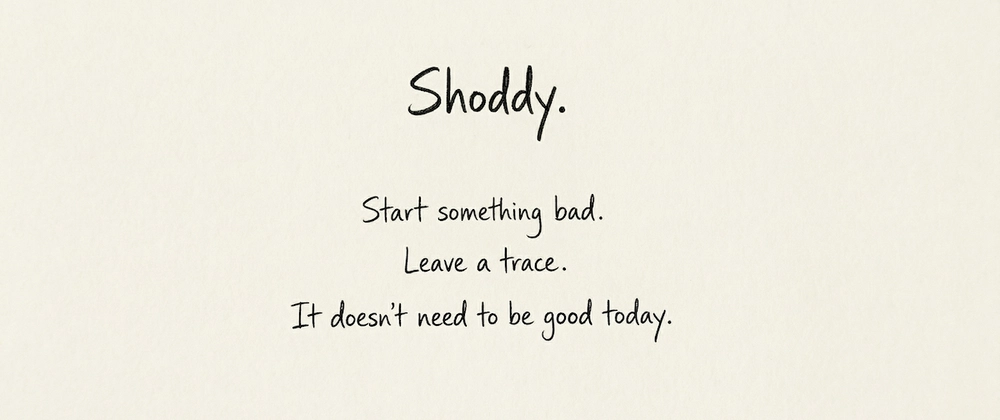
It’s Shoddy. Badly made, roughly done — and that’s exactly the point. The absolute right to be terrible, granted in the form of a countdown. A permission slip to begin imperfectly, to move anyway, to let the first step be ugly.
Whatever you choose when you’re inside it — you’re not doing it wrong.
You never were.
Originally published at https://shoddy.app