






If you've ever pasted a crash log into your AI assistant and gotten back "try moving work off the main thread" — you know the problem.
Your AI assistant has not a single clue what's actually running in your app. No dependency graph, no session data, no component timings. So it guesses.
And sometimes it's right.
That's what we kept hearing from Android and KMP teams. And it's what we built the Kotzilla MCP Server to fix.
The problem
Android and KMP teams spend hours on production issues that should take minutes. An ANR shows up in Play Console.
Someone digs through logs, pastes a stack trace into Claude or Cursor, and gets a suggestion that doesn't account for the actual dependency chain causing the problem.
For KMP teams it's worse.
A crash only shows up on iOS. Your monitoring tool has nothing useful for that target. Your AI assistant has even less. So the debugging process is mostly educated guesses while the issue sits in production.
*The root cause is almost always the same: your AI assistant is working blind. *
It sees your code but not your runtime. It knows your architecture on paper but not how it behaves under real user sessions.
What we built
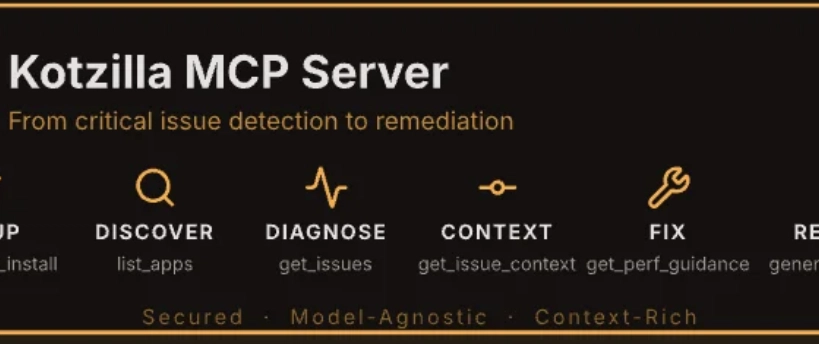
The Kotzilla MCP Server connects your AI coding assistant to the Kotzilla Platform.
It gives your assistant the same structural and runtime context Kotzilla captures from real user sessions — dependency graphs, resolution timings, crashes, component behaviour — together with a knowledge base of proven fix patterns for Android and KMP projects.
The result: your assistant can go from detecting an issue to producing a concrete fix, all without leaving your editor.
How it works
Once connected, you ask your assistant questions in plain language:
What are the main performance issues in my app?
Why is HomeScreen slow?
Show me the crashes on the iOS target of my CMP app
Is version 1.2.1 performing better than 1.1.5?
Your assistant gets back real data. It gets back dependency resolution trees with timings, symbolicated stack traces, component-level performance data across every KMP target.
And uses it to give you a specific answer, not a guess.
Ask it to fix the issue and it retrieves the fix pattern for that specific issue type, reads your code, and applies the changes across files under your review.
A few things you can ask it right now
Setting up
One natural language prompt registers your app, reads your project structure, generates kotzilla.json, updates your version catalog and Gradle plugin, and adds the monitoring() call to your Koin setup.
After that, your assistant is connected to real session data from your app. You don't need a new dashboard, context switching, or copy-pasting between tools.
Works with the tools you already use
Claude Code, Cursor, Windsurf, the Android Studio MCP panel, and any LLM-powered terminal assistant.
Try it
Free to get started.
👉 doc.kotzilla.io/docs/discover/mcpServer
If you try it, we'd love to hear how it holds up in the wild, especially on KMP projects.
Drop a comment below.
— The Kotzilla team