







This is a submission for the Google Cloud NEXT Writing Challenge
It is easy to get swept up in the polished keynote demos of new AI capabilities. However, when evaluating new technology, I approach it with a heavy dose of skepticism. The industry is saturated with flashy wrappers built over basic API calls, and history tells us that if we do not rigorously double-check the underlying architecture, those experimental prototypes will inevitably collapse under the weight of production reality.
After parsing through the announcements at Google Cloud Next '26 and researching the fine print, the core narrative is clear: the era of bolting AI onto existing applications is over. The focus has firmly shifted toward the unglamorous, highly rigorous digital infrastructure required to run autonomous systems reliably, securely, and at scale.
Here is my detailed, fact-checked analysis of the architectural shifts that matter, stripping away the marketing hype to focus on what you actually need to build resilient systems.
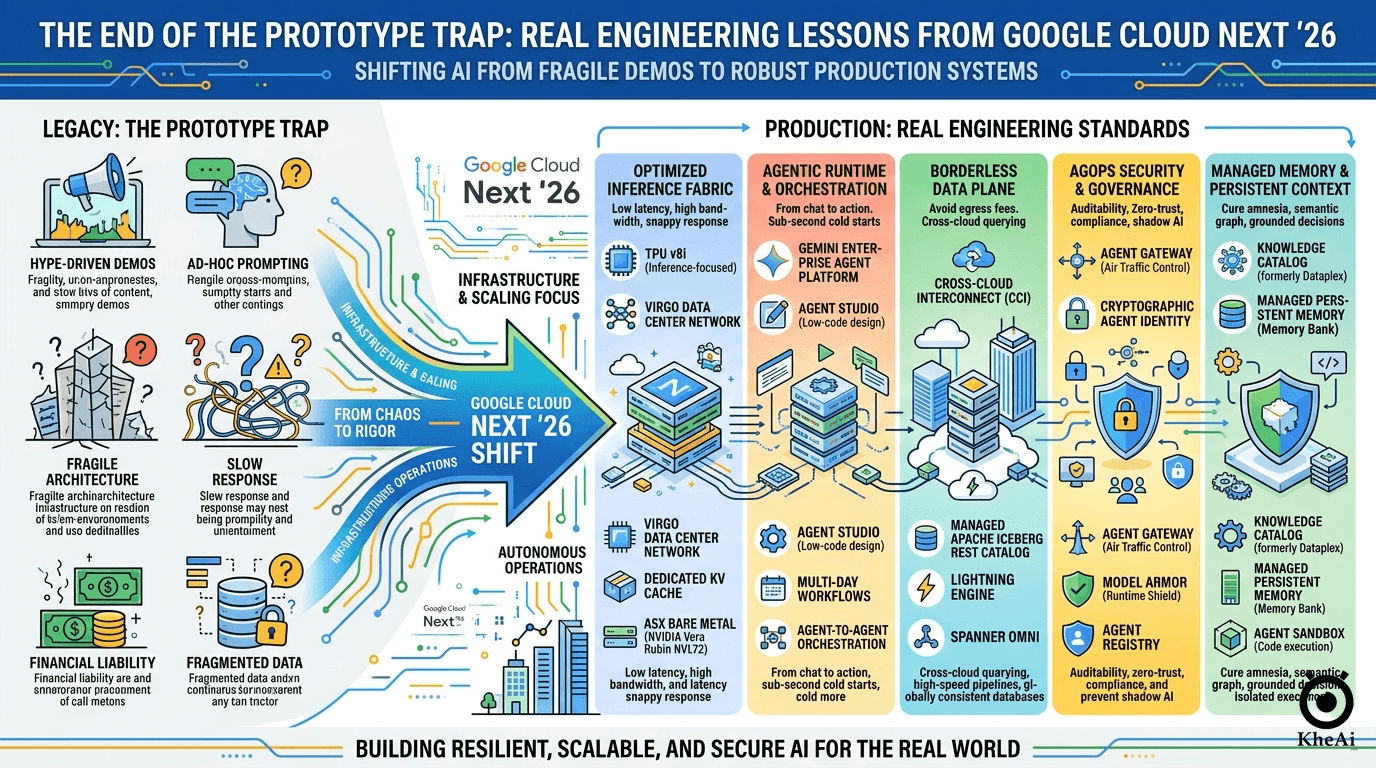
Phase 1: Escaping the Fragility of Ad-Hoc Prompting
For the last two years, development has been heavily reliant on trial-and-error natural language instructions. This ad-hoc approach creates a hard ceiling for reliability. When dealing with high-stakes environments, you cannot rely on unpredictable generative responses to handle complex logic.
The Hardware Reality Check
We have reached a point of diminishing returns with software-only optimization. The major takeaway is the necessary bifurcation of hardware. Throwing massive compute power designed for training at a real-time inference problem is incredibly inefficient. The introduction of purpose-built inference silicon—specifically the TPU v8i—addresses this exact bottleneck. By prioritizing latency and the time it takes to generate the first token, we can finally close the gap that makes AI systems feel sluggish or unresponsive in live environments.
Financial Guardrails as Features
One of the most overlooked updates is the implementation of hard infrastructure-level billing limits for serverless AI deployments. Autonomous systems are inherently chatty and prone to recursive loops if logic fails. Without strict financial controls baked into the runtime environment, experimenting with multi-agent orchestration is a massive fiscal liability.
The New Hardware & Networking Standard
Building the foundation for low-latency reasoning.
- TPU v8i (Inference): This is the "Zebrafish" architecture. Unlike the 8t (Training), the TPU v8i is optimized for high-speed sampling and "chain-of-thought" processing. It’s what makes an agent feel "snappy" rather than laggy.
- Virgo Network: This is the underlying data center fabric. If you are building multi-agent systems that need to "talk" to each other across different clusters, Virgo provides the ultra-high bandwidth required to prevent networking bottlenecks.
- Dedicated KV Cache: A specialized storage subsystem that speeds up model responses by "remembering" parts of the conversation context at the hardware level.
- A5X Bare Metal: For those who need NVIDIA's ecosystem, these instances (powered by Vera Rubin NVL72) are the top-tier alternative for massive-scale inference.
Phase 2: Inverting the Application Architecture
The traditional software model follows a strict hierarchy: a user interface triggers an API, which queries a database, and perhaps an AI model is called to summarize the result. We need to fundamentally invert this thinking.
Intelligence as the Orchestrator
In a modern system, the intelligence layer acts as the entry point, not the afterthought. Instead of hardcoding static conditional statements, the system feeds raw context—sensor data, user history, system state—into a reasoning engine. That engine then decides which backend APIs to execute.
Event-Driven Over Request-Driven
To achieve true autonomy, systems must move away from waiting for human input. The architecture must be deeply integrated with event streaming backbones, reacting instantly to state changes and anomalous data patterns.
Orchestration & The Agentic Runtime
Moving from "Chat" to "Action."
- Gemini Enterprise Agent Platform: Think of this as your "Operating System" for AI. It includes Agent Studio, a low-code environment where you can design agent logic without getting bogged down in boilerplate code.
- Agent Runtime: This isn't just a VM. The new Agent Runtime supports sub-second "cold starts" and—crucially—multi-day workflows. This allows agents to work on a task for 48 hours, go to sleep, and wake up when an external event triggers them.
- Agent-to-Agent (A2A) Orchestration: A protocol that allows you to build a "Manager" agent that can delegate sub-tasks to specialized "Worker" agents (e.g., a "Travel Agent" delegating to a "Booking Agent" and a "Visa Agent").
- Firebase Genkit: An existing, open-source framework that I still recommend for developers who want to build and test their agents locally before deploying them into the Google Cloud ecosystem.
Phase 3: Solving the Data Logistics Crisis
There is a hidden tax on enterprise AI: data gravity. If your organization's data is fragmented across multiple cloud providers, moving that data to process it incurs crippling egress fees and introduces severe latency. In the agentic era, moving data to the model is dead; bringing the model to the data is the only viable path forward.
Compute Meets Data
The real breakthrough is not a shiny new generative model; it is the establishment of standardized, cross-platform data pipelines. Technologies enabling cross-cloud data querying allow the intelligence engine to process massive datasets exactly where they reside. This eliminates the need to centralize data before analyzing it, ensuring systems remain financially viable at scale.
Standardized Translation Layers
We are also moving past the era of writing custom integration code for every new data source. The adoption of universal protocols standardizes how models communicate with external tools and databases. By decoupling the reasoning engine from the data source, we ensure our architecture is modular and protected against vendor lock-in.
The Borderless Data Plane
Processing data without the "Egress Tax."
- Cross-Cloud Interconnect (CCI): This is now integrated directly into the data plane. It allows you to link your AWS or Azure environments to Google Cloud with dedicated, private high-speed lines.
- Managed Apache Iceberg REST Catalog: This is the "Universal Translator" for your data. It allows BigQuery, Spark, and your AI agents to read and write to the same data tables, even if they are sitting in an S3 bucket or Snowflake.
- Lightning Engine: If you are using Spark for heavy data processing, the Lightning Engine provides a massive speed boost, ensuring your agents aren't waiting on slow data pipelines to get the "truth."
- Spanner on Distributed Cloud: You can now run the Spanner database engine anywhere—on-prem or in other clouds—giving you a globally consistent database that agents can query regardless of where they are running.
Phase 4: Operational Rigor for Non-Human Workers
If you deploy a fleet of hundreds of autonomous instances across an enterprise, deployment is no longer your primary engineering challenge. Governance and observability are the new critical paths. We must treat these automated instances with the same security and operational rigor as human employees or microservices.
The "AgOps" Security & Governance Stack
Managing your non-human workforce.
- Agent Gateway: This is "Air Traffic Control." It’s a network-level entry/exit point that inspects all agent traffic. It ensures that an agent isn't trying to send sensitive data to an unapproved third-party API.
- Agent Identity: This assigns each agent a cryptographic ID. It moves us away from "Service Accounts" and toward a world where every action an agent takes is signed and auditable.
- Model Armor: This is your runtime shield. It sits inside the Agent Gateway and automatically scrubs for prompt injections, "jailbreak" attempts, or PII (Personally Identifiable Information) leakage.
- Agent Registry: A central library for your enterprise. It’s where you "register" approved agents and tools, preventing "Shadow AI" where employees deploy unvetted agents that the IT team can't see.
- Cryptographic Identification: Every independent system component needs a unique, auditable identity mapped to strict access management policies. If a database is modified, the logs must show exactly which automated instance authorized the change.
- Centralized Registries: Organizations require a single source of truth for all deployed intelligence tools, ensuring shadow deployments are impossible and version control is absolute.
- Network-Level Security: Security cannot be an afterthought implemented via system prompts. It must live at the network gateway, scanning for malicious injections or logic poisoning before the payload ever reaches the execution layer.
Phase 5: Curing Systemic Amnesia
A persistent flaw in recent AI systems is context degradation over time. The system starts strong but eventually loses the thread of the operation, leading to hallucinations based on stale data.
To ensure accuracy, we must abandon fragile, custom-built retrieval pipelines in favor of managed, persistent stateful memory. By utilizing managed memory banks and structured knowledge catalogs, systems can retain complex operational context across lengthy sessions. This guarantees that decisions are grounded in continuously verified, real-time enterprise data rather than speculative logic.
Managed System Memory & Context
Curing "AI Amnesia."
- Knowledge Catalog: (Formerly Dataplex). This is a "living" index of your entire company’s knowledge—PDFs, Slack, Databases. It creates a Semantic Graph so agents can find the relationship between different pieces of information.
- Managed Persistent Memory (Memory Bank): This service allows an agent to "remember" a user's specific context across multiple days and sessions. You no longer have to manually manage state in a separate database; the platform handles it.
- Agent Sandbox: This is a hardened, isolated environment. If your agent needs to "write and execute code" to solve a math problem or analyze a CSV, the Sandbox ensures that code can't "escape" and infect your main servers.
The Pragmatic Blueprint: What to Do Next
Transitioning your projects from experimental prototypes to rigorous, production-grade systems requires a systematic overhaul of how you approach development.
The Pragmatic Blueprint: Engineering for Production
| Focus Area | The Legacy Mindset | The Production Mindset | Business Impact |
|---|---|---|---|
| System Logic | Linear API requests triggered by users. | Event-driven orchestration and state awareness. | Autonomous Speed: Sub-second resolution without waiting for human intervention. |
| Integration | Custom, hardcoded connections for every tool. | Standardized protocols decoupling models from data. | Vendor Agility: Swap models or data sources in days, not months, without a total system rewrite. |
| Security | Relying on system prompts for behavioral guardrails. | Cryptographic identities and network-level gateways. | Zero-Trust Compliance: Eliminates prompt-injection risks and ensures every "non-human" action is auditable. |
| Reliability | Testing "happy paths" manually. | Generating synthetic traffic to stress-test reasoning. | Architectural Resilience: Systems that handle real-world entropy and edge cases without "hallucinating" logic. |
| Observability | Monitoring basic server uptime and latency. | Deep telemetry tracing to audit every decision branch. | Root-Cause Accuracy: Instant identification of logic failures, providing a "defensible" trail for every AI decision. |
| Cost Control | Uncapped, consumption-based billing models. | Infrastructure-level financial circuit breakers. | Fiscal Predictability: Eliminates "bill shock" from runaway recursive loops or inefficient hardware usage. |
Step-by-Step Execution Plan
- Audit Your Data Logistics: Map out exactly where your enterprise data lives. If you are paying egress fees to move data for analysis, prioritize implementing cross-cloud querying solutions immediately. Keep the data static and move the compute.
- Decouple Your Tooling: Stop writing bespoke integration scripts. Transition your application interfaces to utilize standardized context protocols. This ensures your architecture remains resilient even as underlying models are upgraded or swapped.
- Enforce Identity Management: Do not grant broad service account access to your logic engines. Assign specific cryptographic identities to every automated process and strictly limit their blast radius using principle-of-least-privilege access controls.
- Implement Synthetic Testing: Before pushing any autonomous logic to production, build a simulation environment. Bombard your system with thousands of synthetic edge-case scenarios to expose logical failures that standard unit tests will miss.
- Upgrade Your Telemetry: If an automated decision fails, a standard error log is useless. You must implement deep observability tracing so you can step backward through the exact chain of logic, memory retrieval, and API calls that led to the failure.
- Hardcode Financial Circuit Breakers: Never deploy an autonomous loop without strict, infrastructure-level budget caps. If an agent hallucinates a million API calls, your architecture must sever the connection before the billing cycle catches up.
The transition toward self-governing systems is not about chasing the latest generative trend; it is about applying foundational software engineering principles to a new paradigm. By prioritizing infrastructure, security, and data logistics, we can build systems that actually survive the rigorous demands of the real world.