惯性聚合 高效追踪和阅读你感兴趣的博客、新闻、科技资讯
阅读原文 在惯性聚合中打开

推荐订阅源

Cyber Security Advisories - MS-ISAC
G
Google Developers Blog
S
SegmentFault 最新的问题
Microsoft Security Blog
J
Java Code Geeks
罗磊的独立博客
H
Hackread – Cybersecurity News, Data Breaches, AI and More
量子位
P
Proofpoint News Feed
博客园 - 【当耐特】
MongoDB | Blog
MongoDB | Blog
L
LangChain Blog
F
Fortinet All Blogs
C
Check Point Blog
博客园_首页
I
InfoQ
Jina AI
Jina AI
Blog — PlanetScale
Blog — PlanetScale
OSCHINA 社区最新新闻
OSCHINA 社区最新新闻
酷 壳 – CoolShell
酷 壳 – CoolShell
Engineering at Meta
Engineering at Meta
美团技术团队
Vercel News
Vercel News
Apple Machine Learning Research

DEV Community

Authentication Security Deep Dive: From Brute Force to Salted Hashing (With Java Examples) Why AI Systems Don’t Fail — They Drift Spilling beans for how i learn for exam😁"Reinforcement Learning Cheat Sheet" I Replaced Chrome with Safari for AI Browser Automation. Here's What Broke (and What Finally Worked) How Python Borrows Other People's Work The $40 Architecture: Processing 1 Billion API Requests with 99.99% Uptime Vibe Coding: A Workflow Guide (From Zero to SaaS) Most webhook security guides protect the wrong side. The scary part is delivery. Headless CMS for TanStack Start: Build a Blog with Cosmic EU Age Verification App "Hacked in 2 Minutes" — What Actually Happened Comfy Cloud’s delete function does not actually remove files Running AI Models on GPU Cloud Servers: A Beginner Guide Event-driven media intelligence with AWS Step Functions and Bedrock I scored 500 AI prompts across 8 quality dimensions — here's what broke How to Call Google Gemini API from Next.js (Free Tier, No Backend Needed) The Portal Protocol: Reclaiming Human Connection in the Age of AI How to Fix Your Team's Scattered Knowledge Problem With a Self-Hosted Forum Intro to tc Cloud Functors: A Graph-First Mental Model for the Modern Cloud Designing Multi-Tenant Backends With Both Ownership and Team Access I Built a Neumorphic CSS Library with 77+ Components — Here's What I Learned PostgreSQL Performance Optimization: Why Connection Pooling Is Critical at Scale Cómo construí un SaaS multi-rubro para gestionar expensas en Argentina con FastAPI + Vue 3 🚀 I Built an Ethical Hacking Scanner Tool – Open Source Project I Replaced /usage and /context in Claude Code With a Single Statusline A Pythonic Way to Handle Emails (IMAP/SMTP) with Auto-Discovery and AI-Ready Design I Collected 8.9 Million Polymarket Price Points — Here's What I Found About How Markets Really Move EcoTrack AI — Carbon Footprint Tracker & Dashboard Everyone's Using AI. No One Agrees How. 5 self-hosted ebook managers worth trying in 2026 Building Your First AI Agent with LangChain: From Chatbot to Autonomous Assistant
Stop Paying the Abstraction Tax : How I Built a C-Engine ...
NARESH-CN2 · 2026-04-27 · via DEV Community
Cover image for Stop Paying the Abstraction Tax : How I Built a C-Engine 12x Faster than Pandas

NARESH-CN2

Python is the king of data science, but it charges a heavy price for convenience. When you use pd.read_csv() on a 10GB+ file, Python attempts to load the data into RAM, wrapping every byte in a heavy PyObject.

The result? OOM (Out of Memory) crashes and massive AWS bills. I decided to go to the metal to see if I could bypass this "Abstraction Tax" entirely.

The Problem: The Double-Copy Penalty
Standard data pipelines move data from the SSD ➔ OS Kernel ➔ User Space ➔ Application. This constant copying wastes CPU cycles and explodes the memory footprint.

The Solution: Memory Mapping (mmap)
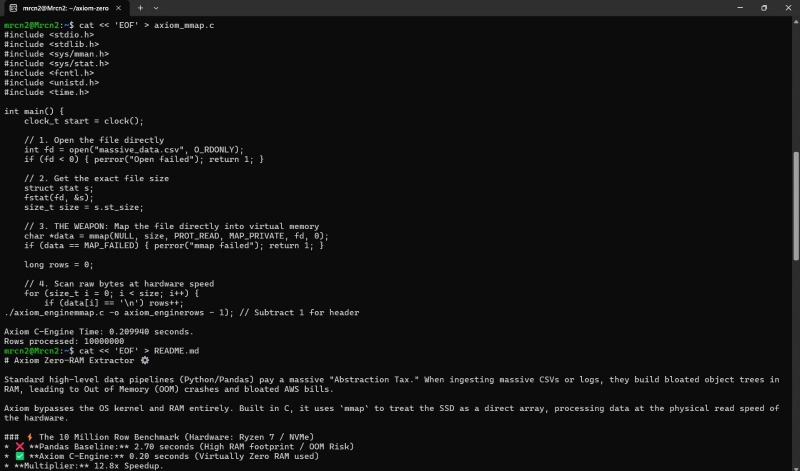
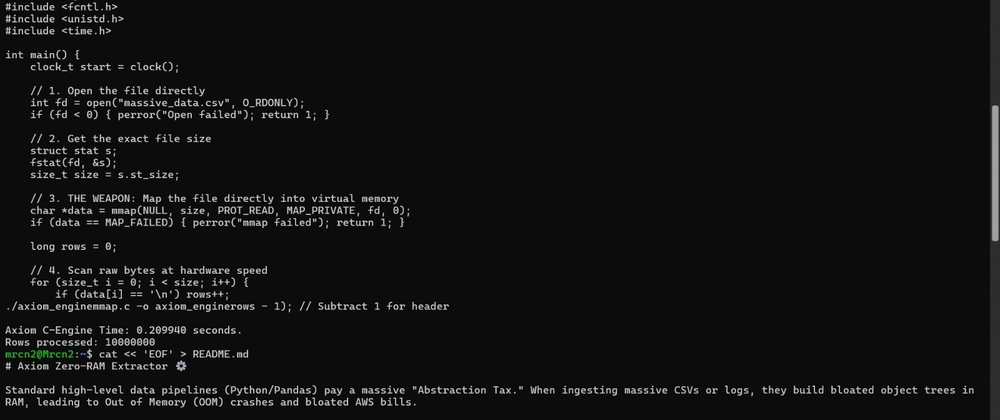
I built the Axiom Zero-RAM Extractor in pure C. Instead of loading the file, Axiom uses mmap to treat the SSD as a direct array.

Key Architectural Gains:

Zero-Copy: Data is only pulled into the L1/L2 cache in tiny 4KB chunks as the CPU requests them.

Mechanical Sympathy: Sequential access triggers the CPU's Hardware Pre-fetcher, hitting the physical read limit of the NVMe drive.

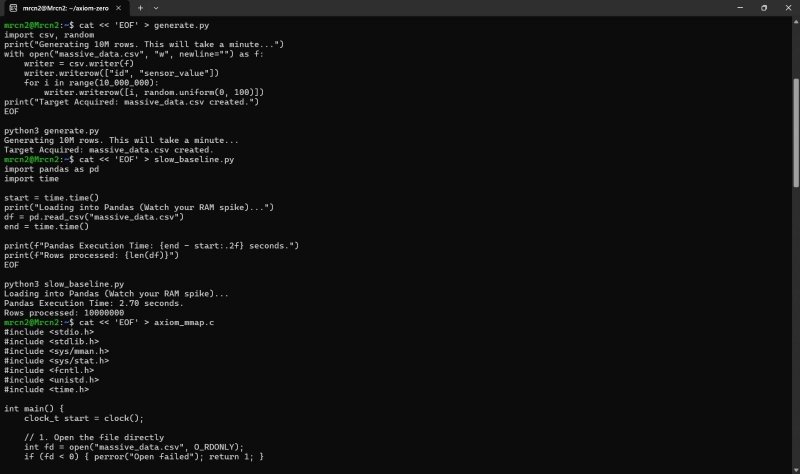
The 1GB Benchmark (10 Million Rows)
❌ Pandas Baseline: 2.70 seconds (High RAM spike)

✅ Axiom C-Engine: 0.20 seconds (Near-zero RAM used)

The ROI
By dropping the memory footprint to near-zero, this architecture allows you to process 100GB+ files on a $10/month micro-instance instead of a $250/month memory-optimized cluster.

The Source Code
You can find the hardened C-engine, the MIT License, and the benchmark generator here:
https://github.com/naresh-cn2/axiom-zero-ram