









*Team Members *
This project was developed by:
- @bhavya_praneethavemuri_7 - BHAVYA PRANEETHA VEMURI
- @alekhya_reddy - ALEKHYA REDDY SANGU
- @masangari_harshitha_e2d71 - HARSHITHA REDDY
- @pravalika_kurva_ab15b2581 -PRAVALIKA
We would like to express our sincere gratitude to @chanda_rajkumar for their valuable guidance and support throughout this project.
Their insights into system design, architecture, and development played a key role in shaping SocialScope.
SocialScope v4 — How Social Media Shapes Young Minds, and the App We Built to Study It
A deep-dive into our peer-reviewed research on 120,000+ adolescents across 18 countries, paired with the full technical breakdown of SocialScope v4 — the AI-powered web platform we built to bring these findings to life.
Research at a Glance
Our systematic review synthesized 63 peer-reviewed studies published between 2015 and 2024, drawn from PubMed, Scopus, Web of Science, PsycINFO, IEEE Xplore, and Google Scholar. The core finding: social media's impact on young people is not binary — it is deeply conditional on how it is used.

Core Thesis: Passive use (scrolling, absorbing) correlates with negative outcomes. Active use (creating, interacting, discussing) correlates with positive development outcomes — regardless of socio-economic background.
Methodology
Starting from 1,247 papers, duplicates were removed to leave 891, then title/abstract screening identified 189 full-text candidates, of which 63 met all inclusion criteria. Quality was assessed using the Mixed Methods Appraisal Tool with an inter-rater agreement of κ = 0.81 (81%).
Quantitative results used Hedge's g for effect sizes and odds ratios for categorical variables under a random-effects model. Where heterogeneity exceeded I² > 50%, subgroup analyses were performed.
What Social Media Does Right
1. Genuine Online Relationships
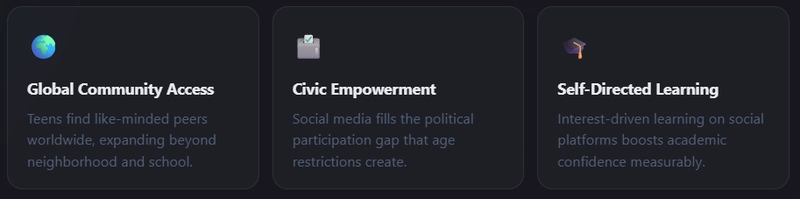
For adolescents facing geographic isolation, physical or mental disabilities, or social alienation within their immediate environment, social media is not merely a supplement to real-world connection — it becomes the social environment. Research confirms that positive online interactions (receiving encouraging messages, collaborative discussions) improve adolescent mood comparably to face-to-face communication.
2. Learning Beyond the Classroom
Platforms like YouTube, Reddit, Discord, and TikTok host entire ecosystems of self-directed learning — covering mathematics, sciences, history, programming, and more. A cross-country study comparing high school students from India, Kenya, and Brazil found that students engaging effectively with school-distributed social media content reported significantly higher academic self-efficacy, and this effect persisted across income levels and parental education — suggesting social media can partially bridge educational inequality.
Participatory Culture (Jenkins, 2009): Teenagers today are not just consumers — they blog, direct videos, manage communities, and design graphics. These acts build real-world skills: communication, editing, feedback integration, and team collaboration.
3. Civic Engagement & Identity Formation
A comprehensive study spanning 14 nations over 15 years revealed a strong correlation between youth social media use and political engagement — including petition participation, election interest, and social activism. Crucially, this correlation held even for previously politically inactive youth, suggesting social media creates civic participation rather than merely attracting those already inclined.
On identity: qualitative research describes social media not as a mirror reflecting who a teenager already is, but as a workshop where they actively construct, test, and refine their identity through expression and peer feedback.
Where Social Media Causes Harm
Mental Health: The Evidence Is Real
Excessive social media use shows a reliable average correlation with signs of depression, anxiety, and loneliness in adolescents. The primary mechanism is social comparison — because users present curated, positive versions of their lives, adolescents measure themselves against an unrealistic standard, leading to diminished self-worth. This effect is particularly pronounced among young females regarding body image.
Cyberbullying: Underestimated by Schools
25–33% of school-aged children report involvement in cyberbullying. Victims face a pooled odds ratio of 2.8 for depression, 2.4 for anxiety, and 3.1 for suicidal ideation. These are clinically alarming figures that demand structured response — not the offline-borrowed solutions schools currently apply.
Cyberbullying is structurally different from physical bullying in three ways: anonymity removes social inhibition; massive audience scale turns rumors viral; and temporal persistence means the attack follows the victim home and can resurface years later.
Sleep Disruption & Academic Impact
Across 14 sleep-related studies with ~20,000 participants, problematic social media use was associated with a mean reduction of 1.8 hours of weekly sleep (95% CI [1.2, 2.4]). Sleep isn't a luxury during adolescence — it governs memory consolidation, emotion regulation, and neurological development.
Junco's empirical study found a significant negative correlation of r = −0.38 between social media use and GPA. But the mechanism matters: the real culprit is not time lost — it is attention fragmentation. Students who multitask with social media while studying incur a measurable cognitive switching cost, yet routinely underestimate how much it hurts their performance.
Behavioral Addiction & Teen Brain Vulnerability
Between 4.5% and 11.3% of adolescents display criteria for behavioral addiction to social media — salience, tolerance, withdrawal symptoms, mood alteration, and relapse after reduction. Neuroimaging shows that social validation stimuli (notifications, likes, comments) activate the same dopamine pathways as food rewards and financial gains. Platform features like infinite scroll, autoplay, and variable-ratio notification schedules are deliberately engineered to exploit these pathways.
What Actually Changes the Outcome
Parental Active Mediation (Not Screen Time Limits)
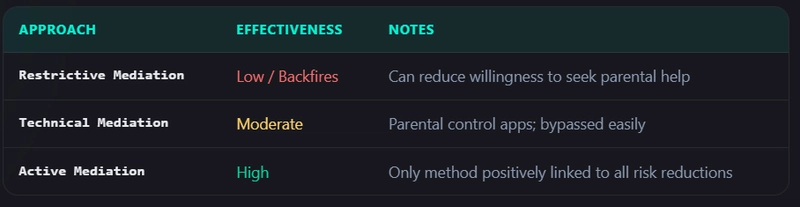
The most powerful protective factor is not parental control apps or screen time restrictions. It is active mediation — non-judgmental joint engagement where parents discuss what their child encounters online, process difficult moments together, and help them learn from negative experiences.
Platform Design Is Not Neutral
Infinite scrolling, autoplay, and visible engagement counters are not random UX choices — they are engineered engagement maximizers that disproportionately harm resource-limited users (i.e., adolescents whose impulse regulation is still developing). Early natural experiments — Instagram's removal of like counts, YouTube's watch-time reminders — show that targeted design changes reduce compulsive use without sacrificing utility.
The Three-Tier Response Framework
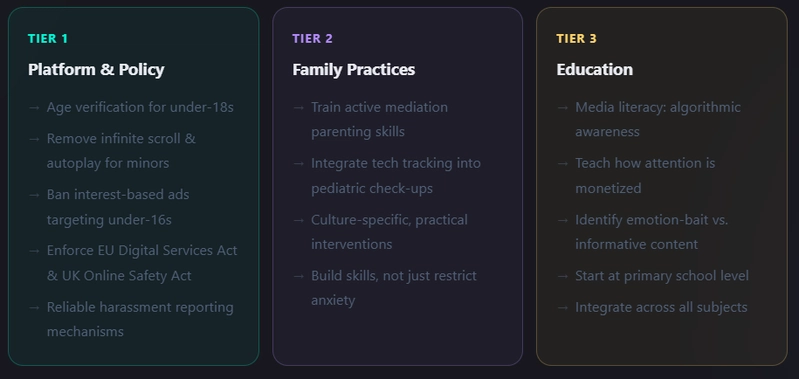
The data makes clear that no single intervention is sufficient. Effective response requires a coordinated three-tier system:
SocialScope v4 — What We Built
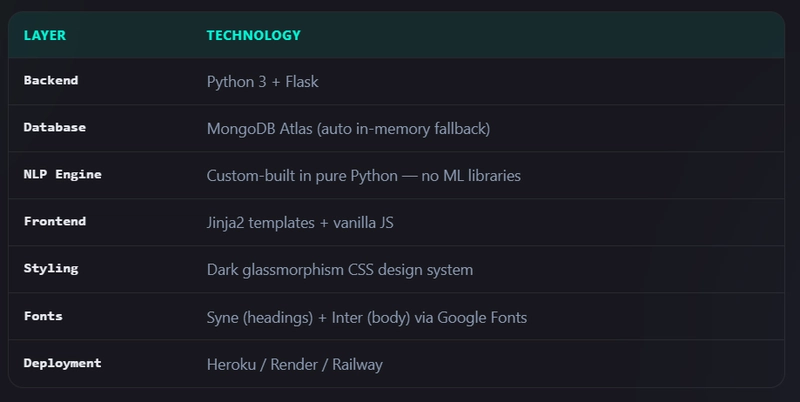
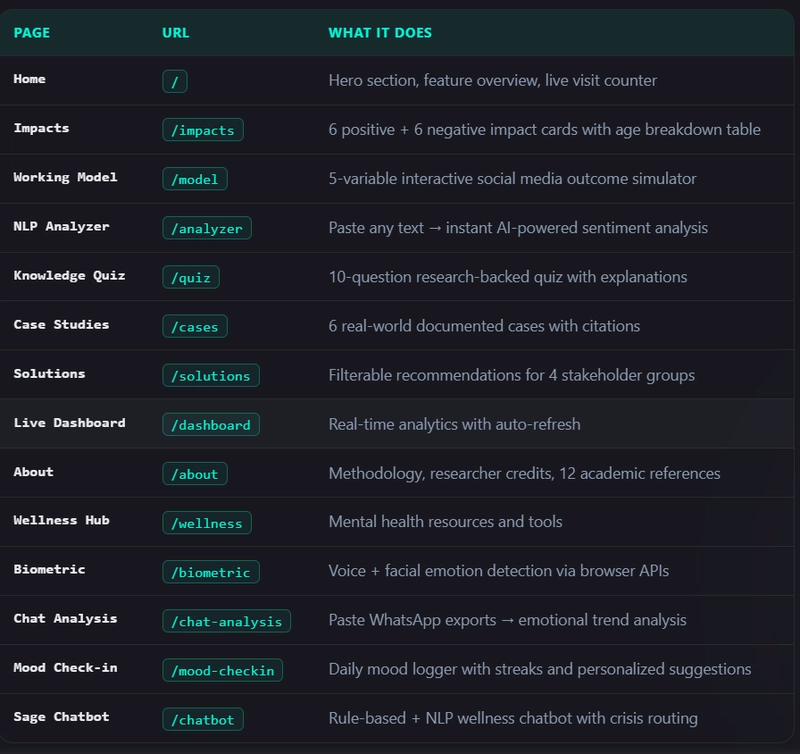
To make our research accessible and interactive, we built SocialScope v4 — a full-stack research web application in Python (Flask) that combines academic content with real, working AI/NLP tools, a chatbot, biometric emotion detection, and a wellness companion. Zero npm. Zero webpack. Zero external ML dependencies.
Quick Start: pip install flask → python app.py → visit http://localhost:5000. That's it. No build step required.
All 14 Pages
The Custom NLP Engine
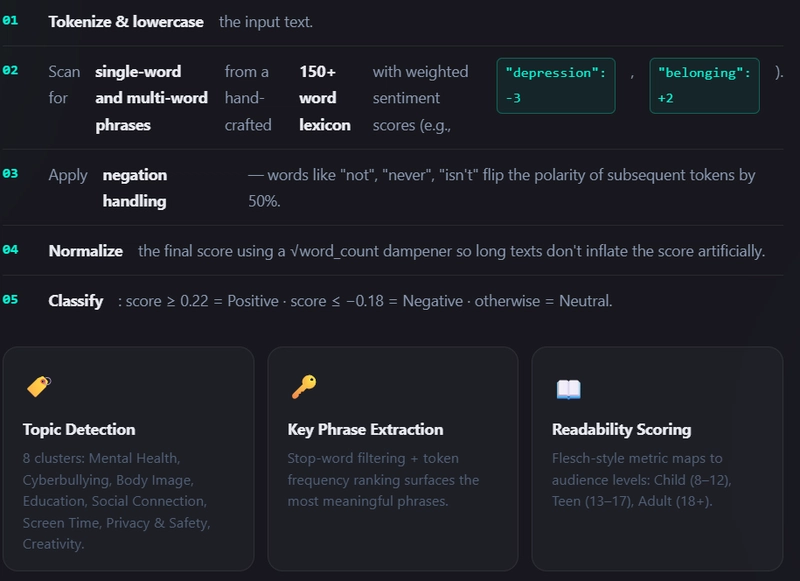
This is the most technically distinctive part of SocialScope. We built a fully custom NLP engine in pure Python — no TensorFlow, no NLTK, no spaCy, no external ML dependencies of any kind. It runs on vanilla Python 3.
How It Works
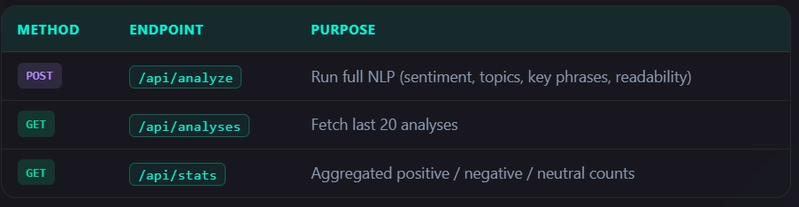
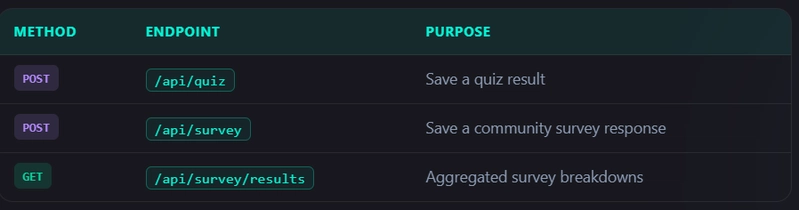
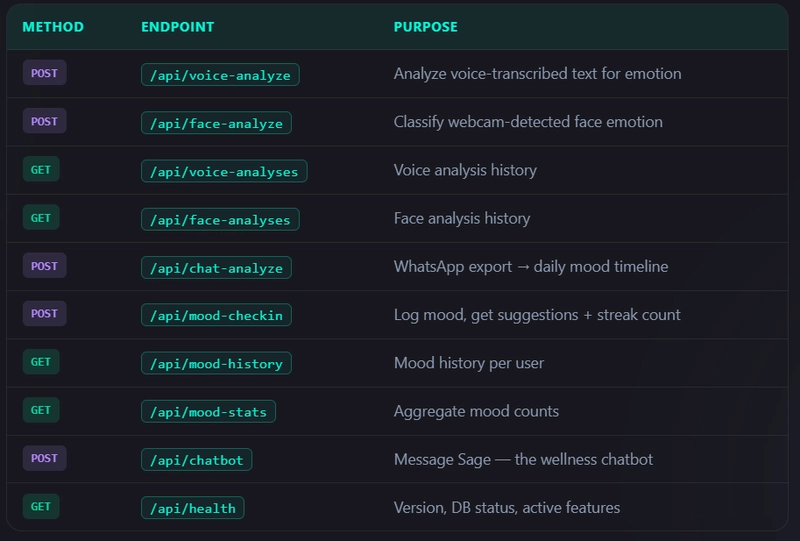
The REST API — 17 Endpoints
Core NLP
Quiz & Survey
Biometric, Chat Emotion, Mood & Chatbot
Feature Deep Dives
Accepts raw WhatsApp export text (up to 100,000 characters) or plain conversations. A regex detects the WhatsApp timestamp format (DD/MM/YYYY, HH:MM — Sender: message) with a plain Sender: text fallback. Each message is analyzed individually, scores are grouped by day, a 7-day mood summary is generated, and the system detects a trend — improving 📈, declining 📉, or stable ➡️ — along with plain-language insights like "Tension detected in last 3 days — try a breathing exercise."
Mood Check-in + Streak System
Users log one of 5 moods: happy, sad, angry, anxious, neutral. Each entry is stored with a user_id and date. The streak calculator walks backwards through sorted unique dates counting consecutive days, returning one of 7 milestone messages — from "Day 1 — every journey starts here!" up to "Legendary! 30 day streak!". Each mood also surfaces curated music recommendations, activity suggestions, and a relevant quote.
Sage AI Chatbot
A rule-based chatbot covering ~20 keyword clusters: greetings, crisis language, negative emotions (sad, depressed, stressed, anxious, angry, lonely, tired), positive states, boredom, activities, social media topics, and bullying. Crisis keywords are checked first (e.g., "suicid", "end my life") and immediately surface Indian crisis hotlines. For unmatched messages, the chatbot falls back to NLP sentiment analysis to pick an emotionally appropriate response from a library of 7 supportive generic replies.
Biometric Page
Voice analysis: the browser's Web Speech API transcribes speech in real time, then sends the text to /api/voice-analyze which runs the full NLP pipeline. Face analysis: face-api.js detects expressions from the webcam feed and sends the dominant detected emotion to /api/face-analyze on the backend for classification and storage.
Database Architecture
The app uses a dual-mode strategy: it attempts to connect to MongoDB Atlas on startup with a 5-second timeout. If that fails (or pymongo isn't installed), it transparently falls back to in-memory Python dicts. All DB operations go through helper functions (db_insert, db_find_recent, db_aggregate_field, etc.) so the rest of the codebase never knows which mode is active.
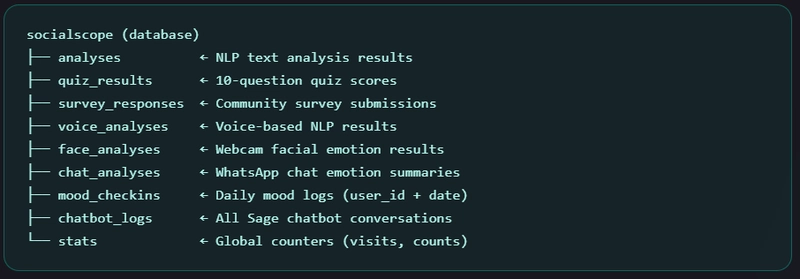
To enable MongoDB persistence: pip install pymongo and update MONGO_URI at the top of app.py with your Atlas connection string. The rest is automatic.
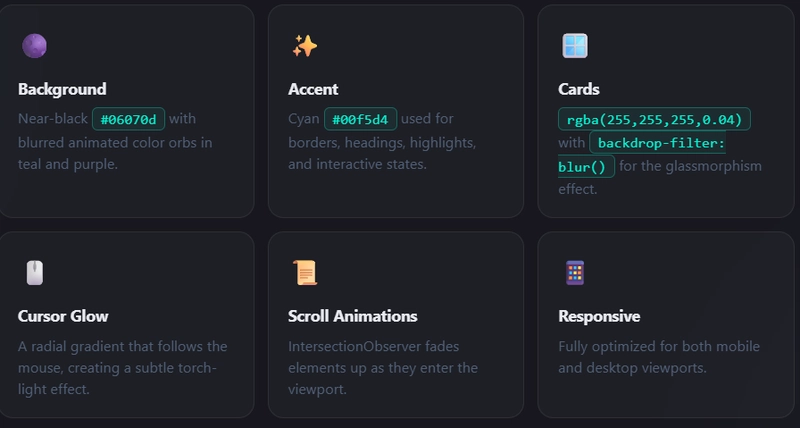
UI Design System
The entire frontend uses a dark glassmorphism aesthetic — the same visual language as this blog post:
Conclusion
Social media is not inherently harmful to adolescents. But neither is it neutral. The evidence from 63 studies and 120,000+ participants across 18 countries is consistent: outcomes depend on usage patterns, individual susceptibility, and structural design choices — not on whether teenagers use social media at all.
The right question is not "should we ban social media for teens?" but "how do we create the structural conditions under which young people can benefit from it?" That means platform redesign, evidence-based parenting support, and media literacy education starting at primary school.
SocialScope v4 embodies that approach — translating peer-reviewed research into a working, deployable platform that puts these tools in the hands of students, educators, and families. Built with a single Python file, 14 interactive pages, a custom NLP engine, and a wellness chatbot — it proves that serious research tooling doesn't need serious infrastructure overhead.
{
  "project": "SocialScope v4",
  "backend": "Flask (Python)",
  "database": "MongoDB Atlas",
  "nlp_engine": "Custom Python (zero ML libs)",
  "frontend": ["Jinja2", "Vanilla JS", "CSS Glassmorphism"],
  "ai_features": ["Sentiment Analysis", "Face Detection", "Voice NLP"],
  "chatbot": "Sage AI (rule-based + NLP)",
  "api_endpoints": 17,
  "pages": 14,
  "deployment": ["Heroku", "Render", "Railway"]
}
Key Takeaway: Design for active engagement. Reduce passive consumption. Educate on algorithmic influence. Support families with practical skills. Hold platforms accountable through law — not voluntary compliance.
GitHub Repository
Demo
▶️ Watch GEOSMART Demo on YouTube
SocialScope v4 is a research-based web app built with Python and Flask that explores how social media affects children and teenagers aged 8–18.
It brings together AI-powered sentiment analysis, a wellness chatbot, mood tracking, and emotion detection — all in one simple, easy-to-run platform with no complex setup.
By turning 63 real research studies into interactive tools, SocialScope makes serious science easy to understand — for students, parents, and educators alike.