








TLDR ;
- Multi-stage Docker builds with BuildKit caching reduce image sizes by 80% and build times by 60%
- Remote build caching shares artifacts across developers and CI, eliminating redundant work
- Parallel pipeline execution runs independent stages simultaneously for faster feedback
- SBOM generation and container signing are now required for European regulated industries
Build systems are the foundation of every CI/CD pipeline. They transform source code into deployable artifacts: container images, binaries, or bundled assets. Slow builds directly impact developer productivity and deployment frequency.
| Team Type | Build Time | Impact |
|---|---|---|
| Elite-performing teams ( DORA State of DevOps Report 2024) | Under 10 minutes | Enables rapid feedback loops for multiple daily deployments |
| Many teams | 20-30 minutes | Tolerated because optimization feels complex |
The reality is simpler. Three techniques cover most optimization: multi-stage Docker builds with layer caching, remote build caches shared across CI infrastructure, and parallel pipeline execution.
For European B2B organizations building cloud-native applications, build systems also need to produce signed artifacts with Software Bill of Materials (SBOM) documentation to satisfy supply chain security requirements. This article covers practical build optimization and security patterns for Kubernetes-targeted applications.
Multi-Stage Docker Builds
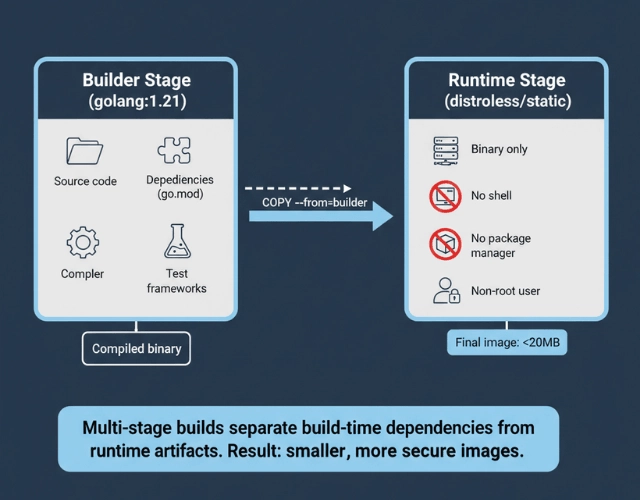
[Source Code] --> [Builder Stage] --> [Runtime Stage] --> [Minimal Image]
                     |                                        |
                [Dependencies]                          [Binary Only]
                [Build Tools]                           [No Shell]
                [Test Frameworks]                       [Non-root User]
Multi-stage builds separate build-time dependencies from runtime artifacts. The builder stage includes compilers, package managers, and test tools. The runtime stage contains only the final binary and its runtime dependencies.
Docker
# Builder stage
FROM golang:1.21 AS builder
WORKDIR /app
go.mod go.sum ./
RUN --mount=type=cache,target=/go/pkg/mod \
    go mod download
. .
RUN --mount=type=cache,target=/go/pkg/mod \
    --mount=type=cache,target=/root/.cache/go-build \
    CGO_ENABLED=0 go build -ldflags="-s -w" -trimpath -o /app/server

# Runtime stage
FROM gcr.io/distroless/static-debian11
--from=builder /app/server /usr/local/bin/
USER nonroot:nonroot
ENTRYPOINT ["/usr/local/bin/server"]
This produces a minimal image with just the Go binary. According to Google's distroless documentation, distroless images contain no shell, no package manager, and no utilities that attackers could exploit. The resulting image is typically under 20MB compared to 800MB+ for a full Ubuntu-based image.
BuildKit cache mounts (--mount=type=cache) persist package manager caches between builds without bloating the final image. Dependency downloads happen once and are reused on subsequent builds.
For Node.js applications, the same pattern applies:
Docker
FROM node:20-alpine AS builder
WORKDIR /app
package*.json pnpm-lock.yaml ./
RUN corepack enable pnpm && pnpm install --frozen-lockfile
. .
RUN pnpm run build

FROM node:20-alpine
WORKDIR /app
--from=builder /app/dist ./dist
--from=builder /app/node_modules ./node_modules
USER node
CMD ["node", "dist/index.js"]
Build Caching Strategies
Caching is the single most impactful build optimization. According to Docker's BuildKit documentation, proper layer ordering and caching can reduce build times by 60-80% on subsequent runs.
Layer ordering matters. Place instructions that change rarely (dependency installation) before instructions that change often (source code copy):
Docker
# Dependencies first (changes rarely)
package.json package-lock.json ./
RUN npm ci

# Source code second (changes often)
. .
RUN npm run build
Remote registry caching shares build cache across your team and CI:
Bash
docker buildx build \
  --cache-from type=registry,ref=registry.example.com/cache \
  --cache-to type=registry,ref=registry.example.com/cache \
  -t registry.example.com/app:v1.2.3 .
First builds populate the cache. Subsequent builds pull cached layers from the registry. This eliminates redundant dependency downloads across CI runners and developer machines.
Monorepo build tools like Turborepo and Nx provide content-addressable caching:
Bash
turbo run build --api="https://cache.example.com" --token="$CACHE_TOKEN"
Changed packages rebuild; unchanged packages use cached outputs. For large monorepos, this transforms 20-minute builds into 2-minute incremental builds.
Remote caching + monorepo tooling = 20-min builds → 2-min builds.
The techniques above work. But configuring remote caches across CI runners and setting up monorepo tooling requires expertise.
We help you:
- Set up remote registry caching – Share build layers across your team and CI
- Implement Turborepo/Nx – Content-addressable caching for monorepos
- Optimize layer ordering – Dependencies first, code last
- Reduce build times by 60-80% – Measurable results
Get Build Optimization Expertise →
Parallel Pipeline Execution
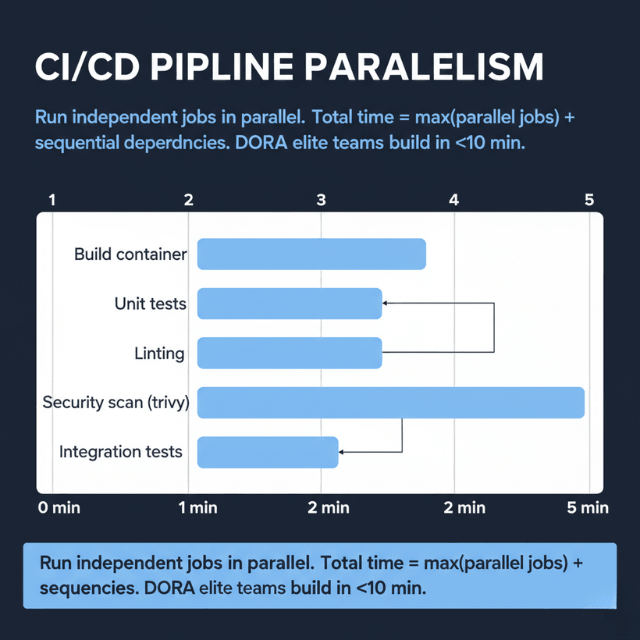
Run independent stages simultaneously instead of sequentially. Build, unit tests, and linting have no dependencies on each other and should run in parallel.
YAML
jobs:
  build:
    runs-on: ubuntu-latest
    steps:
      - uses: actions/checkout@v4
      - name: Build container
        run: docker build -t app:${{ github.sha }} .

  unit-tests:
    runs-on: ubuntu-latest
    steps:
      - uses: actions/checkout@v4
      - name: Run tests
        run: npm test

  security-scan:
    needs: build
    runs-on: ubuntu-latest
    steps:
      - name: Scan image
        run: trivy image app:${{ github.sha }}

  integration-tests:
    needs: build
    runs-on: ubuntu-latest
    services:
      postgres:
        image: postgres:15
    steps:
      - name: Run integration tests
        run: ./run-integration-tests.sh
Build and unit-tests run in parallel. Security scanning and integration tests run after build completes but parallel to each other. According to GitHub Actions documentation, this job dependency model is the standard approach for optimizing workflow execution time.
Build machine sizing impacts cost more than most teams realize
- A machine that costs 4x more per hour but finishes in one-quarter the time costs the same
- Factor in developer wait time → faster machines win decisively
- Most teams underestimate the impact of machine sizing on total cost
Alternative Container Builders
Docker is not the only option for building container images.
| Builder | Best For | Requires Docker Daemon |
|---|---|---|
| Docker BuildKit | General purpose, widest compatibility | Yes |
| Kaniko | Kubernetes-native builds, no daemon needed | No |
| Buildah | Scriptable, fine-grained control | No |
| ko | Go applications, no Dockerfile needed | No |
| Jib | Java applications, no Dockerfile needed | No |
Kaniko runs inside Kubernetes pods, making it ideal for GitOps-driven build pipelines:
YAML
apiVersion: v1
kind: Pod
spec:
  containers:
    - name: kaniko
      image: gcr.io/kaniko-project/executor:latest
      args:
        - "--dockerfile=Dockerfile"
        - "--context=git://github.com/example/app"
        - "--destination=registry.example.com/app:v1.2.3"
        - "--cache=true"
Multi-architecture builds produce images for both amd64 and arm64 platforms:
Bash
docker buildx build \
  --platform linux/amd64,linux/arm64 \
  -t registry.example.com/app:v1.2.3 \
  --push .
Build Security and Supply Chain
Build systems are high-value attack targets. According to Sonatype's State of the Software Supply Chain 2024, supply chain attacks continue to accelerate, making build-time security controls a necessity.
Dependency scanning fails builds on high-severity vulnerabilities:
YAML
- name: Scan dependencies
  run: |
    npm audit --audit-level=high
    snyk test --severity-threshold=high
SBOM generation creates an inventory of all software components:
Bash
syft packages registry.example.com/app:v1.2.3 -o spdx-json > sbom.json
grype sbom.json
Container signing with Sigstore Cosign proves images have not been tampered with:
Bash
cosign sign --yes registry.example.com/app:v1.2.3
For European regulated industries, SBOM documentation and artifact signing satisfy supply chain transparency requirements. Integrate these steps into your pipeline security workflow and enforce signature verification during progressive delivery rollouts.
Optimization Techniques Summary
| Technique | Impact | Implementation |
|---|---|---|
| Multi-stage Docker builds | Minimal image size (20MB vs 800MB+) | Separate builder + runtime stages |
| BuildKit cache mounts | Reduce build times 60-80% | --mount=type=cache |
| Remote registry caching | Share cache across team/CI |
--cache-from / --cache-to
|
| Layer ordering | Maximize cache reuse | Dependencies first, code last |
| Parallel pipeline execution | Reduce total workflow time | Independent jobs run simultaneously |
| Monorepo tooling | 20-min → 2-min incremental builds | Turborepo or Nx |
| Alternative builders | Kubernetes-native, no Docker daemon | Kaniko, Buildah, ko, Jib |
Conclusion
Fast, secure builds are the foundation of a productive CI/CD pipeline. Start with multi-stage Docker builds and BuildKit caching to reduce image sizes and build times. Add remote registry caching to share artifacts across your team. Structure pipeline jobs for parallel execution to minimize total workflow duration.
Layer in supply chain security: dependency scanning, SBOM generation, and container signing. These controls integrate with multi-environment deployment and GitOps workflows to maintain security from build through production.
Frequently Asked Questions
How do I reduce Docker build times?
Three techniques have the most impact: order Dockerfile instructions from least to most frequently changed for better layer caching, use BuildKit cache mounts to persist package manager caches, and implement remote registry caching to share build layers across CI runners.
Should I use distroless images in production?
Distroless Images - Pros and Cons
| Aspect | Assessment |
|---|---|
| Attack surface | Reduced (no shell, no package manager) |
| Image size | Much smaller |
| Debugging | Requires remote debugging tools (no shell) |
| Recommendation | Yes for most workloads. Use debug-tagged distroless images in non-production environments |
What is an SBOM and when do I need one?
SBOM Definition and Requirements:
- SBOM = Software Bill of Materials - a machine-readable inventory of all software components in your artifact
- Required for: Government contracts and regulated industries
- Tools: Generate with Syft during builds; scan with Grype for vulnerabilities