





There are more mobile testing frameworks available in 2026 than ever before and picking the wrong one costs you months. Not in licensing fees, but in setup time, maintenance overhead, and the engineering hours spent fighting flaky tests instead of shipping features.
The problem with most "best frameworks" articles is that they rank tools by popularity instead of fit. Appium is great until your team spends 60% of QA time fixing broken selectors. Espresso is fast until you need iOS coverage. Maestro is simple until you need to test dynamic UIs that change with every A/B experiment.
This guide takes a different approach. We'll walk through the 7 frameworks that matter in 2026, give each one an honest assessment of where it excels and where it struggles, and then help you decide when Drizz a Vision AI testing platform is the right choice for your team.
Key Takeaways
- There's no single "best" framework; the right choice depends on your app type, platform targets, team skills, and how fast your UI changes.
- Appium remains the most flexible cross-platform option but carries the highest maintenance burden at scale.
- Native frameworks (Espresso, XCUITest) offer the best speed and stability but lock you into a single platform.
- Maestro simplifies test authoring with YAML but still relies on element-based identification under the hood.
- Drizz is the strongest fit when your team needs cross-platform coverage, rapid test creation, and near-zero maintenance especially for apps with frequently changing UIs.
How to Think About Framework Selection
Before comparing tools, clarify three things:
1.What are you testing? Native apps, hybrid apps, mobile web, or progressive web apps? Some frameworks only support one type.
2.Which platforms? Android only, iOS only, or both? If both, you need to decide: one cross-platform framework, or two native ones with separate test suites?
3.What's your maintenance tolerance? A framework that's easy to set up but creates a 200-test maintenance burden six months later isn't actually saving time. The total cost of ownership matters more than the getting-started experience.
With that context, let's look at what's available.
The 7 Frameworks That Matter in 2026
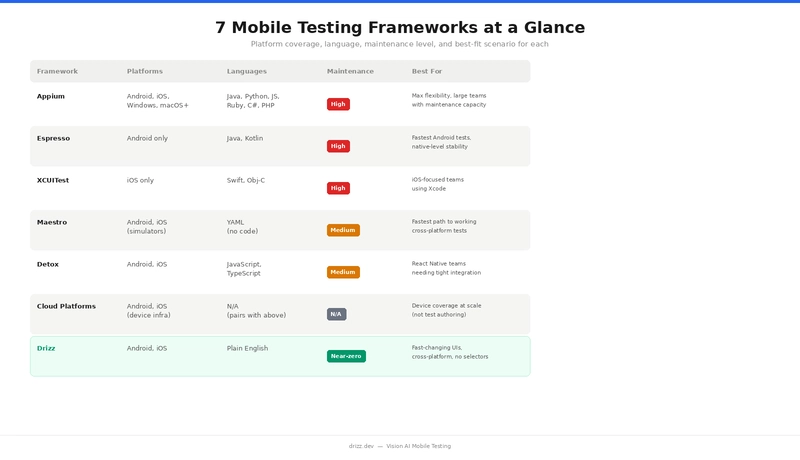
1.Appium
What it is: The open-source industry standard for cross-platform mobile test automation, built on the W3C WebDriver protocol.
Platforms: Android, iOS, Windows, macOS, Tizen, and more. Languages: Java, Python, JavaScript, Ruby, C#, PHP.
App types: Native, hybrid, mobile web.
Cost: Free (Apache 2.0). iOS testing requires macOS and Xcode
Where it excels:
- Broadest platform coverage and deepest ecosystem of any mobile testing framework
- Integrates with every major CI/CD tool and cloud device lab
- Manageable learning curve for teams with Selenium experience
- 17,000+ GitHub stars, OpenJS Foundation backing it's not going anywhere
Where it struggles:
- Test maintenance is Appium's Achilles heel every test depends on element locators that break when the UI changes
- At scale (200+ tests across a fast-moving app), teams routinely spend 60-70% of QA time fixing broken selectors
- Complex setup: Node.js, JDK, Android SDK, platform drivers, environment variables first-time configuration takes half a day
Best for: Large teams with strong engineering capacity that need maximum platform flexibility and can absorb the maintenance overhead.
2. Espresso
What it is: Google's official UI testing framework for Android, built into Android Studio.
Platforms: Android only.
Languages: Java, Kotlin.
App types: Native Android.
Cost: Free.
Where it excels:
- Runs inside the app process extremely fast and stable
- Automatically synchronizes with the UI thread, reducing flaky tests
- Integrates natively with Android Studio no additional setup
- Test execution speed is significantly faster than Appium on Android
Where it struggles:
- Android only if you need iOS coverage, you need a separate framework and test suite
- Requires Java or Kotlin steeper learning curve for QA teams not comfortable with those languages
Best for: Android-focused teams who want the fastest, most stable test execution and are willing to maintain a separate iOS solution.
3.XCUITest
What it is: Apple's native UI testing framework, built into Xcode.
Platforms: iOS only.
Languages: Swift, Objective-C.
App types: Native iOS.
Cost: Free (requires macOS and Xcode).
Where it excels:
- Tightly integrated with the iOS development ecosystem
- Tests run directly through Xcode with access to native debugging and performance profiling
- Fast and stable operates within the platform's native toolchain
Where it struggles:
- iOS only no Windows or Linux option, and you need a completely separate framework for Android
- Requires manual synchronization in some cases (unlike Espresso's auto-sync)
- Swift/Objective-C requirement limits who on your team can write tests
Best for: iOS focused teams who build in Xcode and want native level reliability without additional tooling.
4. Maestro
What it is: A YAML-based UI testing framework for Android and iOS, designed for simplicity.
Platforms: Android (emulators and real devices), iOS (simulators).
Languages: YAML (no code required).
App types: Native, hybrid, web. Supports React Native, Flutter, Swift, Kotlin.
**Cost: **Free (MIT). Paid cloud execution via Maestro Cloud.
Where it excels:
- Easiest framework to get started with tests written in plain YAML, no Java or Python
- Handles UI synchronization automatically, dramatically reducing flakiness vs Appium
- Minimal setup: install CLI, point at your app, write your first test in minutes
- 10,800+ GitHub stars and strong community momentum
Where it struggles:
- Still identifies elements through the accessibility and UI layer not entirely immune to locator-based fragility
- iOS testing limited to simulators (no real device support in the open-source version)
- Complex scenarios like custom gestures, deep native interactions, or system-level testing can hit limits
Best for: Teams that want the fastest path from zero to working cross-platform tests, especially for straightforward user flows.
5. Detox
What it is: A gray-box end-to-end testing framework built specifically for React Native.
Platforms: Android, iOS.
Languages: JavaScript/TypeScript.
App types: React Native (primary), with some support for native apps.
Cost: Free (MIT).
Where it excels:
- Built by Wix specifically for React Native the most tightly integrated option for RN apps
- Monitors internal app state (animations, network requests, UI settling) for exceptional stability
- If your entire app is React Native, nothing else matches Detox's reliability
Where it struggles:
- If your app isn't React Native, Detox isn't the right tool
- Requires some app instrumentation for optimal results
- Struggles with system-level elements (permissions dialogs, push notifications) outside the React Native bridge
Best for: React Native teams who want the most reliable end-to-end testing with minimal flakiness.
6. Cloud Device Platforms (BrowserStack, Sauce Labs, Perfecto)
What they are: Cloud-based real device labs that provide infrastructure for running your tests across thousands of device/OS combinations.
Important distinction: These are not test authoring frameworks. They don't help you write tests, they provide the devices to run them on. You still need a framework (Appium, Espresso, XCUITest, Maestro) to author and execute your tests.
Where they excel:
- Device coverage at scale test across 50+ device/OS combinations without maintaining a physical lab
- Integrate with all major frameworks and CI/CD tools
- BrowserStack, Sauce Labs, and Perfecto are the established leaders
Where they struggle:
- They solve device fragmentation, not test fragility
- If your Appium tests break from locator drift, they'll break the same way on BrowserStack just across more devices simultaneously
Best for: Any team that needs broad device coverage without the operational burden of managing physical devices.
7. Drizz Vision AI: The Next Wave of Mobile Testing
Every framework above from Appium to Maestro shares one architectural assumption: to interact with a UI element, you need to identify it through the app's internal structure. Whether that's an XPath, an accessibility ID, a resource ID, or a YAML reference, the test is ultimately pointing at something in an element tree. Drizz represents a fundamentally different approach that's emerging as the next evolution in mobile test automation.
What it is: A Vision AI mobile testing platform that sees your app the way a human tester does through the rendered screen, not the element tree.
Platforms: Android, iOS.
Languages: Plain English test definitions.
App types: Native, hybrid.
Cost: Contact for pricing.
Where it excels:
- Tests are written by describing what you see: "tap the Login button," "type into the email field," "verify the dashboard is visible" no locators, no selectors, no element trees
- The Vision AI identifies elements visually, the same way a human would by recognizing text, layout, and visual context on the rendered screen
- When a developer refactors a screen or changes a resource-id, tests keep passing because the button still looks like "Login" on screen
- Test stability sits at 95%+ compared to 70-80% typical of selector-based frameworks
- Setup is minimal: upload your APK or IPA, connect a device, start writing tests no Node.js, no JDK, no environment variables
- Teams report having 20 critical test cases running in CI/CD within a day
Where it struggles:
- Newer to the market than established frameworks like Appium and Espresso the ecosystem and community are still growing
- For teams that need deep native device interactions (sensor data, biometric testing, low-level OS APIs), traditional frameworks still offer deeper control
- If your app's UI has no visible text or distinguishing visual elements (rare, but possible in icon-heavy interfaces), visual identification has less to work with
Best for: Teams where the UI changes faster than the test suite can keep up with frequent releases, A/B testing, dynamic content and where the maintenance cost of selector-based testing has become the bottleneck, not the solution.
Decision Framework: When to Choose What
Rather than ranking frameworks, here's a practical decision guide based on your situation:
- Choose Appium if your team has strong engineering capacity, you need the broadest platform coverage possible, your UI is relatively stable, and you can invest in locator maintenance.
- Choose Espresso if you're Android-only, you want the fastest possible test execution, and your team writes Java or Kotlin.
- Choose XCUITest if you're iOS-only, you develop in Xcode, and you want native-level integration.
- Choose Maestro if you want the simplest possible getting-started experience, your test flows are straightforward, and you're comfortable with simulator-only iOS testing.
- Choose Detox if your app is React Native and you want the tightest framework integration.
- Choose a Cloud Platform if you need device coverage at scale but pair it with one of the above frameworks for test authoring.
Choose Drizz if you check two or more of these boxes:
- Your app ships UI updates weekly or more frequently
- Your team has spent significant time maintaining broken selectors
- You need cross-platform coverage (Android + iOS) without maintaining separate test suites
- Your QA team includes manual testers who aren't comfortable writing Java or Python
- You run A/B tests, personalized UIs, or dynamic content that breaks locator-based tests
- You want your 20 most critical test cases running in CI/CD within a day, not a sprint
The Maintenance Question Nobody Asks
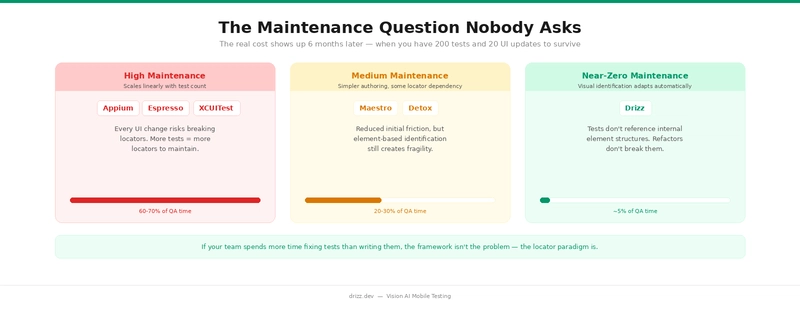
Most framework comparisons focus on setup and features. But the real cost of a mobile testing framework shows up six months after adoption when you have 200 tests, your app has shipped 20 UI updates, and someone has to keep everything passing.
Here's how the frameworks compare on long-term maintenance:
- High maintenance (scales linearly with test count): Appium, Espresso, XCUITest. Every UI change risks breaking locators. More tests = more locators to maintain.
- Medium maintenance: Maestro, Detox. Simpler authoring reduces initial friction, but element-based identification still creates some locator dependency.
- Near-zero maintenance: Drizz. Visual identification adapts to UI changes automatically. Tests don't reference internal element structures, so refactors don't break them.
If your team currently spends more time fixing tests than writing them, the framework isn't the problem the locator paradigm is. That's the specific problem Drizz was built to solve.
Getting Started with Drizz
If your situation matches the criteria above:
- Download Drizz Desktop from drizz.dev
- Connect your device USB or emulator
- Upload your app build No SDK changes, no accessibility ID requirements
- Write tests in plain English Describe the user flow as you'd explain it to a colleague
- Run and iterate Vision AI handles element identification, interaction, and verification
FAQ
Which mobile testing framework is best for beginners?
Maestro and Drizz have the lowest learning curves. Maestro uses YAML and requires no coding. Drizz uses plain English test steps and eliminates the need to learn locator strategies entirely. Appium and Espresso require programming experience and take weeks to become productive with.
Can I use multiple frameworks together?
Yes. Many teams use Espresso or XCUITest for fast unit-level UI tests in their development workflow, then use a cross-platform tool (Appium, Maestro, or Drizz) for end-to-end regression testing. Cloud platforms like BrowserStack layer on top of any framework for device coverage.
Is Appium still worth learning in 2026?
Yes. Appium remains the most widely used mobile testing framework and understanding it is valuable for any QA career. However, for new test suites, especially on fast-moving apps, teams are increasingly choosing alternatives that reduce the maintenance burden Appium creates at scale.
How does Drizz handle apps with no visible text?
Drizz's Vision AI identifies elements using visual context beyond just text, including icons, layout position, colour, shape, and surrounding elements. For apps that are heavily icon-based, you can describe elements by their visual appearance and position (e.g., "tap the search icon in the top right").
Can Drizz integrate with CI/CD pipelines?
Yes. Drizz integrates with GitHub Actions, Jenkins, Bitrise, CircleCI, and other CI/CD tools. Tests can run automatically on every build, PR, or scheduled interval just like any other testing framework.
What's the difference between Drizz and Maestro?
Both simplify test authoring compared to Appium. Maestro uses YAML and interacts through the accessibility layer, simpler than Appium but still element-based. Drizz uses Vision AI to identify elements visually, eliminating locator dependency entirely. The practical difference shows up in maintenance: Maestro tests can still break when accessibility identifiers change; Drizz tests adapt to visual changes automatically.