








We’ve all been there. It’s a Friday afternoon, a deployment just went out, and suddenly the production reporting service crashes.
After an hour of frantic debugging, you find the culprit: a junior developer added a new AWS SES environment variable to the staging .env file but forgot to notify the Ops team to add it to production.
As a Cloud Operations Engineer, troubleshooting missing configurations across environments (dev, staging, prod) is my daily bread and butter. The standard approach? Just use diff.
But if you've ever tried to diff .env files or Key-Value configs, you know it quickly turns into a nightmare.
The Problem with Standard diff
Standard diff is a legend, but it operates purely on literal lines. It completely breaks down with configuration files because:
-
Order doesn't matter, but
diffcares: Secrets Managers (like AWS SSM or Vault) rarely preserve the order of keys when pulling configs. -
Delimiters change: PM2 might output variables using a
:delimiter, while standard.envfiles use=. - Quoting styles differ: Some tools wrap values in double quotes, while others leave them bare.
You could write a bash script with sort, sed, and awk to normalize everything before diffing, but doing that during a live incident is the last thing you want.
Enter Qaren: A Semantic Config Diff Tool
I needed a tool that natively understood Key-Value semantics. It needed to ignore order, ignore delimiter formats, and ignore quoting differences. And most importantly, it needed to be fast.
So, I built Qaren in Rust.
Qaren is a single ~1MB static binary that parses config files, understands their semantics, and outputs a beautiful, unified, colored diff showing exactly what is missing or changed. You can even run qaren kv -g patch.env to automatically generate a patch file of the missing keys (with zero-trust secret masking).
The Performance Flex: Beating POSIX diff
I wanted Qaren to be my daily driver, which meant it also needed to work perfectly as a fallback literal diff tool for massive log files or database dumps.
Initially, my literal diff implementation was getting crushed by GNU POSIX diff. Comparing two 328MB log files took Qaren 4.3 seconds, while diff did it in 2.5s.
After some profiling, I found the bottlenecks:
- Eager
Stringallocation. - Full UTF-8 validation via
read_to_string.
To fix this, I implemented a "fast path". When no ignore-flags (like ignore-case) are passed, Qaren bypasses UTF-8 validation entirely, reading the files as raw bytes (std::fs::read into &[u8]). I paired this with lazy iteration using the similar crate and parallel directory traversal using rayon.
The Results? It now consistently beats highly-optimized GNU diff on massive files.
Here are the hyperfine benchmarks testing two 1.1GB directories:
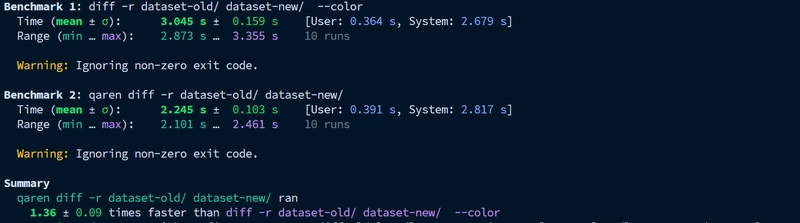
Note: I use --color flag to fair measurement as qaren colored by default
And here is the 328MB single file stress test:
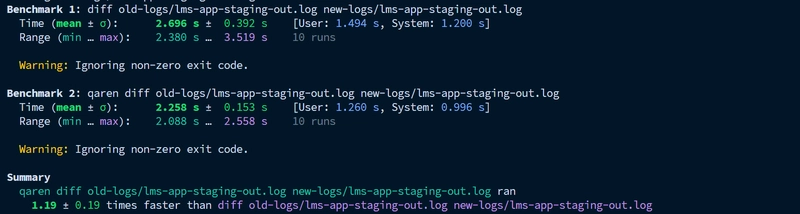
Demo
Compare entire directory structures, identifying orphan files and differences in existing ones.

Exclude known dynamic or irrelevant keys from comparison.

Export results in machine-readable format for automation.

Try it out
Building Qaren has been an incredible journey into systems programming and performance engineering in Rust. It's completely open-source, and I'd love for the community to tear the code apart, try it in your CI/CD pipelines, and let me know what you think.
If you find it useful, a ⭐ on GitHub would mean the world to me! Let me know in the comments how you handle configuration drift in your environments