The way to get good ideas is to get lots of ideas and throw the bad ones away." — Linus Pauling.
In a world dominated by AI, coming up with ideas is no longer the greatest challenge (“Just prompt it,” they say). The real challenge lies in selecting the right ideas. And I know you’re probably thinking, “What is he on about? I can use AI for that too.”
Join me for a few minutes as I babble about a well-proven framework for idea screening.
Why Is It Important to Use a Proven Framework to Screen Ideas?
I know you’re probably asking yourself, “Why not just follow my gut?” Yeah, about that ... we could learn a thing or two from food. Food goes through your mouth, smells nice, follows your gut, and then comes out as sh*t.
What Is It We Are Talking About?
The process of screening opportunities is all about asking questions, and there are not many. All you have to do is ask these three questions:
- Is it REAL?
- Can we WIN?
- Is it WORTH IT?
Those three bad boys combined form a framework called the Real-Win-Worth (RWW). If we are to combine those three into a Venn diagram in the middle, there is a sweet spot, and that's what they call INNOVATION. Your idea needs to answer those three questions to become a great opportunity.
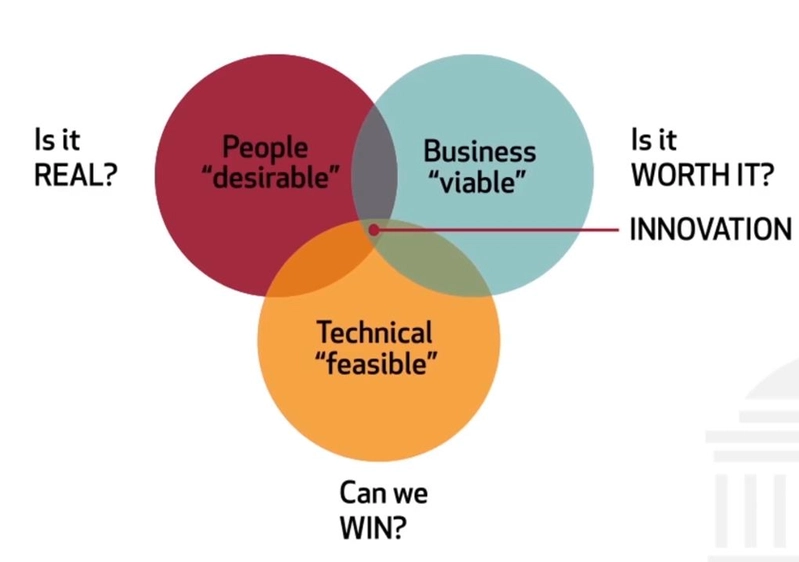
By the way, I am not smart enough to come up with a framework like that, thanks to George Day.
The Breakdown
Now that we have the questions, let's go one by one, asking each question in detail.
Is it REAL?
The Real Dimension or the People Dimension. Here, you need to determine whether there are real people who can benefit from your so-called great idea. It could be you asking yourself: Would I really benefit from what I want to do? Is it really a problem that I should be solving?
In terms of business opportunities, you need to ask: Is the opportunity real? Does someone out there actually want this? Is there a market for it? How big is that market? Is there a genuine unmet need?
In summary, is there a customer with this problem who is willing to pay to solve it? If the REAL is not making real sense, stop being delulu and reflect right away.

Can we WIN?
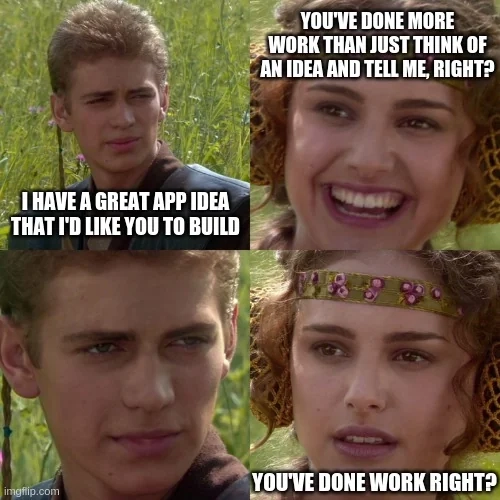
The Technical Dimension or the Win Dimension. Here, you need to ask yourself whether you’ve got what it takes. At this stage, managing delusions has to be on another level. You need to honestly assess yourself and take a hard look at the competition. I appreciate my non-technical friends who always approach me with their crap APP ideas. Kudos for not being delulu.
From a business perspective, ask: Can we deliver? Do we have the necessary resources? Can we solve the problem in a technically feasible way? Do we truly believe we have a better solution? And can we build a real competitive advantage?
Is it WORTH IT?
The Business Dimension or the Worth Dimension. Here, you need to ask yourself whether you have the money to do it and, after putting your money into it, whether you’re going to get some money out of it.
From a business perspective, you’re looking at overall viability. Is it worth it? Is it financially viable? That means building a business around it that is both viable and sustainable.
Why Is It Important for Your Opportunity to Answer All Three Questions?
Your idea needs to be balanced across all three aspects. If it scores highly on all three, you may be onto something special. If it falls short in any one of them, you’ll eventually find out. In Japan, they call it a Chindogu.
Chindogu is the art of inventing ingenious yet "un-useless" gadgets designed to solve everyday problems, while actually creating more problems than they solve (Kenji Kawakami).
Have some time to take a look at the Chindogu website. There are examples of ideas that are weak in different dimensions that we have talked about.
Take a look at the following ideas, they are just incredible, aren't they? Truth is, nobody is ever paying for those kinds of solutions.

That’s it for today. Thank you for wasting your time. Let’s not get addicted to AI, alright?