





When you ask a cloud-based AI agent to "summarize my last 20 emails" or "fill out this expense report from my receipts," you're making an implicit trade: convenience for control. Your screenshots, your documents, your workflow patterns — all uploaded to someone else's infrastructure, processed on someone else's GPUs, stored under someone else's data retention policy.
For many developers and enterprise users, that trade is becoming harder to justify.
This article explores the technical architecture behind running AI agents entirely on local hardware — no cloud round-trips, no data exfiltration, no API keys required — and how a 4B-parameter model running on Apple Silicon can match or exceed cloud-hosted alternatives on GUI automation benchmarks.
The Cloud Dependency Problem
Most AI agent frameworks today follow a predictable pattern:
- Capture screen state (screenshot, DOM, accessibility tree)
- Send it to a cloud API (OpenAI, Anthropic, Google)
- Receive action instructions
- Execute locally
- Repeat
This works. But it has structural problems that no amount of prompt engineering can fix:
Latency compounds. Each action in a multi-step workflow requires a round-trip. A 10-step task that takes 500ms per API call adds 5 seconds of pure network overhead — before you account for token generation time on the server side.
Data leaves the device by design. Screenshots contain everything visible on screen: open tabs, notification previews, partial passwords in terminal windows, private messages, financial data. The agent doesn't selectively capture — it sees what you see.
Cost scales with usage. Vision API calls with screenshot inputs are expensive. A power user running an agent for 8 hours might generate hundreds of screenshots, each consuming thousands of tokens.
Availability depends on infrastructure you don't control. API rate limits, outages, region restrictions, and policy changes can break your workflow without warning.
None of these are hypothetical. They're the everyday reality of cloud-dependent agent architectures.
What "Edge-Native" Actually Means
Edge-native AI isn't just "smaller model on a laptop." It's a fundamentally different architecture where the entire inference loop — perception, reasoning, and action — runs on the device where the work happens.
Mano-P (GUI-Aware Agent Model for Edge Devices, open-source under Apache 2.0) is built around this principle. The name comes from "Mano" (Spanish for "hand") and "P" (Person & Party) — an agent that works with its hands, for its person.
Here's the architecture:
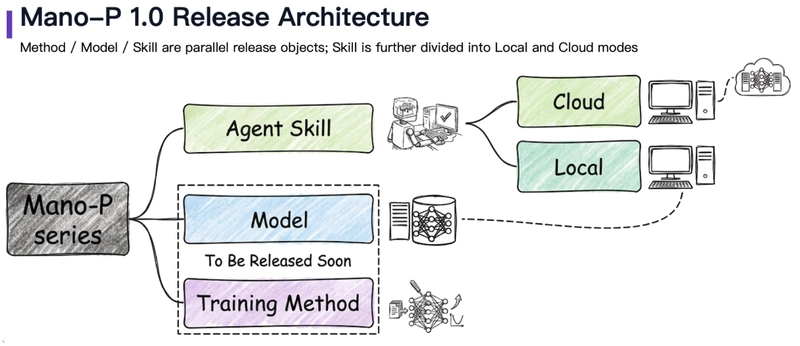
The key design decision: Mano-P uses vision-only understanding. It looks at screenshots — raw pixels — rather than parsing HTML, querying accessibility APIs, or injecting JavaScript into the DOM. This matters for edge deployment because:
- No application-specific adapters. The same model works on browsers, native apps, terminal windows, and 3D tools.
- No privilege escalation required. Screen capture is a standard OS capability. DOM injection and accessibility API access often require elevated permissions.
- Reduced attack surface. The agent reads pixels. It doesn't hook into application internals.
In local mode, screenshots and task data never leave the device. There's no telemetry endpoint, no "anonymous usage data" upload, no cloud fallback. The inference happens on your hardware, and the data stays on your hardware.
Running a 4B Model on Apple Silicon
The practical question is: can edge hardware actually run a capable agent model at interactive speeds?
Here are measured numbers on an Apple M4 Pro with 32GB unified memory:
| Metric | Value |
|---|---|
| Model size | 4B parameters (w4a16 quantization) |
| Prefill throughput | 476 tokens/s |
| Decode throughput | 76 tokens/s |
| Peak memory | 4.3 GB |
Let's break down why these numbers matter.
476 tokens/s prefill means the model can ingest a screenshot (encoded as visual tokens) and the task context in well under a second. This is the "reading" phase — where the model processes what it sees on screen.
76 tokens/s decode means action generation (the "writing" phase — outputting what to click, type, or scroll) takes roughly 100-300ms for a typical action sequence. This is fast enough for real-time interaction.
4.3 GB peak memory means the model fits comfortably alongside your normal workload. On a 32GB machine, you have ~28GB left for browsers, IDEs, design tools — whatever the agent is supposed to be automating.
The w4a16 quantization scheme (4-bit weights, 16-bit activations) is the key enabler here. It reduces the model's memory footprint by roughly 4x compared to fp16, while preserving activation precision where it matters most — in the attention and reasoning layers.
Apple Silicon's unified memory architecture is particularly well-suited for this workload. There's no PCIe bottleneck between CPU and GPU memory; the model weights, the screenshot tensor, and the action output all live in the same memory space. The Neural Engine and GPU cores can be dispatched to different parts of the inference pipeline without data copies.
For machines without sufficient local compute, Mano-P also supports offloading to a compute stick connected via USB 4.0 — effectively adding a dedicated inference accelerator without changing the data sovereignty model (the stick is still physically local).
Benchmark Performance: Does Local Mean Worse?
The assumption that smaller, local models must sacrifice capability is worth testing empirically.
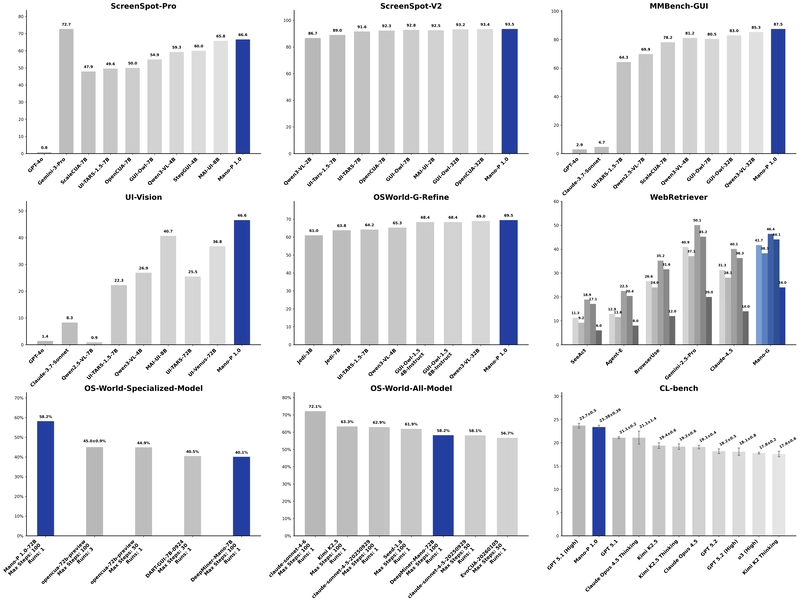
On OSWorld — a benchmark that tests agents on real desktop environments across operating systems — Mano-P achieves a 58.2% success rate, compared to 45.0% for the second-place model. This isn't a narrow domain-specific benchmark; OSWorld tests general GUI automation across diverse applications and multi-step workflows.
On WebRetriever Protocol I, Mano-P scores 41.7 NavEval, ahead of Gemini 2.5 Pro (40.9) and Claude 4.5 (31.3).
These results suggest that the "edge tax" — the performance cost of running locally instead of in the cloud — can be zero or negative when the model architecture is specifically designed for the task. A 4B model trained and optimized for GUI understanding can outperform much larger general-purpose models that treat GUI automation as one capability among many.
The Training Pipeline: How a Small Model Gets Good
Model size alone doesn't explain the benchmark results. The training methodology matters more at this scale because every parameter has to earn its keep.
Mano-P's training follows a three-stage progression:
Stage 1: Supervised Fine-Tuning (SFT). The base model is trained on curated GUI interaction datasets — screenshots paired with correct action sequences. This gives the model foundational competence in visual grounding (mapping screen regions to semantic elements) and action generation.
Stage 2: Offline Reinforcement Learning. Using collected interaction trajectories, the model learns from both successful and failed attempts. This stage improves multi-step planning — the ability to reason about sequences of actions rather than reacting to each screenshot independently.
Stage 3: Online Reinforcement Learning. The model interacts with live environments and learns from real outcomes. A think-act-verify loop ensures the model checks whether its actions achieved the intended result before proceeding. This is where the model develops robustness — learning to recover from unexpected states, handle loading delays, and adapt to UI variations.
An additional technique called GS-Pruning (Gradient-based Structured Pruning) removes redundant model capacity after training, further reducing the model size without proportional capability loss. This is how you get a 4B model that punches above its weight class.
What This Enables
When an AI agent runs entirely on your device with no cloud dependency, certain use cases become possible that were previously impractical or unacceptable:
Sensitive workflow automation. Automating tasks that involve medical records, legal documents, financial data, or classified information — where uploading screenshots to a third-party API would violate compliance requirements.
Air-gapped environments. Research labs, government facilities, and financial trading floors often operate without internet access. A local agent works regardless of network state.
Consistent performance. No API rate limits, no cold starts, no "the service is experiencing high demand" degradation. The model runs at the same speed whether it's Monday morning or Friday night.
Cost predictability. The hardware is a one-time cost. There's no per-token billing, no surprise invoices, no pricing changes.
Beyond single-device automation, the core capabilities extend to cross-system data integration (working across multiple apps to consolidate information), long-task planning (breaking complex goals into executable sequences), and intelligent report generation (synthesizing information from multiple sources into structured output).
Open Source Roadmap
Mano-P is released under Apache 2.0 with a three-phase open-source plan:
- Phase 1 (released): Skills — the agent's capability modules for specific task domains
- Phase 2: Local models and SDK — the inference runtime and developer integration tools
- Phase 3: Training methods — the full pipeline so others can train specialized models
The phased approach is deliberate. Phase 1 lets developers use and evaluate the agent immediately. Phase 2 gives them the tools to integrate it into their own products. Phase 3 enables the community to extend the model to new domains and hardware platforms.
The Bigger Picture
The shift from cloud-dependent to edge-native AI agents isn't primarily a technical argument. It's an architectural one.
Cloud APIs are shared infrastructure. They're powerful, convenient, and constantly improving. But they come with structural constraints — latency, cost, data exposure, availability — that are inherent to the architecture, not bugs to be fixed.
Edge-native agents trade cloud-scale compute for data sovereignty, predictable performance, and zero marginal cost. For many workflows — especially those involving sensitive data or requiring low-latency interaction — that's a trade worth making.
The benchmark results suggest it doesn't have to be a trade at all. A well-designed, well-trained 4B model running on consumer hardware can match or exceed cloud-hosted alternatives on practical GUI automation tasks.
The code is on GitHub: github.com/Mininglamp-AI/Mano-P
If your data matters enough to keep it on your device, your AI agent should be able to stay there too.