


🧘 The Final Lesson
We’ve travelled a long road together.
- Article 1 – Every Software Architecture Is a Lie. Here’s Why That’s OK.
- Article 2 – How AWS Secretly Breaks the Laws of Software Physics (And You Can Too)
- Article 3 – Microservices Destroyed Our Startup. Yours Could Be Next.
- Article 4 – The $15 Million Mistake That Killed a Bank (And What It Teaches You)
- Article 5 – Your “Perfect” Decision Today Is a Nightmare Waiting to Happen.
- Article 6 – 6 Tools That Will Save You From Architecture Hell (No Buzzwords)
Now we arrive at the capstone – the mindset that ties everything together.
“There is no perfect architecture. There is only the architecture that fails in the least painful way, that you can evolve out of, and that your team can actually build.”
This is the Zen of Architectural Pragmatism – the art of making peace with imperfection, leading through uncertainty, and knowing when to stop designing and start delivering.
🎭 The Myth of the “Perfect Architecture”
Why We Chase Perfection
Architects are trained to solve problems. We love clean diagrams, elegant layers, and beautiful trade‑offs. The industry rewards us for predicting the future – “We’ll need to handle 10 million users” – even when that future is imaginary.
The result: Over‑engineering, analysis paralysis, and architectures that are theoretically perfect but practically unusable.
The Truth That Sets You Free
| The Myth | The Reality |
|---|---|
| “We can design it right the first time.” | Every architecture has hidden flaws. You’ll discover them in production. |
| “We can predict future requirements.” | You can’t. The best you can do is build reversible decisions. |
| “Best practices are universal.” | Best practices are context‑dependent. What works for Google will kill a startup. |
| “We can eliminate all trade‑offs.” | Trade‑offs are physics. You can only choose which ones hurt the least. |
The mature architect’s mantra: “I will be wrong. My job is to be wrong in ways I can recover from.”
🧠 The Mature Architect’s Mindset (7 Key Shifts)
Shift #1: From “Predicting the Future” to “Preserving Optionality”
- Old thinking: “Let’s lock in AWS DynamoDB now because we’ll need unlimited scale.”
- New thinking: “Let’s use PostgreSQL with a repository abstraction. If we outgrow it, we can migrate. That’s a two‑way door.”
Real‑time example: Basecamp (37signals) ran on a single MySQL server for years while serving millions of users. They delayed sharding until the pain was real – and when they finally sharded, they had clear data on the right boundaries.
Shift #2: From “Perfect Isolation” to “Controlled Leakage”
- Old thinking: “All modules must be completely decoupled.”
- New thinking: “Some coupling is inevitable. Let’s make it explicit, documented, and monitored.”
Real‑time example: The bank’s ESB tried to isolate everything – and created a single point of failure. AWS Cells, by contrast, accepts that cross‑cell operations are impossible – that’s controlled leakage.
Shift #3: From “Big Rewrites” to “Incremental Strangling”
- Old thinking: “Let’s rewrite the monolith in Rust. It’ll be cleaner.”
- New thinking: “Let’s use the Strangler Pattern – peel off one module at a time, keeping the old system alive until the new one proves itself.”
Real‑time example: Microsoft rewrote Skype’s backend from a peer‑to‑peer monolith to a cloud‑native system. They did it over 3 years, running both systems in parallel, migrating users gradually. The old system was only turned off when the new one had 100% feature parity.
Shift #4: From “Gold Plating” to “Just Enough Architecture”
- Old thinking: “We need a service mesh, a message broker, a distributed tracing system, and a chaos monkey.”
- New thinking: “What’s the simplest thing that could possibly work? We can add complexity when we feel the pain.”
Real‑time example: The startup from Article 3 should have stayed with a modular monolith. The “just enough” architecture would have been: one codebase, one database, well‑defined modules, and CI/CD that deploys 10x/day.
Shift #5: From “Blame” to “Blameless Post‑Mortems”
- Old thinking: “Who caused this outage?”
- New thinking: “What about our architecture made this failure possible? How do we redesign so it can’t happen again?”
Real‑time example: After the 2017 S3 outage, AWS published a detailed, blameless post‑mortem – not pointing fingers at the engineer who typed the wrong command, but explaining how the system allowed a single command to take down so much. They then redesigned the metadata layer to be cell‑aware.
Shift #6: From “Architecture Astronauts” to “Pragmatic Shipbuilders”
- Old thinking: “Let’s spend three months designing the perfect event‑sourced, CQRS, DDD‑compliant masterpiece.”
- New thinking: “Let’s build a simple CRUD app, ship it in two weeks, and see what the real pain points are.”
Real‑time example: Stripe’s first version was a simple monolith with a few endpoints. They added complexity only when they had customers demanding it. The result: they shipped in months, not years.
Shift #7: From “Certainty” to “Confident Uncertainty”
- Old thinking: “I must be 100% sure before making a decision.”
- New thinking: “I am 60% sure, but I have a reversibility plan, a fitness function, and a chaos experiment. Let’s learn by doing.”
Real‑time example: A fintech team wasn’t sure whether to use Kafka or SQS. Instead of analysing for weeks, they built a thin MessageQueue interface, implemented both, ran a load test, and measured. The data made the decision obvious.
🌊 Real‑Time Example: The Team That Embraced Pragmatism
Scenario
PayFlow – a 20‑person fintech startup building a payment gateway. Their CTO, Maria, read the entire Architecture Paradox series (yes, this one!). She applied the principles:
| Decision | Pragmatic Choice | Why |
|---|---|---|
| Monolith vs. Microservices | Modular monolith (Rails + Sidekiq) | 20 engineers, 50k TPS peak – no need for distributed complexity |
| Database | PostgreSQL with repository pattern | Team knows it; abstraction keeps migration option open |
| API versioning | Version header from day one (Stripe model) | Hard to add later; cheap to add now |
| Authentication | OAuth2 with pluggable middleware | Two‑way door – can swap later |
| Message queue | Redis (with a wrapper) | Simple; if needed, swap for Kafka later |
| Deployment | Monolith on ECS (not Kubernetes) | Kubernetes would be 10x the complexity for no benefit |
| Chaos engineering | Weekly “game days” – kill a database replica, slow a cache | Start small; build resilience muscle |
The Result
- Ship time: MVP in 8 weeks (competitors took 6 months)
- Outages: 2 minor in first year (both recovered in <10 minutes)
- Team morale: High – no YAML hell, no distributed debugging nightmares
- Scalability: Handled 500k TPS at peak (Black Friday) without microservices
When a board member asked, “But what about when you need to scale to 10 million TPS?” Maria replied:
“When that happens, we will have millions in revenue and 200 engineers. We will have the resources to split then – and we will know exactly which boundaries to cut because our modular monolith has already forced us to think about them. Until then, we ship.”
That is pragmatic architecture.
📚 The Seven Deadly Sins of Architectural Dogma (And Their Antidotes)
| Sin | Dogma | Antidote |
|---|---|---|
| 1 | “Microservices are always better” | Measure the cost of distribution – network, serialisation, debugging |
| 2 | “Kubernetes is the only way” | Start with simpler orchestration (ECS, Nomad, even plain VMs) |
| 3 | “NoSQL for everything” | Use PostgreSQL until you can’t – then migrate one query at a time |
| 4 | “Event sourcing is the only truth” | CRUD is fine for 90% of use cases – add event sourcing when you need audit history |
| 5 | “Serverless is the future” | Serverless is great for spiky workloads – terrible for steady high throughput |
| 6 | “We must be cloud‑native” | Cloud‑native tooling is expensive – a monolith on EC2 is still cloud‑hosted |
| 7 | “We need a service mesh” | Service meshes add 50ms latency – start with simple load balancers |
The common thread: Always ask “what problem are we solving?” – not “what’s the coolest tool?”
🧘 The Zen of “Good Enough”
What “Good Enough” Means
- Not “sloppy” or “unreliable”
- Yes “meets current needs, with a clear path to evolve”
- Yes “the team can understand and operate it”
- Yes “trade‑offs are documented and accepted”
How to Know When to Stop Designing
Ask these three questions:
| Question | If “Yes”, You’re Done |
|---|---|
| 1. Does this architecture solve the current business problem? | ✅ |
| 2. Can we change it without rewriting everything? (Reversibility) | ✅ |
| 3. Does the team understand it and feel confident operating it? | ✅ |
If all three are “yes”, ship it. Stop gold‑plating.
The Paradox of “Good Enough”
“The architecture that is ‘good enough’ today is infinitely better than the ‘perfect’ architecture that never ships.”
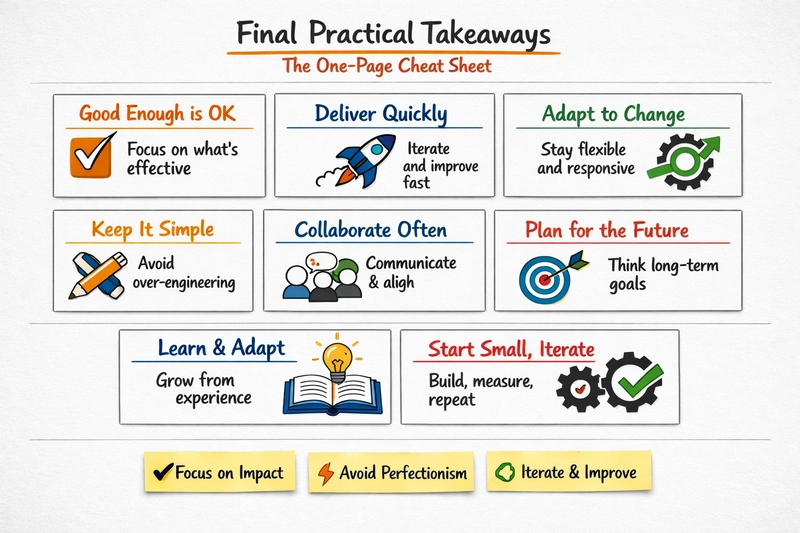
🎁 Final Practical Takeaways (The One‑Page Cheat Sheet)
For Developers
| Instead of… | Do this… |
|---|---|
| Asking “What’s the best pattern?” | Ask “What’s the simplest pattern that works?” |
| Rewriting everything “cleanly” | Refactor incrementally; keep the system running |
| Hiding assumptions | Document them in code comments or ADRs |
| Fighting over framework choices | Agree on a reversible abstraction |
For Architects
| Instead of… | Do this… |
|---|---|
| Designing in isolation | Pair with developers – they’ll find your blind spots |
| Creating 100‑page architecture documents | Write 10 ADRs and a one‑page “architecture overview” |
| Mandating “best practices” | Explain the trade‑offs; let teams decide within boundaries |
| Believing your own diagrams | Chaos‑engineer your assumptions until they break |
For Organisations
| Instead of… | Do this… |
|---|---|
| Rewarding “technical excellence” alone | Reward “delivering value with sustainable complexity” |
| Treating architecture as a phase | Treat architecture as a continuous conversation |
| Blaming teams for outages | Run blameless post‑mortems and fix the system |
| Hiring “rock star architects” | Hire pragmatic problem‑solvers who admit uncertainty |
📖 The Series in One Quote
“Software architecture is not about finding the perfect answer. It is about making the best possible decision with the information you have today, while keeping your options open for the information you will have tomorrow – and being humble enough to admit when you were wrong.”
🎬 The End of the Series… But Not the Conversation
You’ve made it. Seven articles. One paradox. Countless lessons.
Now it’s your turn.
“The architecture that ships today – with all its beautiful lies – is infinitely better than the perfect one that never leaves your laptop.”
Here’s what you can do next:
- 📌 Share the series with one colleague who needs to read it.
- 🧩 Write your first ADR for a decision you’ve been avoiding.
- 💥 Run a small chaos experiment in staging this week.
- 💬 Reply with your own paradox story – the good, the bad, or the worse.
Thank you for reading. Now go build something that fails gracefully. 🚀
If you found this valuable, share it. If you want more, follow for future deep dives. And if you have a war story – the paradox loves company.