






Introduction
Hello everyone! 🚀
In this post, we are diving deep into Midnight, the privacy-focused blockchain!
Previously, we covered how to connect a frontend application to Lace Wallet. Now, we’re taking the next big step: connecting to a smart contract!
Implementing a full-stack ZK (Zero-Knowledge) application can be tricky, but I’ve navigated the pitfalls and version mismatches so you don't have to. Let’s get started!
What You Will Learn
- How to develop a full-stack application on Midnight.
- Concrete source code for calling smart contract functions via Lace Wallet.
- Real-world "gotchas" and how to solve them.
The Sample App: A Full-Stack Counter
We’ll build a simple app that connects to Lace Wallet, displays balances, and interacts with a Counter smart contract.
Prerequisites
- Lace Wallet browser extension (Midnight-compatible version).
- PreProd network selected in Lace settings.
- Some test NIGHT tokens from the official faucet.
- Docker installed (for running the Proof Server).
GitHub Repository
Check out the full source code here:
https://github.com/mashharuki/midnight-sample-fullstack-app
Application Preview
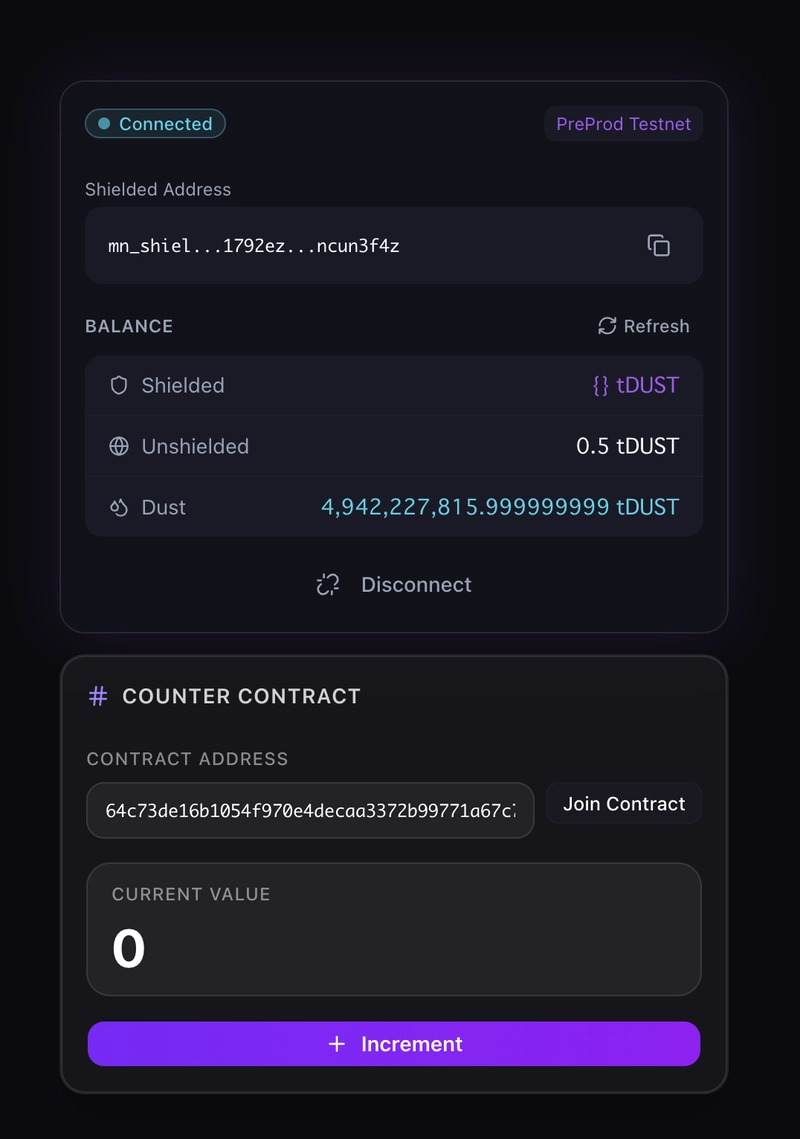
Technical Features
| Category | Feature | Description |
|---|---|---|
| Contract | Build | Compiles Compact files into WASM/ZKIR/Managed Code. |
| Contract | Simulator | Logic verification using CounterSimulator without a live network. |
| CLI | Deploy | Deploys to Standalone/TestNet and retrieves the contract address. |
| CLI | Interaction | Direct CLI commands to increment and check counter values. |
| App | Wallet Connect | Integration with Lace Wallet extension to fetch account data. |
| App | Sync | Automatically joins and fetches current state from a contract address. |
| App | ZK Increment | One-click UI to generate ZK proofs and send transactions. |
Tech Stack
| Layer | Technology |
|---|---|
| Frontend | React 19, Vite 5, Tailwind CSS v4, Lucide React, RxJS |
| Contract | Compact (Midnight's ZK DSL) |
| SDK |
@midnight-ntwrk/* (SDK v2 / DApp Connector API v4) |
| Infrastructure | Midnight Node, Indexer, Proof Server (via Docker) |
| Tooling | Bun, Biome, Vitest, TypeScript |
Deep Dive: Key Implementation Logic
The core logic resides in src/lib/counter.ts and src/hooks/useCounter.ts. This was the most challenging part of the build due to SDK version transitions and compatibility issues with Lace Wallet.
src/lib/counter.ts
This file handles the contract instance creation, state querying, and transaction calls.
1. Contract Instance Creation
We use the SDK to wrap the compiled Compact contract.
import * as CompactJs from "@midnight-ntwrk/compact-js";

// Initialize the compiled contract instance
export const counterContractInstance: CounterContract = (CompactJs.CompiledContract.make(
  "counter",
  Counter.Contract as any,
) as any).pipe(
  CompactJs.CompiledContract.withVacantWitnesses,
);
2. Querying State
Using queryContractState, we can fetch the ledger data (in this case, the round number of our counter).
export const getCounterValue = async (
  providers: CounterProviders,
  contractAddress: ContractAddress,
): Promise<bigint | null> => {
  assertIsContractAddress(contractAddress);

  const contractState = await providers.publicDataProvider.queryContractState(
    contractAddress,
  );

  return contractState != null
    ? Counter.ledger(contractState.data as any).round
    : null;
};
3. Calling Updates (Transactions)
The magic happens in callTx. This triggers the ZK proof generation and requests a signature from Lace Wallet.
export const incrementCounter = async (
  counterContract: DeployedCounterContract,
): Promise<void> => {
  // Call the increment() method on the contract
  await (counterContract as any).callTx.increment();
};
Getting Started: Run it Locally
1. Clone & Install
git clone https://github.com/mashharuki/midnight-lace-react-sample-app.git
cd midnight-lace-react-sample-app
bun install
2. Start the Proof Server
Midnight requires a Proof Server to generate ZK Proofs locally before sending transactions to the network.
cd pkgs/cli
# Start the Proof Server (Ensure it's version 8.0.3)
docker compose -f standalone.yml up -d
3. Build & Deploy the Contract
bun contract build

# Deploy to the PreProd network
bun cli preprod
Note: Copy the contract address displayed in the terminal!
4. Setup & Start the Frontend
# Set environment variables
cp pkgs/app/.env.local.example pkgs/app/.env

# Build and start
bun app build
bun app dev
Visit localhost:5173. You should see the following:
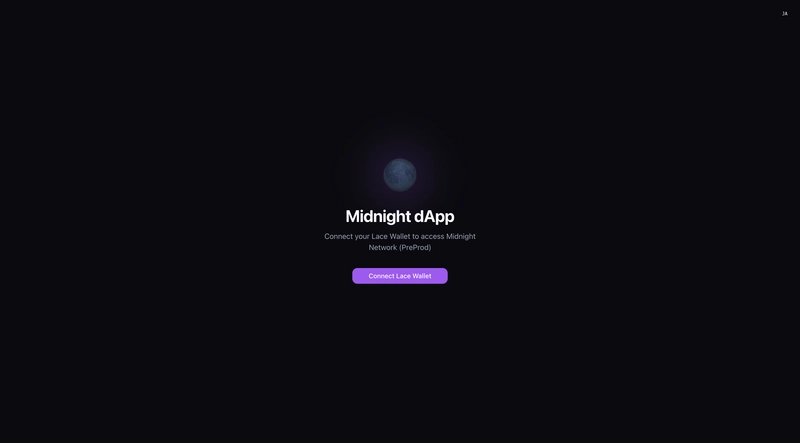
- Connect your wallet.
- Enter your deployed contract address and click Join.
- Click Increment. You will be prompted to sign the transaction.
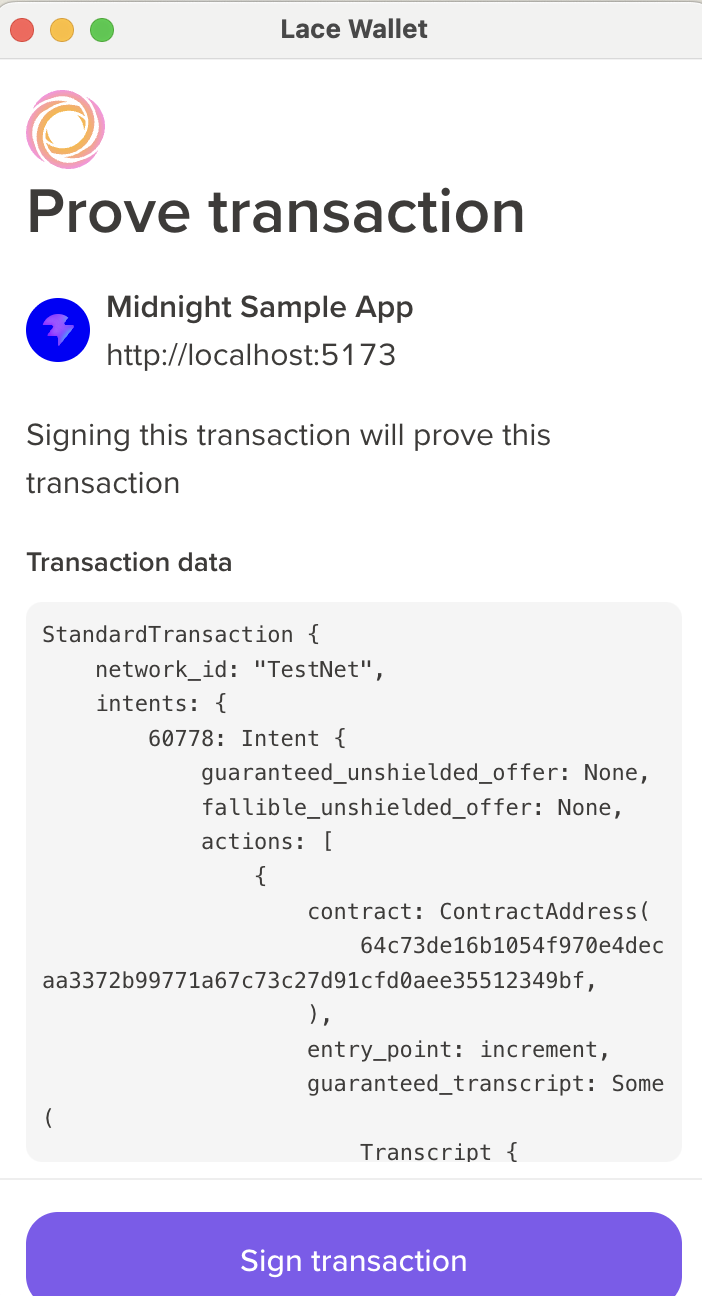
Wait a few moments for the ZK proof generation and network finalization. Once done, refresh to see the updated value!
Sequence Diagrams
Unlike traditional blockchains, Midnight involves a local ZK Proof generation step in every state-changing transaction.
Contract Deployment Flow

Increment Function Call Flow

Summary
Building with ZK-privacy is a paradigm shift. While there were hurdles—especially around SDK versions and wallet compatibility—overcoming them allows you to build applications that truly respect user privacy.
I even created a custom AI Agent skill to help debug the Midnight SDK logic, which made the final stretch much smoother! You can find my Claude skills in the repo if you're interested.
Happy coding, and see you in the next one where we might tackle some hackathon challenges! 🛡️✨