










Why we built Beever Atlas — and why “distill first, retrieve second” works where vanilla RAG falls apart.
By Alan Yang
Your team already documents everything — in chat. Beever Atlas distills those conversations into a wiki that the LLM can actually reason over. Across Slack, Discord, Microsoft Teams, and Mattermost (More platforms will be integrated).
5-Day Beever Atlas Series — start here.
This is Day 1 of a five-part deep dive into Beever Atlas — the open-source, wiki-first RAG system that turns your team’s chat into a self-writing knowledge base.
Day 1: Why Beever Atlas exists — concept, comparison with other tools, real use cases
If any of this lands for you, the single best thing you can do is ⭐ the GitHub repo — it makes a real difference for an OSS launch.
The Karpathy Insight
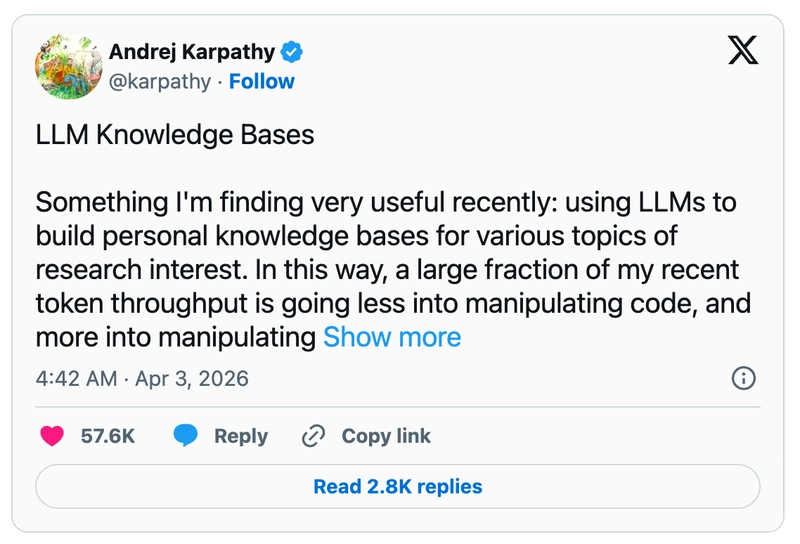
Andrej Karpathy put it plainly in a post on X:
LLMs are “far better at reasoning over curated, encyclopedic content (books, docs, wikis) than over raw conversational transcripts.”
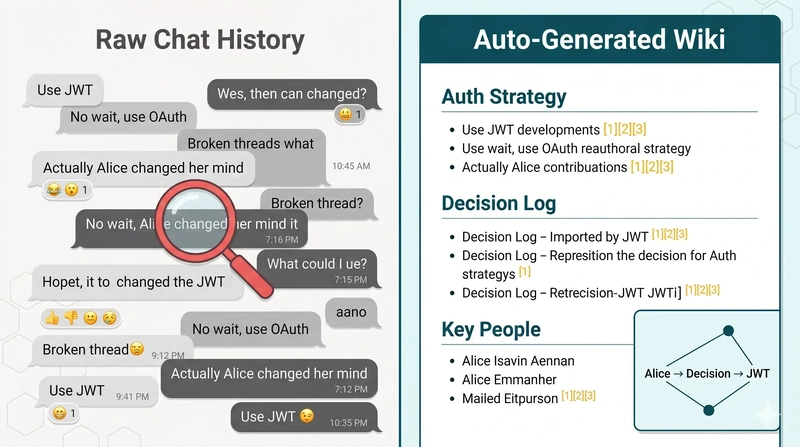
Chat history is noisy, redundant, temporally scattered, and packed with implicit context that only the people who were there can resolve. A wiki is the already-distilled form of that knowledge — deduplicated, structured, citation-bearing, organized by topic rather than by timestamp.
Most RAG systems retrieve from the messy left-hand side. We distill into the right-hand side first. That’s the entire idea.
Feed an LLM a raw Slack export and ask it to reason about your auth strategy. Then feed it a two-page wiki summarizing the same conversation. The second version produces better answers, fewer hallucinations, and traceable citations. Every time. This isn’t a subtle distinction — it’s a structural one.
The quality of LLM reasoning is bounded by the quality of its input.
What Beever Atlas Does
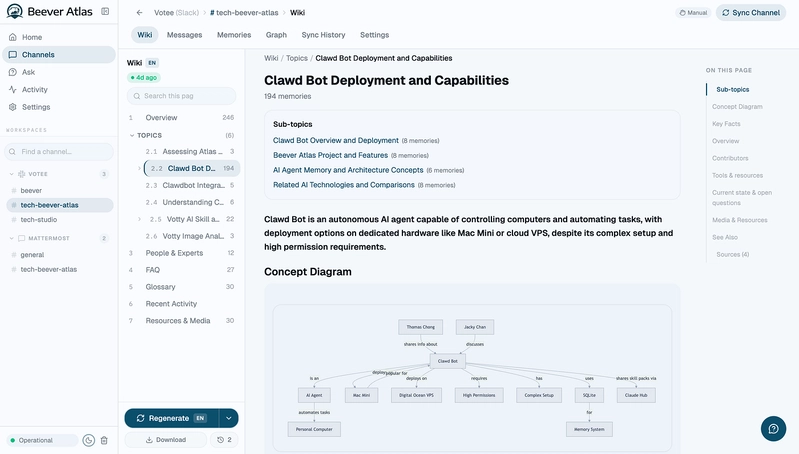
The wiki-preview above is real output. That page — concept map, topic clusters, FAQ section, glossary, decision log — was produced entirely from 246 Slack messages. Nobody scheduled a documentation sprint. Nobody opened Confluence.
Beever Atlas connects to your team’s chat platforms and continuously distills conversations into a structured, queryable wiki. Three things it does:
Reads from Slack, Discord, Microsoft Teams, Telegram, Mattermost — all five, on a schedule or on demand (README.md:31)
Continuously distills into a structured wiki with seven page types per channel: overview, topics, decisions, people, FAQ, glossary, activity (docs/mcp-server.md:139–149)
Answers questions with citations — through the dashboard or via MCP directly into Claude Code and Cursor
One limitation worth naming up front: very recent messages (last few minutes) may not yet appear in the wiki. The QA agent falls back to raw messages for facts that haven’t been distilled yet. You trade a small recency window for dramatically better reasoning quality on the bulk of your history.
How It Compares
The tools below all touch “AI + knowledge.” None of them do the same thing.
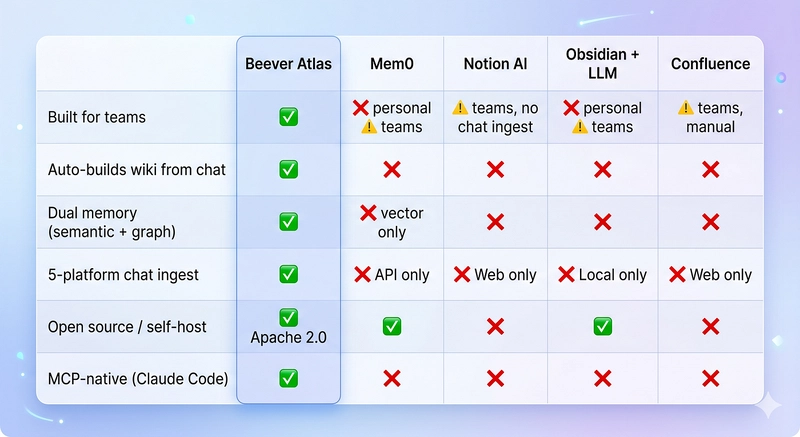
The honest version: Mem0 is good for personal memory. Notion AI is good if your team already writes the docs themselves. Obsidian with an LLM plugin is good for individual researchers who curate their own notes. Beever Atlas is good if your team’s knowledge already lives in chat and you want it to organize itself — without anyone touching a wiki editor.
What Teams Actually Do With This
These aren’t hypothetical. They’re four questions that surfaced in our own team chat the week we started building Beever Atlas.
1 The new hire who doesn’t DM Alice
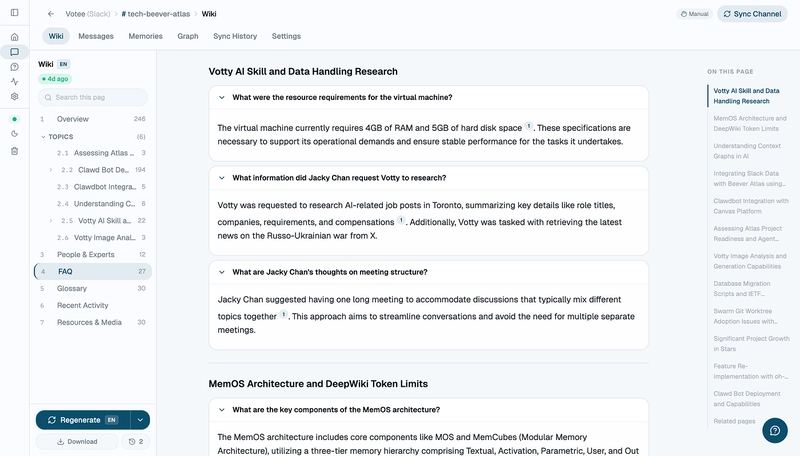
It’s day three at a new company. Instead of pinging Alice on Slack (“hey, why are we using Stripe and not Adyen?”), The new hire opens the #payments wiki and clicks Decisions. The Stripe-vs-Adyen entry is right there — extracted from the original thread, with citations linking back to the source messages. No DM. No interruption. Onboarding scales without putting anyone on call.
2 The decision archaeologist
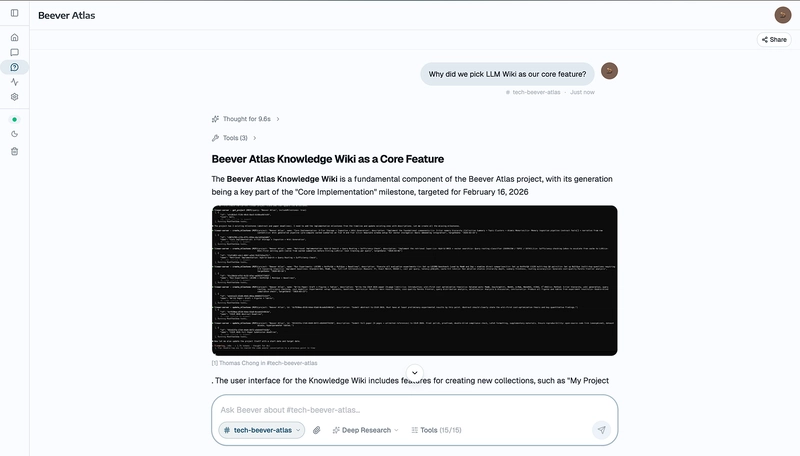
Six months after the JWT-vs-OAuth debate, you ask: ”Why did we pick JWT?” The QA agent traces the decision through the entity graph and returns a chronological timeline — who proposed each option, what was rejected and why, when the final call landed, and a link back to the original Slack thread. It’s the institutional memory your team’s chat already had, now searchable.
3 The expert finder
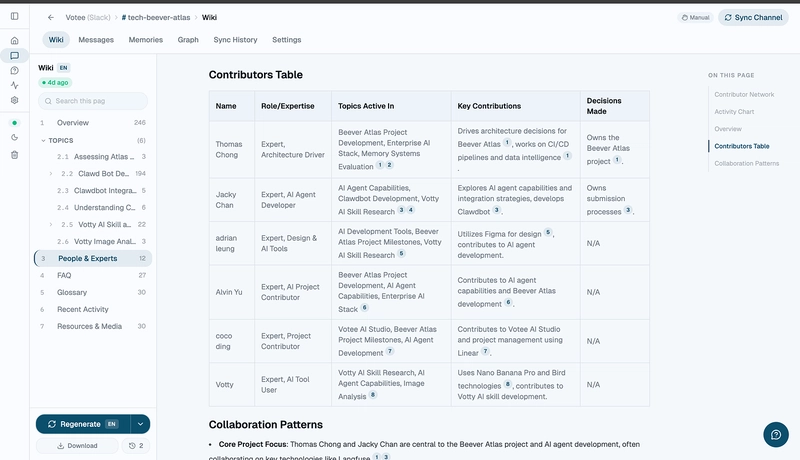
You ask: ” Does anyone know about database indexing?” Most teams answer this with @channel and hope. Atlas ranks teammates by message frequency on the topic, citation count from other facts, and graph weight — quietly, without putting anyone on the spot. The person who’s been answering indexing questions for three years bubbles to the top.
4 The Claude Code power-up
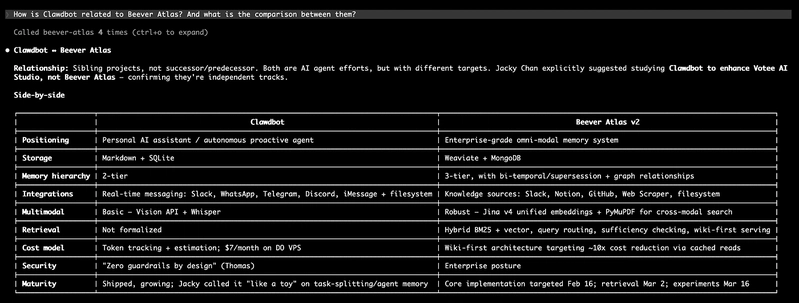
Inside Cursor (or Claude Code), your AI assistant calls ask_channel() over MCP. The response comes back with citations from your team’s actual decisions — not from training data, not made up. The same agent that powers the dashboard is now sitting next to your code editor, reading from the same brain.
Try It
Apache-2.0. Two free keys — Google AI Studio for Gemini, Jina for embeddings. Docker Compose. Runs on a laptop. About 15 minutes including Docker pulls.
Please Star Us on GitHub ⭐⭐⭐ (https://github.com/Beever-AI/beever-atlas)
One Line Installation:
git clone && ./atlas — running in a few minutes.
⭐ Star us on GitHub · 💬 Join the Discord · 🐦 Follow on X
Next — Day 2: Why Beever Atlas Uses Two Databases — and the 6-Stage Pipeline That Feeds Them.