



惯性聚合 高效追踪和阅读你感兴趣的博客、新闻、科技资讯
阅读原文 在惯性聚合中打开

推荐订阅源

F
Fortinet All Blogs
爱范儿
爱范儿
freeCodeCamp Programming Tutorials: Python, JavaScript, Git & More
B
Blog
WordPress大学
WordPress大学
Jina AI
Jina AI
GbyAI
GbyAI
aimingoo的专栏
aimingoo的专栏
N
Netflix TechBlog - Medium
腾讯CDC
Cyber Security Advisories - MS-ISAC
阮一峰的网络日志
阮一峰的网络日志
The GitHub Blog
The GitHub Blog
V
Visual Studio Blog
Google DeepMind News
月光博客
月光博客
博客园 - Franky
Y
Y Combinator Blog
MyScale Blog
MyScale Blog
大猫的无限游戏
大猫的无限游戏
Martin Fowler
Martin Fowler
雷峰网
雷峰网
小众软件
小众软件
H
Hackread – Cybersecurity News, Data Breaches, AI and More

DEV Community

Authentication Security Deep Dive: From Brute Force to Salted Hashing (With Java Examples) Why AI Systems Don’t Fail — They Drift Spilling beans for how i learn for exam😁"Reinforcement Learning Cheat Sheet" I Replaced Chrome with Safari for AI Browser Automation. Here's What Broke (and What Finally Worked) How Python Borrows Other People's Work The $40 Architecture: Processing 1 Billion API Requests with 99.99% Uptime Vibe Coding: A Workflow Guide (From Zero to SaaS) Most webhook security guides protect the wrong side. The scary part is delivery. Headless CMS for TanStack Start: Build a Blog with Cosmic EU Age Verification App "Hacked in 2 Minutes" — What Actually Happened Comfy Cloud’s delete function does not actually remove files Running AI Models on GPU Cloud Servers: A Beginner Guide Event-driven media intelligence with AWS Step Functions and Bedrock I scored 500 AI prompts across 8 quality dimensions — here's what broke How to Call Google Gemini API from Next.js (Free Tier, No Backend Needed) The Portal Protocol: Reclaiming Human Connection in the Age of AI How to Fix Your Team's Scattered Knowledge Problem With a Self-Hosted Forum Intro to tc Cloud Functors: A Graph-First Mental Model for the Modern Cloud Designing Multi-Tenant Backends With Both Ownership and Team Access I Built a Neumorphic CSS Library with 77+ Components — Here's What I Learned PostgreSQL Performance Optimization: Why Connection Pooling Is Critical at Scale Cómo construí un SaaS multi-rubro para gestionar expensas en Argentina con FastAPI + Vue 3 🚀 I Built an Ethical Hacking Scanner Tool – Open Source Project I Replaced /usage and /context in Claude Code With a Single Statusline A Pythonic Way to Handle Emails (IMAP/SMTP) with Auto-Discovery and AI-Ready Design I Collected 8.9 Million Polymarket Price Points — Here's What I Found About How Markets Really Move EcoTrack AI — Carbon Footprint Tracker & Dashboard Everyone's Using AI. No One Agrees How. 5 self-hosted ebook managers worth trying in 2026 Building Your First AI Agent with LangChain: From Chatbot to Autonomous Assistant
Why I Built a Native Mac App Instead of a Web App — and W...
hiyoyo · 2026-04-29 · via DEV Community
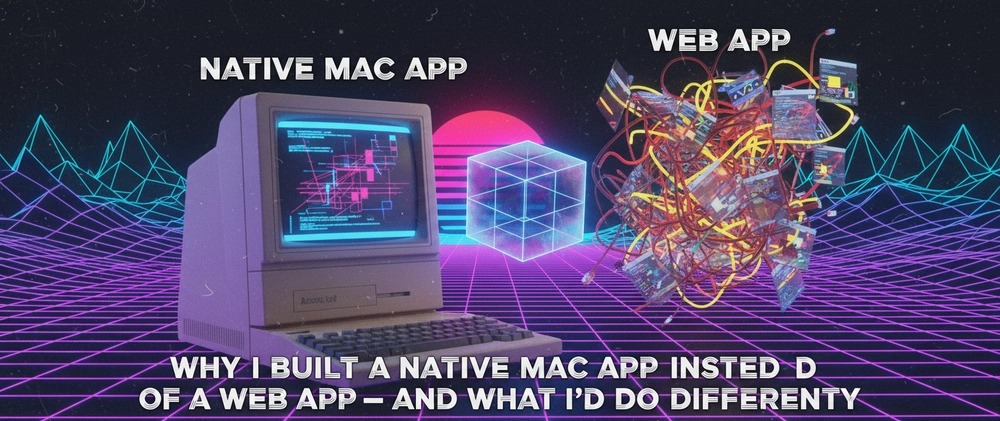
Cover image for Why I Built a Native Mac App Instead of a Web App — and What I'd Do Differently

hiyoyo

All tests run on an 8-year-old MacBook Air.

When I decided to build a PDF tool, the obvious choice was a web app.

I built a native Mac app instead. Here's the honest breakdown of that decision — including the parts I'd reconsider.


Why native won

Privacy is a feature, not a differentiator.

PDF tools that run in the browser send your files somewhere. Even "client-side" web apps have privacy gray areas — telemetry, crash reports, CDN-loaded libraries.

A native app with no network calls is the only architecture where "your files never leave your machine" is actually true. For the use case (contracts, medical records, tax documents), this matters to users.

Access to macOS APIs.

Apple Vision Framework for OCR. PDFKit for rendering. Core Image for filters. FSEvents for file watching. These aren't available in a browser — and the web equivalents are dramatically worse.

Performance on large files.

Processing a 500-page PDF in a browser means fighting the main thread. In a native app with Rust doing the heavy lifting, the UI stays responsive regardless.


What I'd reconsider

Distribution is painful.

Web apps ship instantly. Native apps need code signing, notarization, DMG packaging, and a manual update mechanism. I'm currently not code-signed (below the Apple Developer Program revenue threshold), which means users see a security warning on first launch.

No cross-platform.

Mac-only means I'm leaving Windows and Linux users behind. Tauri supports all three — but the macOS-specific APIs I rely on (PDFKit, Vision, FSEvents) don't.

Discovery is harder.

The App Store has an algorithm. Gumroad does not. Getting found requires active marketing, which takes time away from building.


The honest verdict

Right choice for this product, given the privacy constraints and the macOS API dependencies.

Wrong choice if your primary goal is reach. A web app would have 10x the potential user base from day one.


Hiyoko PDF Vault → https://hiyokoko.gumroad.com/l/HiyokoPDFVault
X → @hiyoyok