
惯性聚合 高效追踪和阅读你感兴趣的博客、新闻、科技资讯
阅读原文 在惯性聚合中打开

推荐订阅源

云风的 BLOG
云风的 BLOG
The GitHub Blog
The GitHub Blog
Y
Y Combinator Blog
博客园 - 三生石上(FineUI控件)
T
The Blog of Author Tim Ferriss
宝玉的分享
宝玉的分享
Hugging Face - Blog
Hugging Face - Blog
WordPress大学
WordPress大学
V
Visual Studio Blog
小众软件
小众软件
Cyber Security Advisories - MS-ISAC
MongoDB | Blog
MongoDB | Blog
V
V2EX
钛媒体:引领未来商业与生活新知
钛媒体:引领未来商业与生活新知
博客园 - 【当耐特】
Microsoft Azure Blog
The Cloudflare Blog
H
Hackread – Cybersecurity News, Data Breaches, AI and More
freeCodeCamp Programming Tutorials: Python, JavaScript, Git & More
Engineering at Meta
Engineering at Meta
L
LangChain Blog
Martin Fowler
Martin Fowler
GbyAI
GbyAI
博客园 - 司徒正美

DEV Community

Authentication Security Deep Dive: From Brute Force to Salted Hashing (With Java Examples) Why AI Systems Don’t Fail — They Drift Spilling beans for how i learn for exam😁"Reinforcement Learning Cheat Sheet" I Replaced Chrome with Safari for AI Browser Automation. Here's What Broke (and What Finally Worked) How Python Borrows Other People's Work The $40 Architecture: Processing 1 Billion API Requests with 99.99% Uptime Vibe Coding: A Workflow Guide (From Zero to SaaS) Most webhook security guides protect the wrong side. The scary part is delivery. Headless CMS for TanStack Start: Build a Blog with Cosmic EU Age Verification App "Hacked in 2 Minutes" — What Actually Happened Comfy Cloud’s delete function does not actually remove files Running AI Models on GPU Cloud Servers: A Beginner Guide Event-driven media intelligence with AWS Step Functions and Bedrock I scored 500 AI prompts across 8 quality dimensions — here's what broke How to Call Google Gemini API from Next.js (Free Tier, No Backend Needed) The Portal Protocol: Reclaiming Human Connection in the Age of AI How to Fix Your Team's Scattered Knowledge Problem With a Self-Hosted Forum Intro to tc Cloud Functors: A Graph-First Mental Model for the Modern Cloud Designing Multi-Tenant Backends With Both Ownership and Team Access I Built a Neumorphic CSS Library with 77+ Components — Here's What I Learned PostgreSQL Performance Optimization: Why Connection Pooling Is Critical at Scale Cómo construí un SaaS multi-rubro para gestionar expensas en Argentina con FastAPI + Vue 3 🚀 I Built an Ethical Hacking Scanner Tool – Open Source Project I Replaced /usage and /context in Claude Code With a Single Statusline A Pythonic Way to Handle Emails (IMAP/SMTP) with Auto-Discovery and AI-Ready Design I Collected 8.9 Million Polymarket Price Points — Here's What I Found About How Markets Really Move EcoTrack AI — Carbon Footprint Tracker & Dashboard Everyone's Using AI. No One Agrees How. 5 self-hosted ebook managers worth trying in 2026 Building Your First AI Agent with LangChain: From Chatbot to Autonomous Assistant
Why I Use Argon2id Instead of bcrypt for PDF Encryption Keys
hiyoyo · 2026-04-25 · via DEV Community
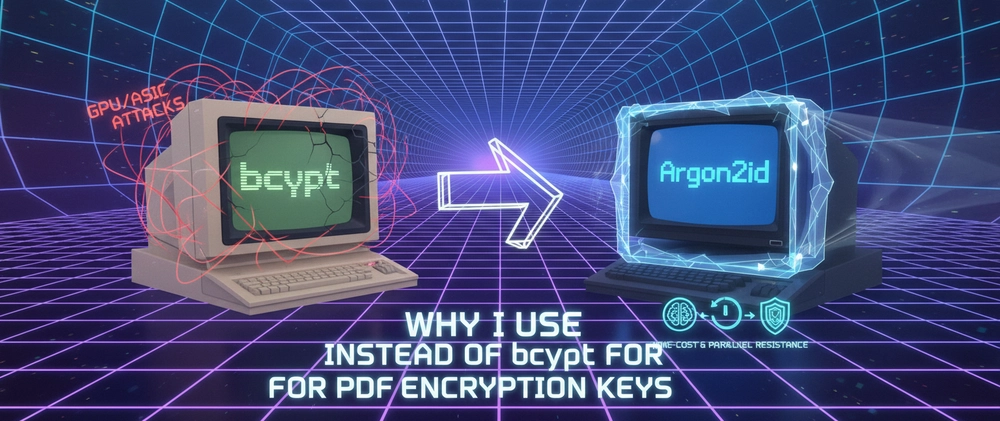
Cover image for Why I Use Argon2id Instead of bcrypt for PDF Encryption Keys

hiyoyo

All tests run on an 8-year-old MacBook Air.

When you encrypt a PDF with a password, that password needs to become a 32-byte key.

How you do that conversion matters more than most people realize.


The problem with bcrypt

bcrypt is fine for password hashing. It's not designed for key derivation.

  • Output is fixed at 60 characters — not suitable as a raw encryption key
  • Memory usage is low, making GPU-based brute force cheap
  • No built-in support for generating arbitrary-length keys

PBKDF2 is better but still memory-light. A GPU farm can run billions of iterations per second against it.


Why Argon2id

Argon2id won the Password Hashing Competition in 2015. It's memory-hard by design.

Memory-hard means: to brute force it, you need not just compute but RAM. A GPU with thousands of cores but limited memory per core is suddenly much less useful.

use argon2::{Argon2, Params};

pub fn derive_key(password: &str, salt: &[u8]) -> [u8; 32] {
    let mut key = [0u8; 32];

    let params = Params::new(
        64 * 1024,  // 64MB memory
        3,          // 3 iterations
        1,          // 1 thread
        Some(32),   // 32-byte output
    ).expect("invalid params");

    Argon2::new(argon2::Algorithm::Argon2id, argon2::Version::V0x13, params)
        .hash_password_into(password.as_bytes(), salt, &mut key)
        .expect("key derivation failed");

    key
}

Enter fullscreen mode Exit fullscreen mode

64MB of memory per derivation attempt. That makes large-scale GPU attacks expensive.


The salt

Never reuse a salt. Generate a fresh random one per encryption:

use aes_gcm::aead::rand_core::RngCore;
use aes_gcm::aead::OsRng;

pub fn generate_salt() -> [u8; 16] {
    let mut salt = [0u8; 16];
    OsRng.fill_bytes(&mut salt);
    salt
}

Enter fullscreen mode Exit fullscreen mode

Store the salt alongside the ciphertext — it's not secret, just needs to be unique.


For new implementations: Argon2id, no exceptions.

bcrypt was designed in 1999. The threat model has changed.


Hiyoko PDF Vault → https://hiyokoko.gumroad.com/l/HiyokoPDFVault
X → @hiyoyok