








This is a submission for the Google Cloud NEXT Writing Challenge

Google Cloud Fraud Defense Is the Old reCAPTCHA Finally Growing Up — And Developers Should Care
Every developer has a reCAPTCHA story. You know the one. You are trying to buy concert tickets or create an account or just read an article, and suddenly you are staring at a blurry intersection of faded traffic lights and crosswalks wondering if that pixelated shape is a bus or a truck. You try three times. You get it wrong every time. You switch to audio mode and hear something that sounds like a dial-up modem having a stroke. You give up.
If that scenario sounds familiar, you are not alone. reCAPTCHA has been annoying developers and users alike for nearly two decades. And at Google Cloud NEXT 26, Google finally acknowledged what the entire internet has known for years — the old approach to verifying humans was broken.
They did not just fix it. They replaced it entirely.
What Is Google Cloud Fraud Defense?
In simple terms, Google Cloud Fraud Defense is the next evolution of reCAPTCHA — but calling it that is like calling a smartphone an upgraded telephone. It is a complete rethink of how we verify humans versus bots versus sophisticated automated agents that are getting harder to distinguish from real people every single day.
The old reCAPTCHA worked like a checkpoint. You either passed or you did not. It was binary. You were a human trying to prove you were not a bot, and the system either believed you or it did not. There was no nuance, no context, no understanding of behavior — just a snapshot test at a single moment.
Fraud Defense works completely differently. It watches everything. Not just the moment of verification, but the entire journey of a user — how they landed on your site, what they clicked, how fast they moved the mouse, whether their typing pattern feels human, whether their device fingerprint looks consistent, whether the IP address matches their location, whether this account has been used for fraud before across Google's entire network of data.
This is not just captcha replacement. This is a full trust platform for businesses that need to make decisions about risk and fraud in real time.
Why This Matters for Developers
Here is the thing that got me genuinely excited about this announcement. As someone who has worked on e-commerce platforms and dealt with fraud detection before, I know the pain of trying to stop fraudulent transactions without blocking legitimate customers.
ms
The old reCAPTCHA was frustrating for everyone. Legitimate users had to prove they were human. Developers had to implement it, debug it, deal with false positives, and still end up with fraud getting through anyway. And attackers got smarter — they built farms of humans to solve captchas for them, they used AI to bypass image recognition challenges, they found ways to make bots behave just human enough to pass the basic tests.
The result was a perpetual arms race that nobody was winning.
Fraud Defense flips this entirely. Instead of asking are you a robot at a single gate, it asks can we trust this interaction based on everything we know about this user, this device, this behavior pattern, and this context.
This means fewer interruptions for real users. No more squinting at blurry images just to add something to your cart. No more being blocked from your own account because your VPN made you look suspicious.
And for developers, it means much more powerful tools to actually fight fraud — not just stop the most obvious bots, but understand the full picture of what is happening on your platform.
How It Works: The Policy Engine
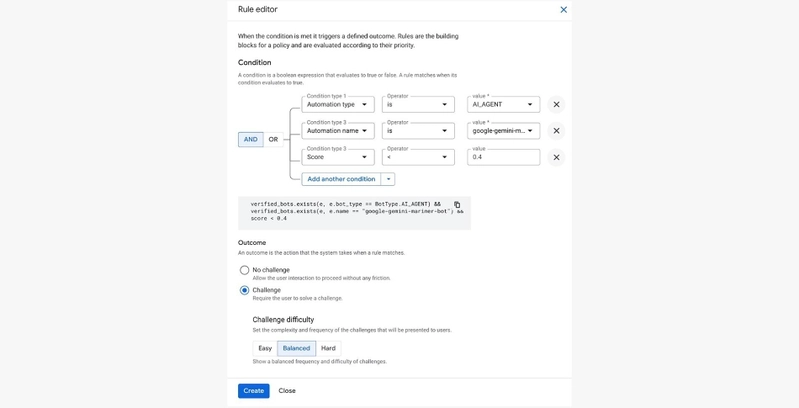
The core of Fraud Defense is what Google is calling a policy engine. Think of it as a rules system where you can define how risk decisions get made based on all the signals available.
In practice, this means you can set up rules that make sense for your specific use case. A bank might want very strict verification because a compromised account could mean financial theft. A news site might want lighter touch verification because they just want to stop scrapers without annoying their readers.
You can layer intelligence into these policies. The system can score every request based on thousands of signals — device age, behavior patterns, historical fraud data, third-party threat intel, IP reputation — and then your policy decides what to do with that score. Block it, challenge it with a lighter verification, or let it through.
For developers building on Google Cloud, this integrates directly with their existing infrastructure. You do not need to rip out your current auth system and replace it with something new. You layer Fraud Defense on top as an additional risk signal that makes your existing decisions smarter.
The New Verification Experience
One of the most interesting parts of the announcement is the evolution of the actual challenge experience for users. Google showed a new QR code-based verification that is genuinely clever.
Imagine you are logging into a high-value application — maybe a banking portal or an admin dashboard. Instead of typing a code or answering security questions, you scan a QR code with your phone. Your phone confirms your identity through biometrics, and the session on the computer is verified in seconds with essentially zero friction.
This is dramatically better than the old way for two reasons. First, it is fast. No typing, no reading, no guessing. Second, it is actually more secure — scanning a QR code with your personal phone that has your biometrics is significantly harder to spoof than a distorted image or an audio challenge.
For developers, this means you can now offer genuinely better security without making your users miserable. That is a rare combination.
The Agentic Web Problem
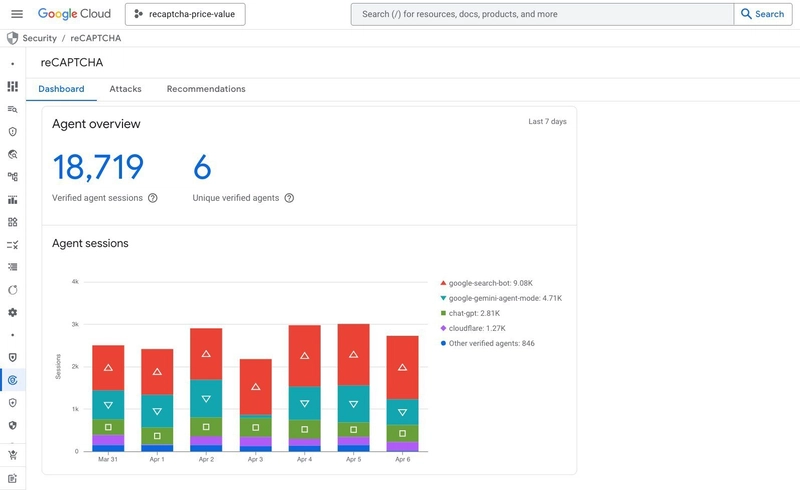
Google framed this launch around the concept of the agentic web — the idea that soon, software agents will be doing more and more on behalf of users. Booking travel, making purchases, filling forms, scheduling meetings — all handled by AI systems acting on your behalf.
This creates a fundamental challenge for traditional verification. If an AI agent is legitimately acting on behalf of a human, how do you verify that the request is authorized? The old captcha approach treats all automation as suspicious by default, but in an agentic world, some automation is completely legitimate and even desired.
Fraud Defense is explicitly built to handle this. The system is designed to differentiate between unauthorized bots, suspicious automated behavior, avxnd legitimate AI agents operating with proper authorization. It looks at the broader context — is this agent known and trusted, has this user authorized this specific action, does the pattern of behavior indicate consent?
This is a genuinely forward-looking approach. Most fraud and verification systems today are still fighting the last war — trying to catch bots and scrapers. Fraud Defense is trying to solve the next problem before it becomes a crisis.

What This Means for the Average Business
If you run an online business and deal with fraud or fake accounts, this matters a lot. The old reCAPTCHA was a cost of doing business — you accepted some fraud, you accepted some user frustration, and you hoped the balance came out okay.
Fraud Defense changes that math. By providing much richer signals about what is happening on your platform, you can actually make better decisions. Lower fraud without raising false positives. Smoother user experience without opening yourself up to abuse.
For large enterprises handling millions of transactions, this could represent significant cost savings — fewer fraud losses, fewer manual reviews, fewer chargebacks. For smaller businesses that could not afford sophisticated fraud detection systems, this brings enterprise-grade intelligence within reach through Google Cloud infrastructure.
The Bigger Picture
What strikes me most about this announcement is the timing. Google did not just decide to rebuild reCAPTCHA for fun. They did it because the threat landscape has fundamentally changed.
Bots used to be easy to catch. They moved wrong, clicked wrong, behaved wrong. But as AI has advanced, the line between human behavior and automated behavior has blurred considerably. A sophisticated enough bot can move a mouse naturally, type at human speed, avoid common honeypots, and pass basic behavioral checks.
The old captcha approach is simply not adequate for this world anymore. You cannot reliably tell a human from an AI-generated bot using static challenges.
Fraud Defense approach of looking at the full context — the entire behavioral pattern, the device history, the cross-platform signals — is the only viable path forward. It is not about passing one test at one moment. It is about building a continuous understanding of trust based on everything Google knows across billions of interactions.
That is a very different philosophy, and it is the right one for where the internet is heading.
Final Thoughts
As someone who has spent time building and maintaining web applications, I am genuinely excited about this launch. The old captcha experience was a necessary evil — something we inflicted on our users because we had no better option. Fraud Defense finally gives developers a real alternative.
The hands-on aspects are what make me most curious to try it. The policy engine seems powerful enough for real enterprise use cases, and the fact that it is available through Google Cloud means any developer can experiment with it without massive infrastructure investment.
Most importantly, it is designed for where the web is going — not where it has been. The focus on the agentic web, on handling authorized AI agents differently from unauthorized bots, on continuous trust signals rather than point-in-time verification — all of this points toward a more thoughtful approach to the problems developers will actually face in the next five years.
Whether this actually delivers on its promise depends on how well it works in practice across real, varied use cases. But the direction is right, the philosophy is sound, and the execution looks thoughtful. That is more than you can say for most product announcements.
I will definitely be experimenting with this on my own projects. And if you have been dealing with fraud, fake accounts, or bot problems without a good solution — you probably should too.
Tags: googlecloud frauddefense security webdev ai recaptcha cloud devops developers