





This article introduces three top-conference-accepted research achievements by Alibaba Cloud that solve core AIOps challenges in data augmentation, se...
As the core direction of enterprise digital transformation and artificial intelligence for IT operations (AIOps), operation intelligence is becoming a key enabler for improving business stability and reducing O&M costs in the AI-native era. Its technical development and engineering implementation always revolve around core aspects such as data processing, semantic understanding, and exception detection.
The Alibaba Cloud Observability team continues to work deeply in this field. Recently, a series of research achievements in the operation intelligence realm jointly published with universities such as Fudan University, Tsinghua University, and Tongji University have been consecutively accepted by top international academic conferences International Conference on Learning Representations (ICLR) 2026, Transactions on Software Engineering (TSE) 2026, and International Symposium on Software Testing and Analysis (ISSTA) 2025. These achievements systematically overcome core technical challenges in realms such as metric data augmentation, large-scale semantic parsing, and cross-system exception detection. They build a complete operation intelligence technical system from data infrastructure to semantic understanding, and then to industrial-level deployment. This further promotes the engineering implementation of large language model (LLM) in scenarios such as automatic inspection by AI agents, assisted root cause analysis, and automatic fault recovery. This lays a solid technical foundation for large-scale applications.
Three Major Challenges in the Engineering Implementation of AIOps
Challenge 1: Semantics Gap
Traditional tools process O&M data essentially by performing "format matching". Log resolvers categorize similar strings into one class. Timing analysis applies common methods in the image realm. Exception detection only looks at a single metric. These methods do not understand the essential difference between "timeout after 30s" and "timeout after 0.01s" in the O&M context. They do not understand the statistical semantics such as the trend, epoch, or stationarity of metrics. They also do not know the deep association among logs, metrics, or traces. The lack of semantics directly leads to persistently high missed detections and false positives.
Challenge 2: Generalization Bottleneck
Real O&M systems are never static. Microservices frequently release new versions, and log templates continuously evolve. After new operational systems are published, all history annotations become invalid. The data distribution drifts over time, and the model that was well-trained yesterday may fail today. More critically, the annotation cost of industry-level systems is extremely high. For each new system annotated, it often requires months of human effort. Existing methods perform excellently in a stable lab environment. However, they struggle to adapt to a dynamically evolving production environment.
Challenge 3: Industrial Availability
The academic community pursues accuracy. The industrial community requires both accuracy and efficiency. Log streaming of 100,000 logs per second, abnormal response requirements within 100 ms, and limited memory and computing power budgets are hard constraints. These hard constraints keep many "good methods in papers" confined to the lab. They cannot be truly implemented.
Systematic Breakthroughs of Alibaba Cloud Observability
① AutoDA-Timeseries: Break through the limitations of timing modeling, enabling AI to predict faults with less data
Without a good augmentation policy, the true potential of metrics cannot be tapped. For a long time, metric data augmentation has been limited by paradigm migration in the image domain. Timing features are ignored. Augmentation policies cannot be adaptive. Existing Automated Data Augmentation (AutoDA) frames blindly apply image transformations. This destroys autocorrelation and time dependencies. This critically restricts the performance of downstream tasks such as categorization, prediction, and exception detection.
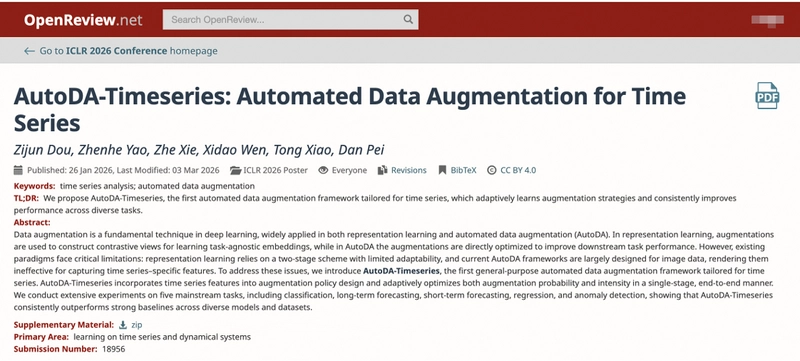
The paper "AutoDA-Timeseries: Automated Data Augmentation for Time Series" (Tsinghua University & Alibaba Cloud) accepted by ICLR 2026 proposes the first general automated data augmentation frame for metrics. It fetches 24-dimensional timing statistical features and integrates them into a stacking augmentation layer. Through Gumbel-Softmax differentiable sampling, it adaptively optimizes the augmentation probability and intensity in a single-stage end-to-end manner. It covers five major jobs such as categorization, long- and short-term prediction, regression, and exception detection. The categorization accuracy reaches 0.730 (+6.7%) on Temporal Convolutional Network (TCN) and 0.721 (+5.2%) on ROCKET. It comprehensively surpasses 7 state-of-the-art (SOTA) baselines. This provides the first generalized and automated solutions for metric data augmentation.
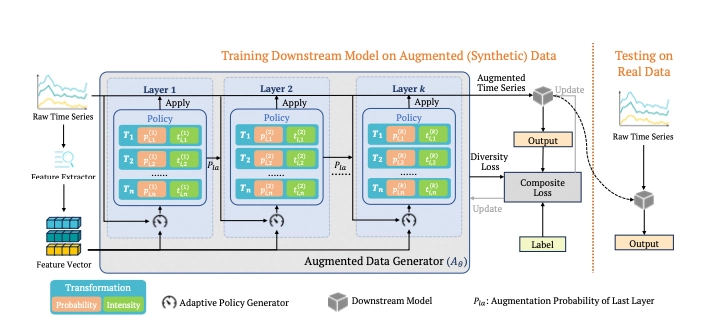
Paper address: https://openreview.net/forum?id=vTLmHAkoIW
② A SemanticLog: Balancing high accuracy and high throughput, the peak throughput of semantic log parsing reaches 1.28 million logs per second
Without good semantic understanding, the true meaning behind log parameters cannot be read. Log parsing technology has remained at the syntax layer for a long time. That is, it uniformly replaces dynamic parameters with the wildcard character (*). This loses semantic information carried by parameters, such as object identifier (ID), status code, and UNIX timestamp. This critically restricts the accuracy of AIOps downstream tasks such as exception detection and root cause analysis. Existing LLM resolvers mostly depend on the online APIs of ChatGPT. They face three major challenges: privacy leakage, unstable latency, and uncontrollable versions. They are difficult to implement in a production environment.
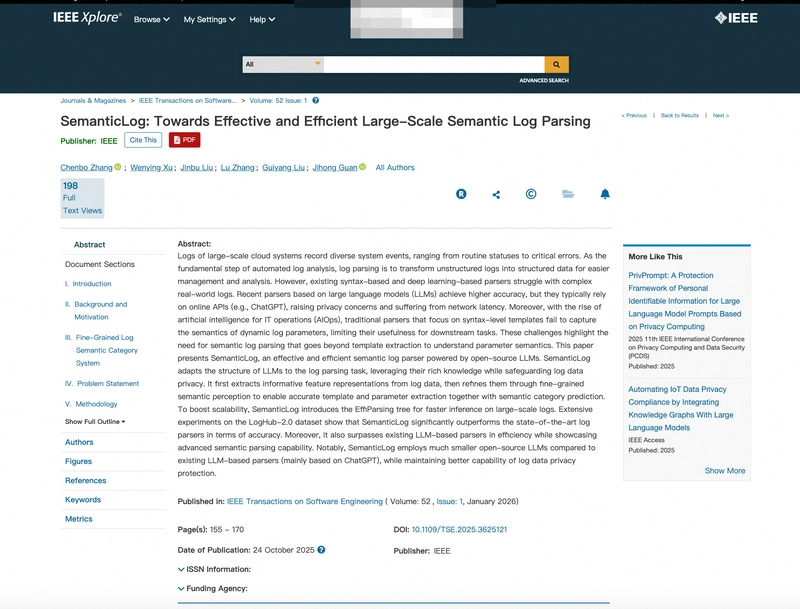
The paper "SemanticLog: Towards Effective and Efficient Large-Scale Semantic Log Parsing" (Fudan University & Alibaba Cloud & Tongji University), accepted by TSE 2026, proposes the first semantic log resolver based on an open-source LLM. The semantic log resolver consists of three core modules that work together. LogLLM removes causal masks and reconstructs log parsing from text generation to a token categorization job to fully utilize bidirectional context. The SemPerception module uses multi-head cross-attention to aggregate subword features and achieves 16 classes of fine-granularity semantic categorization (which is extended by 60% compared to the VALB 10-class system, and 96% of parameters in enterprise logs can be accurately categorized). The EffiParsing prefix tree caches parsed templates to significantly reduce repetitive inference overhead.
A comprehensive evaluation based on LLaMA2-7B on the LogHub-2.0 benchmark shows that SemanticLog achieves the best results in five traditional and semantic parsing Metrics (GA 93.3%, PA 93.6%, FTA 84.4%, SPA 83.2%, SPA+ 55.9%). SemanticLog comprehensively surpasses 11 SOTA resolvers including the ChatGPT solution. The semantic parsing accuracy SPA is improved by 18.7% compared to the similar method VALB. The inference speed is better than all LLM resolvers. In the downstream exception detection experiment, fine-granularity semantic tagging increases the detection F1 score by up to 4%. This provides an efficient and reliable open-source solution for the engineering implementation of semantic log parsing in privacy-sensitive scenarios.
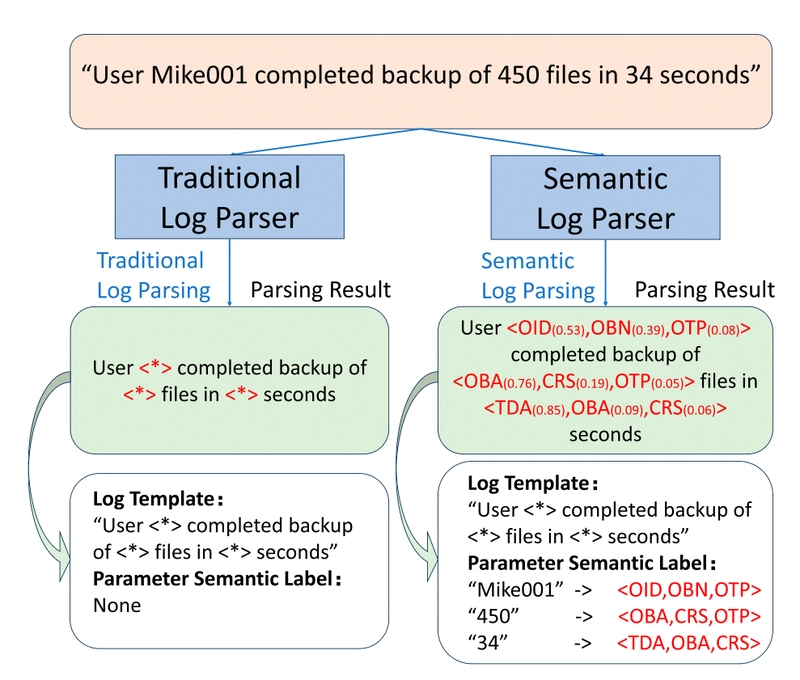
Paper address: https://ieeexplore.ieee.org/document/11216353/
③ LogBase: The first semantic log parsing benchmark, enabling AI to truly "understand" every log
Without a good ruler, you cannot measure true progress. The semantic log parsing realm has long faced systematic challenges such as scarce annotations, limited data size, and fragmented evaluation standards. The mainstream benchmark LogHub-2.0 only covers 14 systems and 3,488 templates, which critically restricts the accuracy of AIOps downstream tasks.
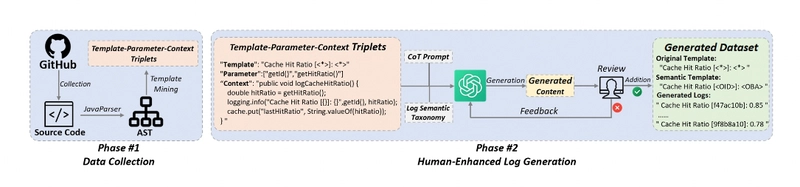
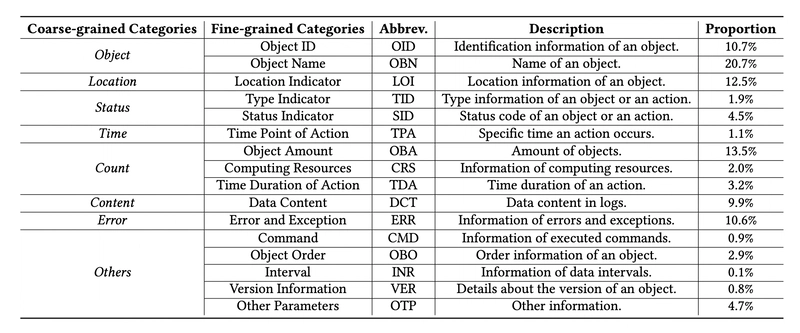
The paper "LogBase: A Large-Scale Benchmark for Semantic Log Parsing" (Fudan University & Alibaba Cloud & Tongji University), accepted by ISSTA 2025, builds the first large-scale semantic log parsing benchmark. The benchmark covers 130 open-source projects and provides 85,300 high-quality semantic tagging templates. Compared to LogHub-2.0, the data source size is increased by about 9 times, and the quantity of templates is expanded by 24.5 times. The benchmark is equipped with an 8+16 hierarchical semantic categorization system and an automated building frame GenLog. The benchmark achieves the evaluation paradigm upgrade from syntax parsing to semantic understanding for the first time. A comprehensive evaluation of 15 mainstream resolvers exposes the true shortcomings of existing methods in complex scenarios. This provides a unified standard and reliable foundation for the engineering implementation of semantic log parsing.
Paper address: https://dl.acm.org/doi/10.1145/3728969
Currently, the Alibaba Cloud observability team has integrated the aforementioned innovative technologies into product systems such as Cloud Monitor (CMS), Simple Log Service (SLS), and Application Real-Time Monitoring Service (ARMS). This achieves accurate intelligent alerting, in-depth log understanding, and low-threshold intelligent O&M. This helps enterprises break O&M efficiency bottlenecks, reduce costs, and improve business stability.
The iteration of LLM and AI agent technologies is accelerating. The value of observability data as a key link connecting AI and production systems continues to become prominent. The Alibaba Cloud Observability team will continue to drive technological breakthroughs through academic innovation. The team will improve the operation intelligence technology system, participate in the construction of industry standards, and promote the large-scale implementation of AIOps. This provides more solid artificial intelligence for IT operations support for the digital transformation of enterprises.