






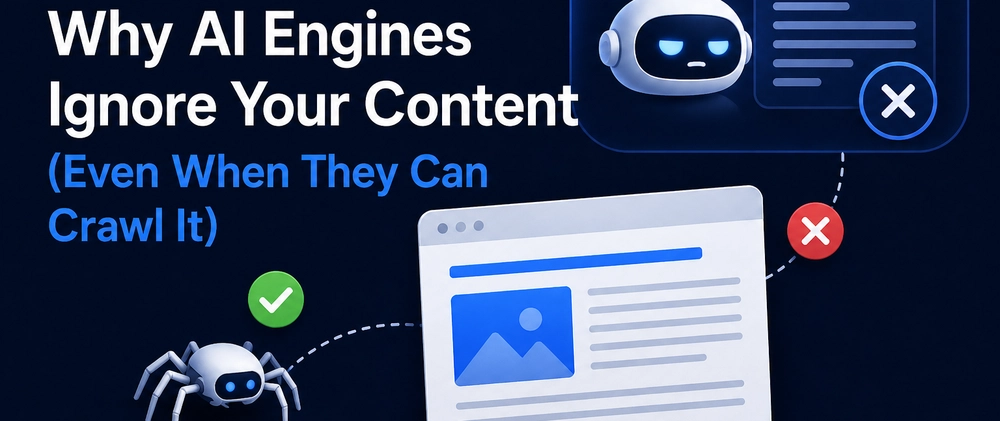

Fixing your robots.txt and disabling Cloudflare Bot Fight Mode is step one.
Most developers stop there and wonder why they still don't appear in ChatGPT, Gemini, Claude or Perplexity answers.
Crawlability is access. Citations are trust. They're two different problems.
I run LearnQ.ai and VEGA AI. After fixing the crawlability issues I wrote about in my previous article, I still wasn't getting cited consistently.
The bots could reach the content. They just weren't using it. Here's what was actually wrong.
The Real Reason AI Engines Skip Your Content
Your answers are buried inside paragraphs
Google trained us to write flowing prose with the answer somewhere in the middle. AI engines work differently.
They extract the most direct, self-contained answer to a query and surface it.
If your answer is buried three sentences into a paragraph, the engine either misses it or picks a competitor who answered more directly.
The fix is structural. Every H2 and H3 section should open with a direct answer in the first sentence. Supporting detail follows. Not the other way around.
Before:
Schema markup is a type of structured data that you add to your HTML.
It has been used by Google for years and is now becoming important for
AI search as well. Adding it can help AI engines understand your content.
After:
Schema markup helps AI engines understand what your content is about.
Add it to your HTML using JSON-LD format. This is the single most
impactful technical change you can make for AI search visibility.
The second version is extractable. The first one isn't.
Your FAQ section doesn't exist or isn't self-contained
FAQ sections are the highest-leverage content format for AI citations.
AI engines frequently pull FAQ answers verbatim because they are already
structured as question-answer pairs.
Two rules for FAQ content that actually gets cited:
Each answer must be self-contained. It should make complete sense
without the reader having seen any other part of the article. If your
FAQ answer says "as mentioned above," it will not get extracted cleanly.
Use the exact question phrasing your audience types. Not "What is GEO?" but "What is generative engine optimization and how is it different from SEO?"
The closer your question matches the actual query, the higher the extraction probability.
You have no FAQPage schema
Writing FAQ content is not enough. You need to tell AI engines it's a FAQ section using structured data. FAQPage schema in JSON-LD format does this.
<script type="application/ld+json">
{
  "@context": "https://schema.org",
  "@type": "FAQPage",
  "mainEntity": [
    {
      "@type": "Question",
      "name": "What is generative engine optimization?",
      "acceptedAnswer": {
        "@type": "Answer",
        "text": "Generative engine optimization (GEO) is the practice of
        optimizing your content so it gets cited and recommended by AI
        search engines like ChatGPT, Perplexity, and Google AI Overviews.
        It differs from traditional SEO in that the goal is citation and
        direct answer extraction, not ranking position."
      }
    }
  ]
}
</script>
Add this to every page that has FAQ content. On WordPress, WPCode makes this straightforward without touching theme files.
Your paragraphs are too long
AI engines have a strong preference for short, dense, information-rich paragraphs. Three sentences maximum per paragraph is the practical rule.
Long flowing text gets skipped in favour of content that is easier to
extract and attribute.
Audit your existing content. Any paragraph over three sentences is a
candidate for splitting.
You have no structured data identifying your entity
AI engines build a model of what your website is about based on structured data, not just content.
Without Organization schema on your homepage and Article or BlogPosting schema on your articles, you are an anonymous
source. Anonymous sources don't get cited.
Minimum schema set for AI search visibility:
- Organization on homepage: name, URL, logo, description, sameAs (your social profiles)
- Article or BlogPosting on every article: headline, author, datePublished, dateModified, publisher
- FAQPage on every page with Q&A content
- Person on author pages: name, jobTitle, url, sameAs
A Quick Content Audit Process
Run this on your five most important pages before doing anything else:
Open the page and read only the first sentence of each H2/H3 section. Does each one answer the section question directly? If not, rewrite the opening sentence.
Check whether a FAQ section exists. If not, add one with at least
five self-contained questions relevant to the page topic.Validate your schema at schema.org/validator. Fix any errors shown.
Count sentences per paragraph. Split any paragraph over three sentences.
Disable JavaScript in your browser and reload. Confirm all content
is still visible in raw HTML.
This process takes about 90 minutes per page. The structural changes
compound quickly because AI engines re-crawl and update their citation pool regularly.
What Changed When I Applied This
After restructuring the key pages on LearnQ.ai — rewriting section openings to lead with direct answers, adding FAQ schema, and reducing paragraph length - citation frequency in Perplexity responses increased within two to three weeks.
The crawlability fix gets you in the door. The content structure fix gets you cited.
Full guide on AI-readable content structure:
proaisearch.com/robots-txt-ai-crawlers/