






(OpenClaw = brain, ClawFlow = muscle)
The problem: AI agents are great at reasoning, but when you need something done reliably and instantly, they fall apart.
The solution: ClawFlow is a fast, deterministic execution layer that OpenClaw agents call for structured data transformation — parsing, validation, and workflow orchestration in milliseconds.
Submission for the OpenClaw Challenge
The Real-World Problem I Solved
Last week, I was building a startup idea tracker. I wanted to go from a messy voice memo to a structured product roadmap in seconds — without waiting 3-5 seconds for an LLM to "think" and possibly hallucinate.
Traditional approach: GPT-4 call → unpredictable output → retry logic → more latency → $0.02 per run.
My approach with ClawFlow: Voice memo → OpenClaw agent (decides intent) → ClawFlow deterministic pipeline → structured roadmap in < 5ms, 100% predictable, $0 cost.
This isn't about replacing AI. It's about giving AI agents a reliable execution layer for tasks that need precision, not creativity.
What I Built
ClawFlow is a production-ready execution backend that acts as the "muscle" to OpenClaw's "brain." While OpenClaw agents handle intent recognition and orchestration decisions, ClawFlow handles the deterministic work: parsing, transforming, validating, and structuring data.
Core Architecture
┌─────────────────┐     intent recognition       ┌──────────────────┐
│  OpenClaw Agent │ ───────────────────────────→ │  ClawFlow Engine │
│  (The Brain)    │  "Parse this task list"      │  (The Muscle)    │
└─────────────────┘                              └──────────────────┘
         │                                              │
         │    POST /api/webhook/openclaw                │
         │    { flow: "task", input: "..." }            │
         │←─────────────────────────────────────────────┘
         │         structured result (3-5ms)
         ▼
   ┌─────────────┐
   │   Action    │  ← agent makes next decision
   └─────────────┘
The 3 Killer Workflows
Here are the workflows that demonstrate ClawFlow's power:
Voice Memo → Structured Roadmap
Input: "Build landing page, setup auth urgently, deploy by Friday"
Pipeline:
Clean-Claw → Task-Claw → Brain-ClawOutput: Structured product plan with prioritized phases
Error Log → Actionable Tasks
Input: Raw server logs
Flow:
Debug-ClawOutput: Severity-classified issues with fix suggestions
Messy Data → Clean Structure
Input: Unformatted CSV, JSON, or text
Flow:
CSV-Claw,JSON-Claw, orClean-ClawOutput: Validated, normalized structured data
All 14 skills:
| Flow | Icon | Description |
|---|---|---|
| Task-Claw | 📋 | Breaks input into actionable tasks with priority detection |
| Debug-Claw | 🔍 | Scans for error patterns with severity classification |
| Brain-Claw | 🧠 | Converts raw ideas into structured product plans |
| Clean-Claw | ✨ | Normalizes messy text with stats extraction |
| Summary-Claw | 📝 | Extracts key points using positional scoring |
| Calendar-Claw | 📅 | Extracts event details from natural language |
| Git-Claw | 🐙 | Parses git diffs and suggests commit messages |
| CSV-Claw | 📊 | Parses messy CSV to clean JSON |
| Email-Claw | 📧 | Drafts professional emails from bullet points |
| Note-Claw | 📓 | Formats markdown notes with keyword tagging |
| JSON-Claw | {} |
Validates and formats JSON strings |
| Diff-Claw | ↔️ | Word-level text comparison |
| Sentiment-Claw | 😊 | Extracts emotional tone and sentiment score |
| Pipeline-Claw | ⚡ | Multi-stage workflow orchestration |
Key Features (v2.1):
| Feature | Description |
|---|---|
| OpenClaw Webhook Bridge | Native integration via /api/webhook/openclaw — agents send {trigger_id, flow, input}, receive structured results |
| 14 Built-in Skills | Parsing, validation, and transformation without LLM unpredictability |
| Visual Claw Creator | Create custom claws in seconds — no coding required |
| 11 Pre-built Templates | Task extraction, link parsing, JSON formatting, text transformation, and more |
| Visual Pipeline Builder | Chain skills into complex workflows at /pipeline
|
| SQLite Persistence | Full execution history for agent memory and traceability |
| 22-Test Suite | Production-ready reliability |
| Sub-5ms Execution | Fast enough for real-time agent loops |
How I Integrated with OpenClaw
📖 Full Integration Guide: OPENCLAW_INTEGRATION.md — architecture diagrams, 3 concrete examples, routing strategies, and delegation rules.
1. The Webhook Bridge (Real Integration)
ClawFlow exposes an authenticated webhook endpoint that accepts standard OpenClaw task payloads:
# OpenClaw sends this to ClawFlow
POST /api/webhook/openclaw
Headers: { "x-api-key": "clawflow_prod_key" }
Body: {
  "trigger_id": "oc-999",
  "flow": "task",
  "input": "urgent: fix auth bug, deploy patch"
}

# ClawFlow returns structured result
{
  "bridge_version": "1.0",
  "trigger_id": "oc-999",
  "status": "completed",
  "execution_data": {
    "success": true,
    "duration": 3,
    "output": {
      "tasks": [
        { "title": "Fix auth bug", "priority": "high" },
        { "title": "Deploy patch", "priority": "normal" }
      ]
    }
  }
}
2. Example OpenClaw Agent Configuration
See openclaw.config.yml in the repo for a complete agent setup:
# OpenClaw agent that delegates parsing to ClawFlow
skills:
  - name: "parse_tasks"
    type: "webhook"
    endpoint: "https://clawflow.vercel.app/api/webhook/openclaw"
    headers:
      x-api-key: "${CLAWFLOW_API_KEY}"
    payload_template: |
      {
        "flow": "task",
        "input": "{{user_input}}"
      }
3. The CLI Trigger (Development Tool)
For local testing, the CLI sends OpenClaw-format payloads:
node trigger.js
# Simulates: POST /api/webhook/openclaw
# Payload: { trigger_id, flow, input }
Demo
Live: https://clawflow-engine.vercel.app/ →
Screenshots
| Feature | Screenshot |
|---|---|
| Dashboard | 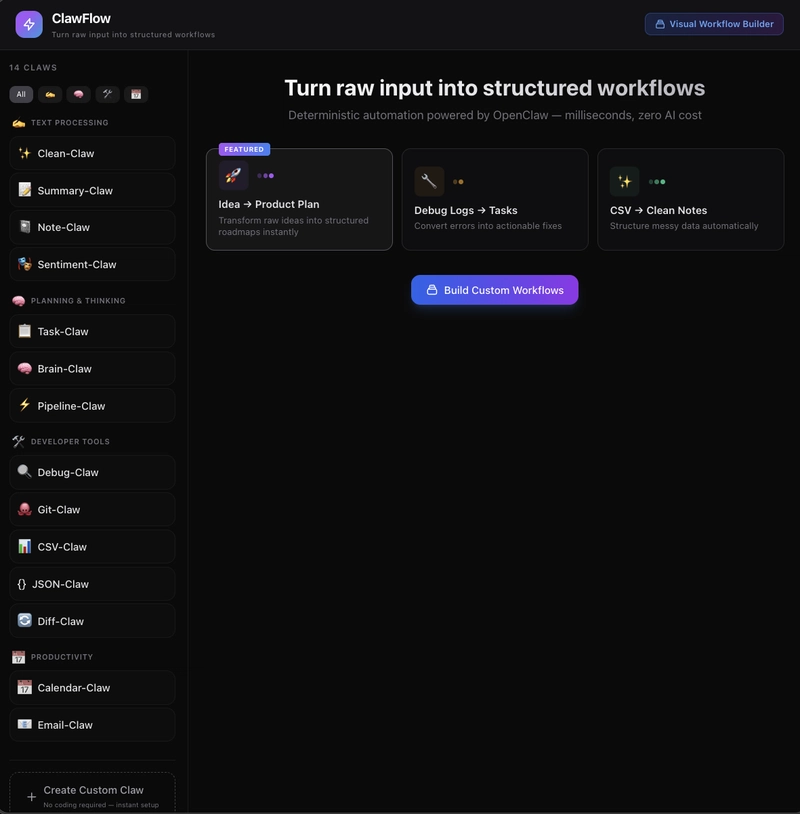 |
| Email-Claw | 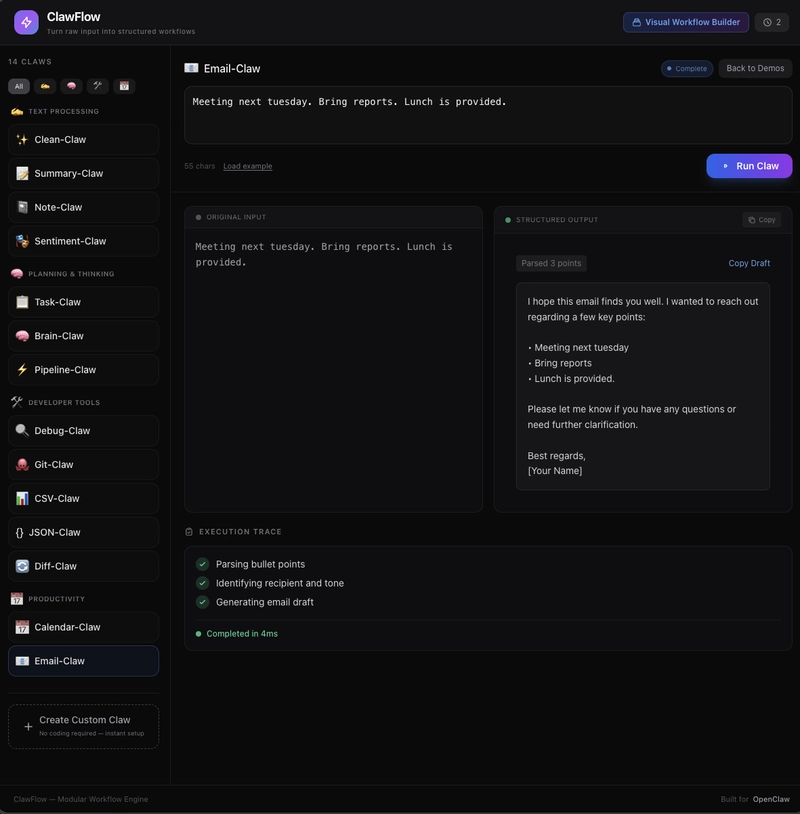 |
| Pipeline Builder | 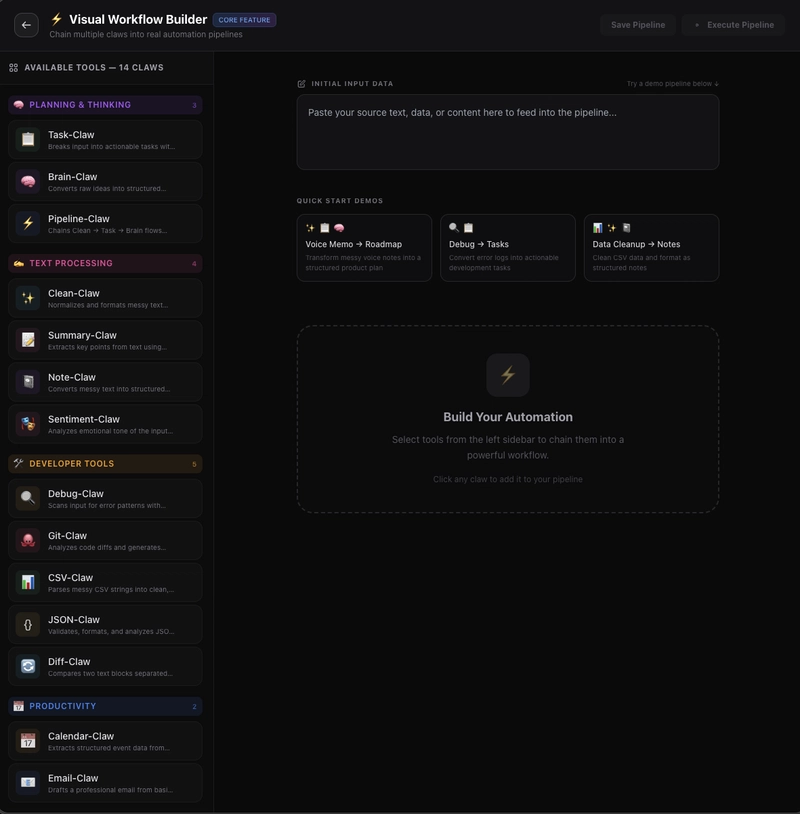 |
| Rich Output | 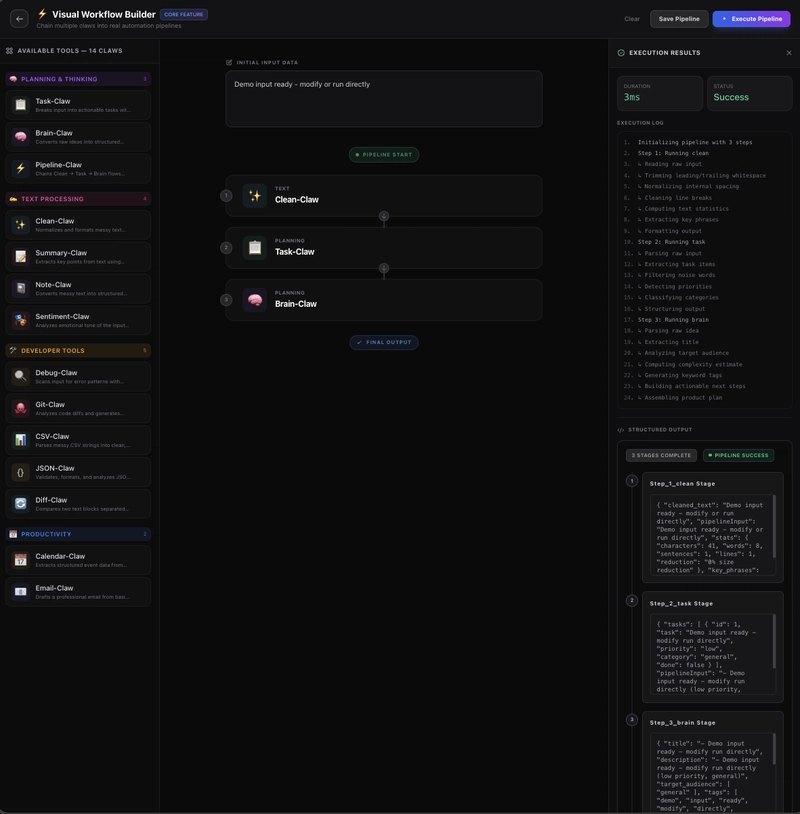 |
| CLI Trigger | 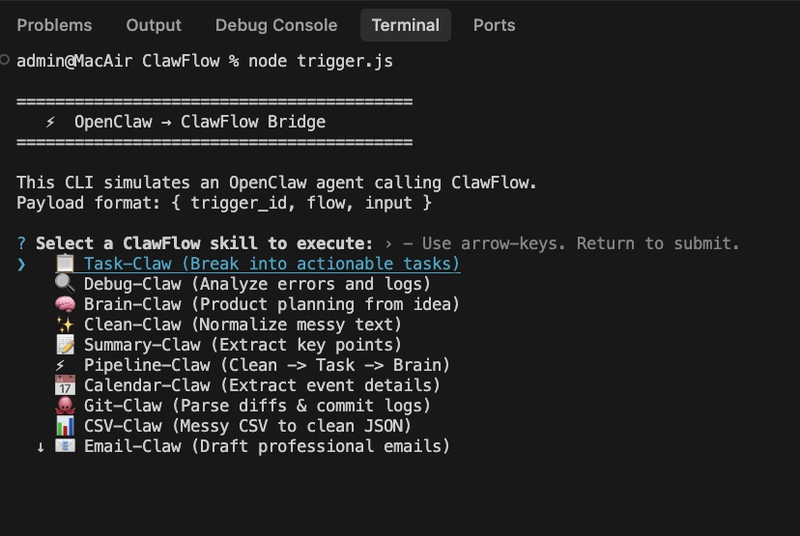 |
| Email-CLI | 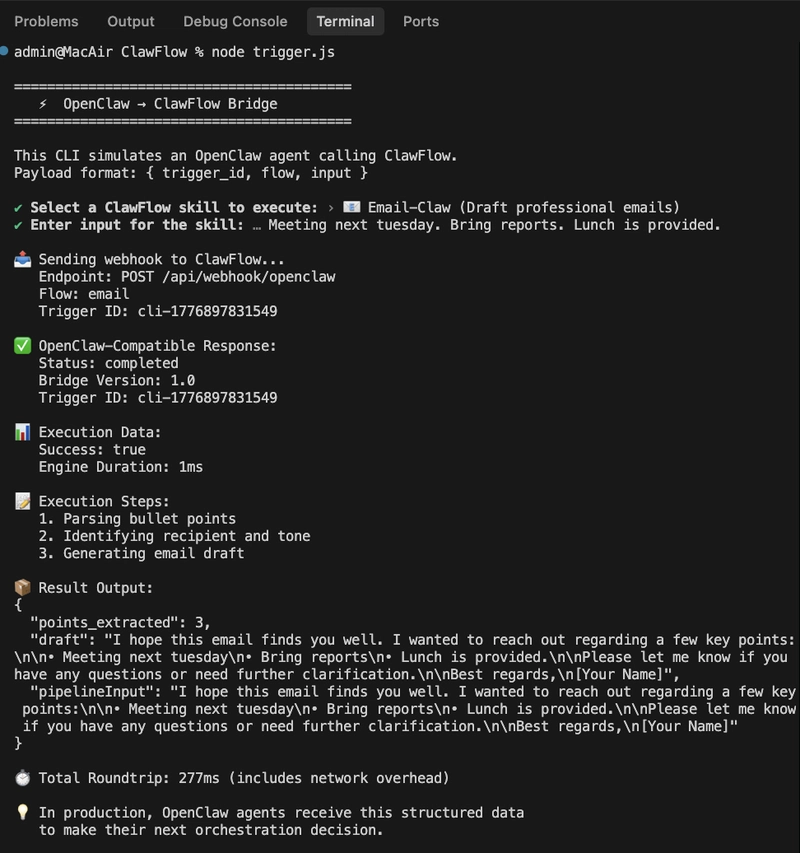 |
Quick Demo Flow:
- Task-Claw → Input: "urgent: fix auth bug, deploy patch" → Structured tasks with priority
- Debug-Claw → Paste error logs → Severity-classified issues with fix suggestions
- Pipeline-Claw → Input messy text → Watch 3 stages execute with full trace
Simulated OpenClaw Trigger
The demo simulates an OpenClaw agent calling ClawFlow:
# Simulated webhook call (shown in demo terminal)
POST /api/webhook/openclaw
Content-Type: application/json
X-API-Key: clawflow_prod_key

{
  "trigger_id": "oc-2026-001",
  "flow": "pipeline",
  "input": "build an AI app for farmers..."
}

# Response: 3ms
{
  "status": "completed",
  "execution_data": { "tasks": [...], "plan": {...} }
}
How I Used OpenClaw
ClawFlow is designed as a complementary execution layer for OpenClaw. While OpenClaw orchestrates high-level workflows and agents, ClawFlow handles deterministic, low-latency task execution through modular "Claws."
I implemented a webhook bridge (/api/webhook/openclaw) that allows OpenClaw agents to trigger flows programmatically, effectively separating orchestration (OpenClaw) from execution (ClawFlow).
This architecture lets OpenClaw agents route simple, structured tasks to ClawFlow for fast, predictable execution (< 5ms, zero cost), while reserving LLM calls for tasks requiring reasoning and creativity.
What I Learned
AI agents need deterministic execution partners. OpenClaw agents excel at intent and orchestration, but they need reliable backends for data transformation. ClawFlow fills that gap.
Speed is a feature. At < 5ms execution, ClawFlow can run inside agent decision loops without blocking UX. LLMs take 1-5 seconds — that's unusable for real-time agent workflows.
Persistence unlocks agent memory. With SQLite, every execution is traceable. Agents can query history: "What did I parse yesterday?" → retrieve and continue workflows.
The OpenClaw skills model is elegant. Building a compatible execution engine gave me deep appreciation for the separation of concerns: agents decide what to do, skills determine how to do it.
No-code extensibility matters. By adding a visual Claw Creator with 11 pre-built templates, I made the platform accessible to non-developers while keeping the code-based extension path for power users. This "product-facing" approach makes the platform more compelling — anyone can click, create, and run immediately (from "developer-only" into "anyone can use this immediately").
🛠 QUICK Q&A's
Q: How does this actually integrate with OpenClaw?
A: ClawFlow exposes an authenticated webhook at /api/webhook/openclaw that accepts standard OpenClaw payloads. Agents send {trigger_id, flow, input} and receive structured results. See openclaw.config.yml for a complete agent configuration example.
Q: Why not just use an LLM for parsing?
A: Three reasons: (1) Speed — LLMs take 1-5 seconds, ClawFlow takes < 5ms, usable in real-time agent loops. (2) Reliability — deterministic output means agents can trust the structure. (3) Cost — zero API calls vs $0.02 per LLM invocation. It's about giving agents precision tools, not replacing AI.
Q: How extensible is it?
A: Two ways: (1) Visual Claw Creator — pick from 11 templates, name it, done. Instant, no-code. (2) Code path — create lib/flows/mySkill.ts, register in lib/flows/index.ts. The engine handles validation, timing, persistence, and webhook compatibility automatically. It's designed for both beginners and developers.
Q: Is this really using OpenClaw or just inspired by it?
A: This is a real integration. ClawFlow acts as an execution backend that OpenClaw agents can call via webhook. The CLI trigger demonstrates the exact payload format. The openclaw.config.yml shows how an agent would be configured to use ClawFlow as a skill provider.
Built with Next.js 15, TypeScript, SQLite, Drizzle ORM, and Tailwind CSS.