








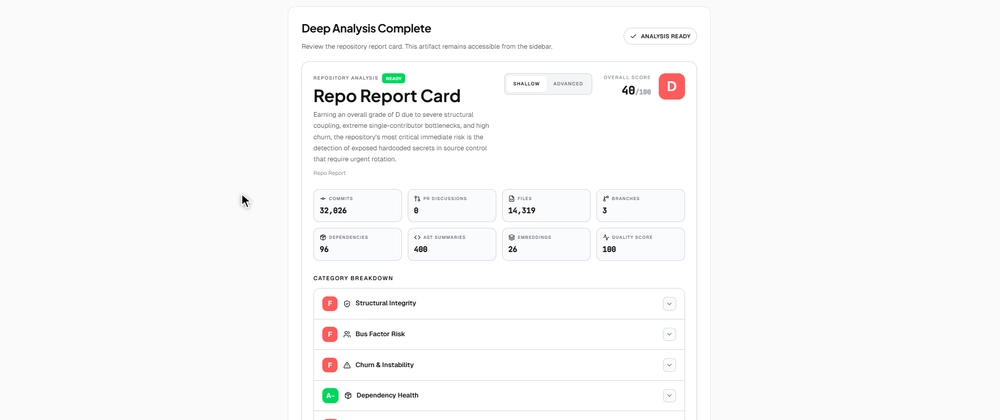

Linor Repo Report runs six independent analysis engines against any GitHub repo and produces a structural diagnosis:
Bus factor risk, churn and instability, structural integrity, dependency health, gap analysis, and code quality signals.
Every finding names exact files, exact modules, exact counts. No hand-waving.
I ran it on OpenClaw.
Result: D grade, 40/100.
- 8 god files — one with 198 functions
- 5 modules at critical bus factor risk — 100% owned by a single contributor
- Accelerating churn in files that had zero changes in the prior 90 days
- Co-change clusters with cohesion scores showing hidden coupling
- Revert-prone files with extracted revert reasons
- Potential hardcoded secret exposure flagged
- Missing linting/formatting configuration
- Zero PR discussion across hundreds of PRs
Full unfiltered artifact — the actual output, not a summary:
https://drive.google.com/file/d/19Zt_93lHwzGcwyoSwDYHscFy4tFmVppp/view
I also ran it on Linor itself.
It scored 44/100.
The system diagnosed its own creator:
Circular dependencies, flat module structure, 8 god files, Bus Factor F across 5 modules.
I shipped that result publicly because a tool that protects its creator's comfort is not a tool anyone should trust with their production codebase.
What each engine does
Bus Factor Risk
Maps per-module contributor concentration, dominant contributor percentages, single-owner file counts, and critical risk zones.
Shows you exactly where one person leaving kills delivery.
Churn & Instability
Detects accelerating files against a 90-day baseline, co-change clusters with cohesion scores, and revert-prone files with revert reasons extracted from git history.
Shows you which files are changing together in ways that suggest hidden coupling.
Structural Integrity
Classifies architectural patterns per module and flags god files, orphan files, circular dependencies, and cross-module coupling.
Shows you where the architecture says one thing and the code does another.
Dependency Health
Counts direct and transitive dependencies, dependency-to-source ratio, lockfile verification, duplicate-purpose overlap, and deprecated package detection.
Shows you dependency scale and dependency hygiene in one view.
Gap Analysis
Checks for CI/CD presence, linting/formatting config, error-handling coverage, environment templates, type safety, documentation surface, test-to-source ratios, and hardcoded secret scanning.
Shows you what infrastructure is missing or underpowered.
Code Quality Signals
Measures function complexity, monolithic files, naming consistency, comment density, commit message quality, PR discussion culture, and average time to merge.
Shows you code health trends across the whole repo, not just one file.
Output
The output includes:
- Overall grade
- Numerical score
- Six individual grades
- Synthesized summary
- Prioritized roadmap with rationale and concrete actions
I built this because consulting firms charge $10K–$15K for this kind of structural review and take two weeks.
I wanted it to exist as a self-serve tool that any founder or engineering lead could run without hiring anyone.
Happy to answer questions about methodology, scoring, or the analysis pipeline.