


惯性聚合 高效追踪和阅读你感兴趣的博客、新闻、科技资讯
阅读原文 在惯性聚合中打开

推荐订阅源

WordPress大学
WordPress大学
L
LangChain Blog
酷 壳 – CoolShell
酷 壳 – CoolShell
罗磊的独立博客
J
Java Code Geeks
freeCodeCamp Programming Tutorials: Python, JavaScript, Git & More
博客园 - 叶小钗
小众软件
小众软件
博客园 - Franky
D
Docker
Google DeepMind News
Microsoft Azure Blog
OSCHINA 社区最新新闻
OSCHINA 社区最新新闻
U
Unit 42
宝玉的分享
宝玉的分享
C
Check Point Blog
B
Blog
V
V2EX
博客园 - 三生石上(FineUI控件)
MyScale Blog
MyScale Blog
The Cloudflare Blog
博客园 - 聂微东
博客园_首页
Engineering at Meta
Engineering at Meta

DEV Community

Authentication Security Deep Dive: From Brute Force to Salted Hashing (With Java Examples) Why AI Systems Don’t Fail — They Drift Spilling beans for how i learn for exam😁"Reinforcement Learning Cheat Sheet" I Replaced Chrome with Safari for AI Browser Automation. Here's What Broke (and What Finally Worked) How Python Borrows Other People's Work The $40 Architecture: Processing 1 Billion API Requests with 99.99% Uptime Vibe Coding: A Workflow Guide (From Zero to SaaS) Most webhook security guides protect the wrong side. The scary part is delivery. Headless CMS for TanStack Start: Build a Blog with Cosmic EU Age Verification App "Hacked in 2 Minutes" — What Actually Happened Comfy Cloud’s delete function does not actually remove files Running AI Models on GPU Cloud Servers: A Beginner Guide Event-driven media intelligence with AWS Step Functions and Bedrock I scored 500 AI prompts across 8 quality dimensions — here's what broke How to Call Google Gemini API from Next.js (Free Tier, No Backend Needed) The Portal Protocol: Reclaiming Human Connection in the Age of AI How to Fix Your Team's Scattered Knowledge Problem With a Self-Hosted Forum Intro to tc Cloud Functors: A Graph-First Mental Model for the Modern Cloud Designing Multi-Tenant Backends With Both Ownership and Team Access I Built a Neumorphic CSS Library with 77+ Components — Here's What I Learned PostgreSQL Performance Optimization: Why Connection Pooling Is Critical at Scale Cómo construí un SaaS multi-rubro para gestionar expensas en Argentina con FastAPI + Vue 3 🚀 I Built an Ethical Hacking Scanner Tool – Open Source Project I Replaced /usage and /context in Claude Code With a Single Statusline A Pythonic Way to Handle Emails (IMAP/SMTP) with Auto-Discovery and AI-Ready Design I Collected 8.9 Million Polymarket Price Points — Here's What I Found About How Markets Really Move EcoTrack AI — Carbon Footprint Tracker & Dashboard Everyone's Using AI. No One Agrees How. 5 self-hosted ebook managers worth trying in 2026 Building Your First AI Agent with LangChain: From Chatbot to Autonomous Assistant
I was paying 3x too much for AI APIs. Here's what I changed.
Phillip Tori · 2026-04-23 · via DEV Community

I started using AI APIs about a year ago for side projects I was hacking on in the evenings. Nothing production scale.

By month three I was running up about $80 a month in charges. Not wild, but when I broke it down, I was spending way more than I needed to. Half of what I was doing could have run on a cheap model for pennies. I was just lazy.

Here's what I actually changed:

First, I stopped using the flagship for everything. My defaults were Claude 3.5 Sonnet and GPT 4o. Both great. Both way overpowered for half of what I asked them.

I had a little utility that turned a messy chunk of text into a clean title. Take in a paragraph, return one sentence. I was using Sonnet at $3 input and $15 output per million tokens. For a task a much simpler model could handle.

Swapping that one call to Gemini 2.5 Flash Lite at $0.10 input and $0.40 output cut the per request cost by about 30x. Output quality was identical.

Rule I follow now. If the task is "transform this text a little," try a budget model first. Only reach for a flagship if the budget one actually fails.

Second, I cached and trimmed my system prompts. Every major provider offers prompt caching now. Anthropic gives you 90 percent off cached tokens. OpenAI does it automatically once your prompt goes over 1,024 tokens.

At 3,000 calls a month with a 600 token system prompt, that prompt alone was costing me $5.40 on Sonnet. With caching, 54 cents.

While I was in there, I actually read my prompt for the first time in months. It was a mess. "Please provide a response." "It would be helpful if you could." Polite costs tokens. I cut it from 600 to 300. Saves 50 percent on input forever.

Read your system prompt out loud. If it sounds like a cover letter, it's too long.

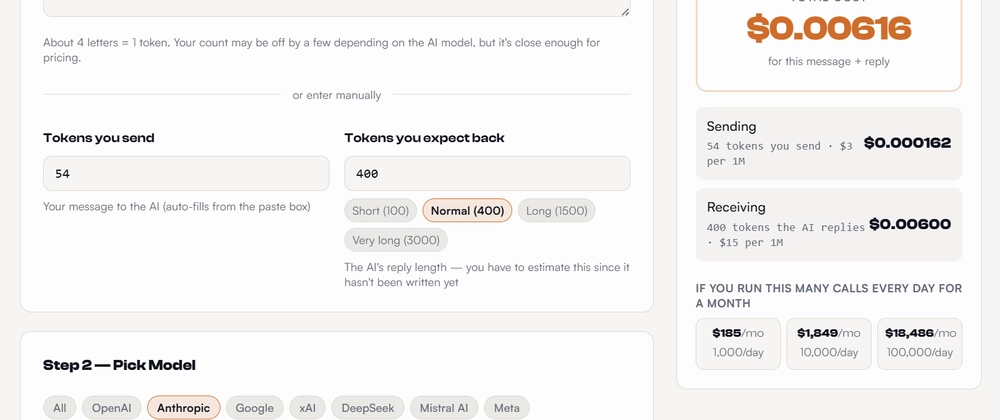
Third, I got tired of doing the math. For every new model I wanted to try, I was running the same spreadsheet. Input tokens times price per million. Output tokens times price per million. Add. Check caching. It took long enough that I'd just pick something and hope.

So I built it into a tool. It's at quantacost.com. Paste text, pick a model, see what it costs. Compare 39 models side by side. Free, no signup. Prices are verified every morning against the official pricing pages, because I got burned once using someone else's calculator with numbers that were a year stale.

The right model for most tasks is not the smartest one. It's the cheapest one that doesn't fail.