







I replaced my monitoring dashboard with a factory warning light.
Not metaphorically. Literally.
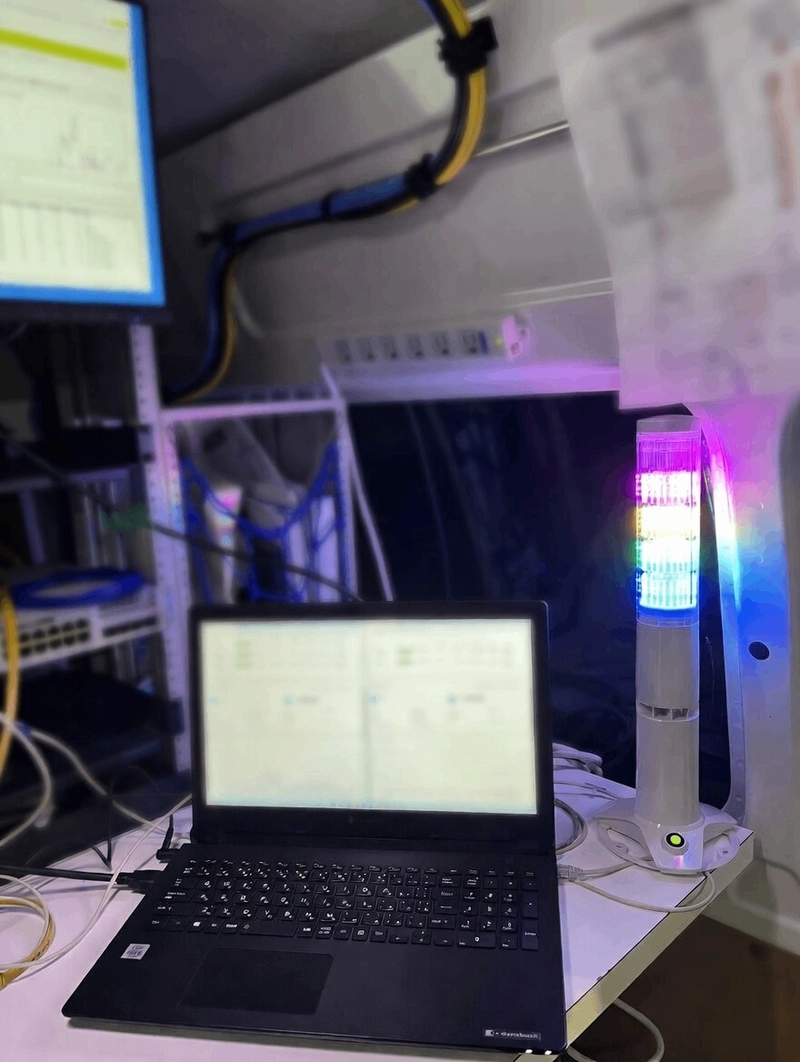
It's a Patlite LA6-POE — the kind of stacked warning light you see on Japanese factory floors that flashes red when the line stops. Five segments, one PoE cable, ~30 cm tall.
Mine doesn't warn. It shows.
The Inversion
Warning lights are designed to stay dark until something is wrong, then scream.
So I inverted it.
I wanted a light that stays always on, showing current bandwidth as a stack. The more layers lit, the more the network is active.
When 1 segment is lit, things are quiet.
When all 5 are lit and the top one flashes, someone is pushing a lot of traffic.
I barely open the dashboard anymore. The corner of the room tells me what I need to know.
The Build
- Hardware: Patlite LA6-POE, one PoE switch port (power + data in a single cable)
- Software: ~200 lines of Python on the monitoring host
- Protocol: Patlite's obscure PNS binary protocol over TCP/10000. Reverse-engineered from the manufacturer PDFs. One round-trip is ~11 ms.
Data path:
PRTG (sFlow/SNMP from edge router)
    ↓ XML API polled every 5 seconds
    ↓ Python daemon + hysteresis logic
    ↓ PNS command over TCP
    ↓ Patlite LA6-POE
Colors (fixed by hardware):
Bottom → Blue → Green → Yellow → Pink → Red (top)
The PRTG Trap
PRTG's XML for traffic sensors contains <lastvalue_raw> twice per channel:
- First: cumulative bytes since sensor start
- Second: current rate in bytes/second
# WRONG — you will see 8 million Mbps and question reality
rate = channel.find('lastvalue_raw').text

# RIGHT
raw_values = channel.findall('lastvalue_raw')
rate_bps = float(raw_values[1].text)
I lost half a day.
This kind of bug is the worst — it doesn't crash, it just lies.
Thresholds with Hysteresis
I didn't design this for precision. I designed it for perception.
Naive thresholds make the light flicker like a broken Christmas tree. Hysteresis (separate UP/DOWN thresholds with ~10% gap) fixes it.
| Level | UP (Mbps) | DOWN (Mbps) | Segments | Flash | Buzzer |
|---|---|---|---|---|---|
| 0 | — | < 18 | none | — | — |
| 1 | ≥ 20 | < 27 | 1 | — | — |
| 2 | ≥ 30 | < 45 | 2 | — | — |
| 3 | ≥ 50 | < 72 | 3 | — | — |
| 4 | ≥ 80 | < 90 | 4 | — | — |
| 5 | ≥ 100 | < 135 | 5 | ON | — |
| 6 | ≥ 150 | < 135 | 5 | ON | 0.6s chirp |
Result
This device solves zero tickets.
Sends zero notifications.
Improves no SLAs.
But I open the dashboard far less — and I notice problems earlier.
It does nothing useful, and everything I wanted.
It turned a factory warning light — originally designed to scream until somebody makes the screaming stop — into a device I actually want to glance at.
And that, in 2026, is more than enough.
(Six months ago, I solved a Cloudflare Wrangler problem with X11 forwarding instead of API tokens. Apparently this is my brand now: solving modern problems with historically inappropriate tools. This is the second time.)
If people are interested, I can share the exact setup and code.