







One of the quickest ways to make an impressive agent demo is to prepare a clever prompt. One of the quickest ways to make that same agent fall apart in production is to give it no durable memory.
In this article, we'll build a small, memory-backed assistant with LangChain4j and Oracle AI Database. The assistant can search prior incidents, runbooks, decisions, and shift handoffs to answer questions. It can write new memories back to the database so they become searchable in any session. Additionally, all user, agent, and tool messages are logged to database table for observability and auditing.
- Database feature overview
- Run the sample
- Chat Memory vs Durable Memory
- Hybrid retrieval: semantic + full-text search
- Lightweight reranking
- LangChain4j agent
- Memory writeback
- Recording user, agent, and tool messages
- Why database memory is useful for agents
- Code pointers
- Where you can take this next
Database feature overview
The agent is built with modern Oracle AI Database features:
- persistent
JSONmemory documents in Oracle AI Database - vector embeddings in a
VECTORcolumn - Oracle Text search over the same JSON document
- hybrid ranking that blends semantic and exact-match retrieval
- append-only transcript logging by conversation ID
Using these features, the agent (a fictional operations assistant) can answer question about runbooks, incident reviews, change requests, and shift handoffs from its persistent memory. Because the memory is database backed, multiple agents from concurrent sessions may access the same data safely.
Run the sample
You will need Java 21+, Maven, Docker, and an OpenAI API Key.
From the module root, run the tests:
export OPENAI_API_KEY=<your key>
mvn test
To run the live terminal app using your database connection string and user:
export OPENAI_API_KEY=<your key>
mvn compile exec:java \
  -Dexec.args="jdbc:oracle:thin:@localhost:1521/freepdb1 testuser testpwd"
Once it starts, try prompts like:
What happened during the checkout incident after CHG2145?Which runbook section should I use for the checkout rollback?Draft a next-shift handoff and remember it.
Chat Memory vs Durable Memory
Chat memory and durable memory solve different problems. Operational memory has different requirements:
- it should survive process restarts
- it should be queryable across conversations from distributed, concurrent agents
- it should support structured metadata like service, environment, incident ID, and change ticket
- it should be searchable both semantically and exactly
- it should allow writeback when the agent learns something worth preserving
That starts to look a lot more like a database problem than a prompt engineering problem.
Hybrid retrieval: semantic + full-text search
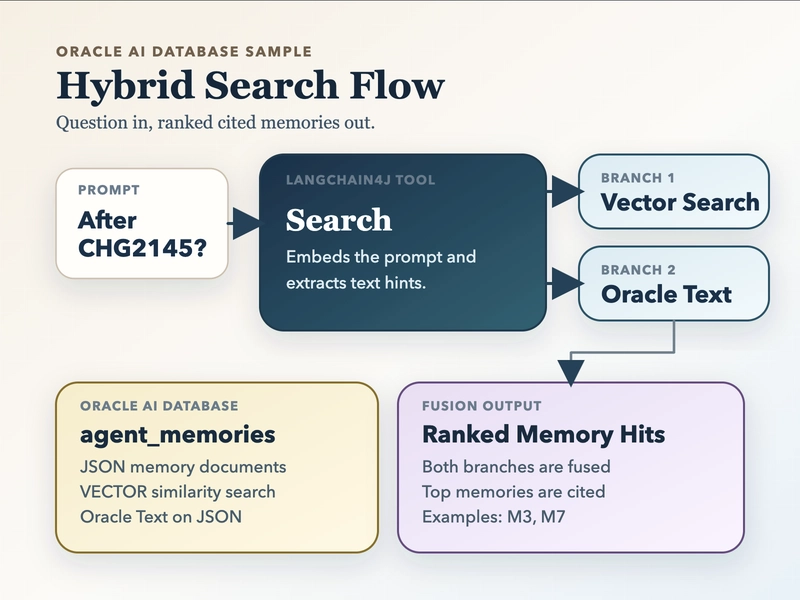
The MemoryRepository runs two queries, which are fused into one ranked list:
-
Vector search over the
embeddingcolumn using cosine distance. -
Oracle Text search over the JSON payload using
json_textcontains.
Here is the vector query:
select id,
       memory_kind,
       title,
       memory_doc,
       (1 - vector_distance(embedding, ?, COSINE)) as vector_score
from agent_memories
order by vector_score desc, id
fetch first ? rows only
And here is the text query:
select id,
       memory_kind,
       title,
       memory_doc,
       score(1) as text_score
from agent_memories
where json_textcontains(memory_doc, '$', ?, 1)
order by score(1) desc, id
fetch first ? rows only
Pure vector search is often too fuzzy for ticket IDs. Pure text search is often too brittle for paraphrases. Hybrid retrieval handles both.
Lightweight reranking
Once both branches return hits, MemorySearchRanker merges the results with deterministic weights:
- a bonus when the incident ID or change ticket matches directly
- a bonus for keyword overlap in the indexed memory text
- a combined
matchedByindicator ofVECTOR,TEXT, orBOTH
The deterministic ranker could be implemented by an LLM judge or a more complex re-ranking system. For this sample, I kept it intentionally lightweight and low-latency.
LangChain4j agent
The LangChain4j agent implementation is quite small, using a single interface:
public interface OpsMemoryAssistant {
    @SystemMessage("""
            You are an operations handoff assistant backed by Oracle AI Database memory.
            Use searchMemories when prior incidents, runbooks, handoffs, decisions, or change history are relevant.
            When you rely on memory results, include the references in the form [M123].
            If the user asks you to remember or preserve a new handoff or decision, call storeMemory after drafting it.
            Keep answers concise and operational. Mention incident IDs and change tickets when they matter.
            """)
    @UserMessage("{{message}}")
    String chat(@V("message") String userMessage);
}
That is the right level of abstraction for this sample.
LangChain4j handles chat orchestration and tool wiring. Oracle AI Database handles durable memory, search, and transcript persistence. Each layer is doing the job it is actually good at.
Memory writeback
The sample keeps two memory stores:
- a curated durable memory store for retrieval
- an append-only transcript for observability and auditing
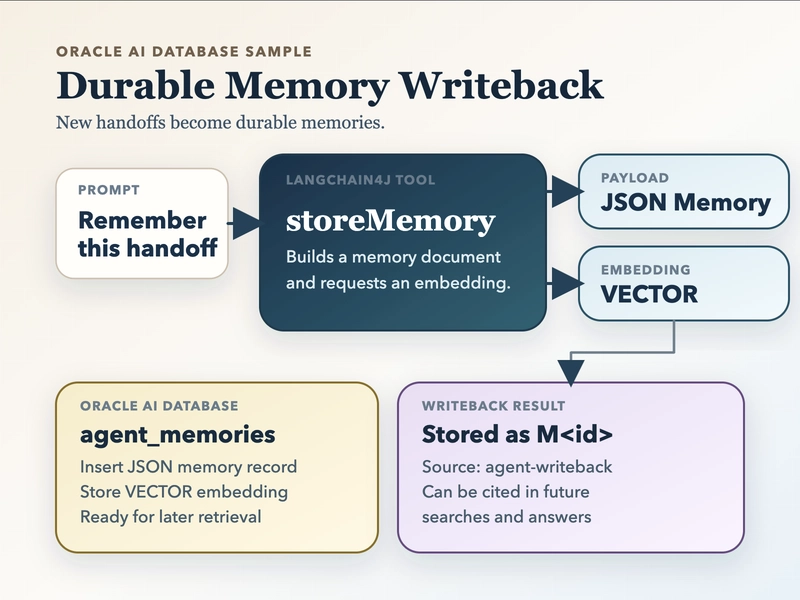
This one also stores new durable memory through the storeMemory tool when the user explicitly asks the assistant to preserve a handoff or decision.
That matters because an agent memory system should not just be a read-only archive. If a useful conclusion comes out of a conversation, the system should be able to keep it.
In this sample, writeback creates a new MemoryDocument, generates an embedding, and inserts both the JSON payload and vector into agent_memories. Because the JSON search index is configured with sync (on commit), newly stored handoffs are searchable immediately after commit.
That last detail is important. Delayed indexing is exactly the kind of thing that makes an agent feel unreliable.
Recording user, agent, and tool messages
With our database connection, it's easy to record chat sessions in the database. To do this with LangChain4j, we implement the ChatMemory interface in the LoggingChatMemory.java class.
Each session gets its own unique conversation ID, and user/agent/tool messages are written to the agent_conversation_log table.
That table captures:
conversation_idmessage_seq- role and message type
- message text
- tool name and tool call ID when relevant
- optional JSON context
- creation timestamp
That distinction tends to get blurred in agent demos. It should not.
Why database memory is useful for agents
Chat windows and flat files can't scale the same way a database can. A database-backed memory layer gives you:
- durable storage
- structured metadata
- many types of retrieval: semantic, text, relationship, graph, etc.
- transactional writes and concurrency
- better auditability
Databases can help you progress from agent demos to real applications that effectively utilize agent memory.
Code pointers
If you want to explore the implementation, start here:
- README.md -> app overview
- OpsMemoryAgentApplication.java -> Main class and agent loop
- MemoryRepository.java -> Memory retrieval for text and vector search
- MemoryTools.java -> LangChain4j tool bindings to search and store memories
- LoggingChatMemory.java -> LangChain4j ChatMemory implementation to log chat interactions
- MemoryRepositoryIntegrationTest.java -> test using Oracle AI Database Free and Testcontainers
The tests validate the behavior that matters
The integration tests are worth reading because they verify the actual retrieval patterns we care about:
- exact text search finds the checkout incident for
CHG2145andINC4721 - vector search finds the same incident from a paraphrased outage description
- hybrid fusion marks the strongest result as matched by both channels
- a stored handoff can be found on the next combined search
Where you can take this next
If you'd like to extend this sample, here's a few ideas to play with:
- Add "forgetting" with recency ranking so newer memories are ranked as more relevant.
- Parameterize scoring and filtering mechanisms to make the app more flexible.
- Add another agent tool that uses an LLM to judge search results.
- Add approval/rejection when storing memories. Maintain a log of failures so the agent knows what not to do.