






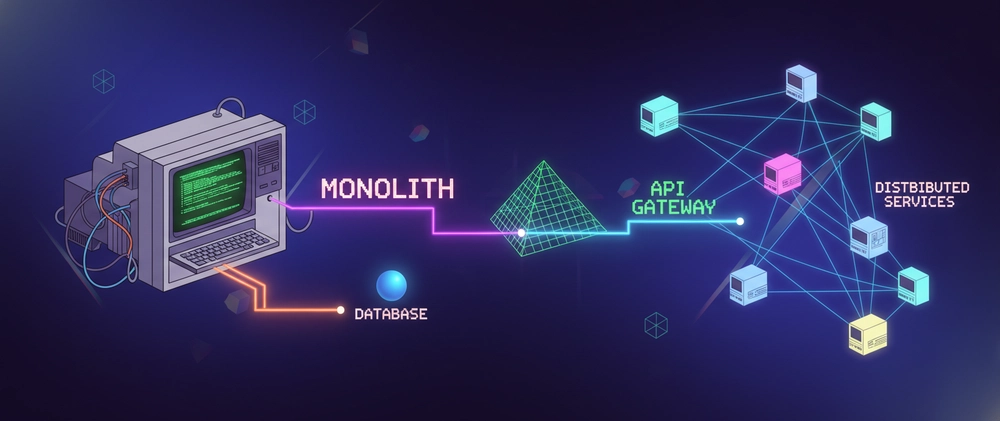

When you start building applications, everything feels simple — one codebase, one database, one deployment. But as your app grows, things start breaking in subtle ways: slow performance, deployment risks, tight coupling.
That’s where System Architecture becomes critical.
Let’s break it down in a practical, developer-first way.
🔹 What is System Architecture?
System Architecture defines:
- How components interact
- How data flows
- How scalable and maintainable your system is
Think of it as the blueprint of your application.
🔹 Monolithic Architecture (Where Most of Us Start)
In a monolith:
- Everything is in one codebase
- One database
- Single deployment unit
✅ Pros:
- Simple to build and deploy
- Easy debugging (initially)
- Great for MVPs
❌ Cons:
- Hard to scale specific parts
- Deployment becomes risky
- Tight coupling across modules
Example (Laravel App):
- Auth + Payments + Orders + Notifications → all inside one project
🔹 When Monolith Starts Failing
You’ll notice:
- Small changes break unrelated features
- Deployments take longer
- Scaling requires scaling everything
- Teams step on each other’s code
This is the point where you rethink architecture.
🔹 Microservices Architecture
Instead of one big app:
👉 You split into independent services
Example:
- Auth Service
- Payment Service
- Order Service
- Notification Service
Each service:
- Has its own codebase
- Can have its own database
- Is deployed independently
🔹 Microservices Pros & Cons
✅ Pros:
- Independent scaling
- Faster deployments
- Better fault isolation
- Tech flexibility (Go, Node, PHP, etc.)
❌ Cons:
- Network complexity
- Debugging becomes harder
- Requires DevOps maturity
- Distributed data challenges
🔹 Real-World Architecture Pattern
A common modern setup:
[ Client (Vue/React) ]
          ↓
     API Gateway
          ↓
 ┌────────┼────────┐
 ↓        ↓        ↓
Auth   Orders   Payments
Svc     Svc       Svc
 ↓        ↓        ↓
 DB       DB       DB
🔹 Key Concepts You Must Know
1. API Gateway
- Single entry point
- Handles auth, routing, rate limiting
2. Service Communication
- REST (simple)
- gRPC (fast, efficient)
- Message Queues (async processing)
3. Database Strategy
- Shared DB ❌ (avoid)
- Database per service ✅
4. Caching Layer
- Redis for performance boost
5. Queue System
- Background jobs (emails, reports)
- Tools: Redis queues, Kafka, RabbitMQ
🔹 Monolith vs Microservices (Quick Comparison)
| Feature | Monolith | Microservices |
|---|---|---|
| Deployment | Single | Independent |
| Scaling | Full app | Service-level |
| Complexity | Low | High |
| Flexibility | Low | High |
🔹 What Should YOU Choose?
👉 If you're building:
- MVP / Startup → Monolith
- Growing SaaS → Modular Monolith
- Large-scale system → Microservices
💡 Pro tip:
Don’t jump to microservices too early. Scale your architecture only when needed.
🔹 Final Thoughts
System architecture is not about trends — it’s about trade-offs.
Start simple.
Measure pain points.
Evolve your architecture.
That’s how real systems are built.