







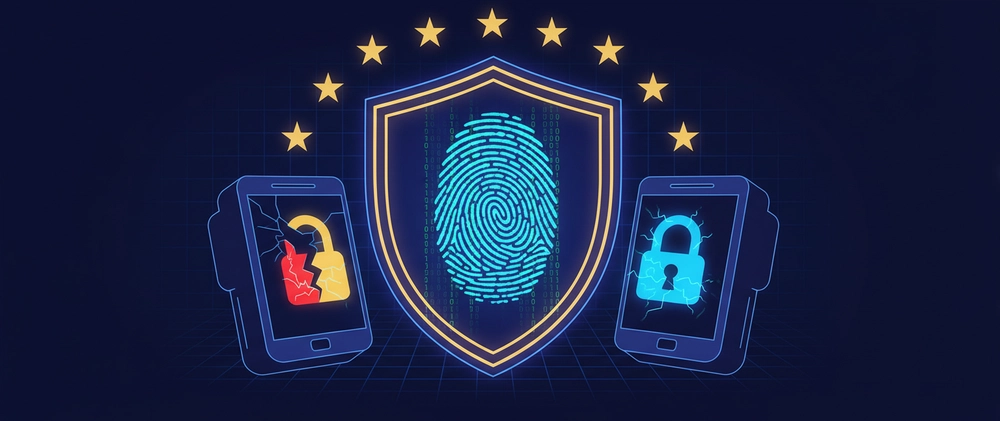

On April 15, 2026, the EU launched the age verification "mini-wallet" app. Within 24 hours, security researcher Paul Moore published a video claiming he bypassed it in 2 minutes. The story went viral across Reddit with tens of thousands of upvotes.
The headlines write themselves, but the technical reality is more nuanced.
Paul Moore identified three design flaws in the wallet app's local device implementation:
1. PIN decoupled from the credential vault
The PIN protecting the wallet is verified locally, separate from the cryptographic key store that holds the actual credentials. On a rooted device, the PIN can be brute-forced without triggering the key store's protections.
2. Rate limiting stored as plaintext
Lockout counters that prevent repeated PIN attempts are stored as plaintext values in local storage. With root access, these counters can be reset directly.
3. Biometric gate is a boolean flag
The biometric authentication check resolves to a simple boolean value. On a rooted device, this flag can be toggled without actually completing biometric verification.
All three bypasses share a critical prerequisite: physical access to a rooted device. None of them enable remote attacks.
More importantly, the OpenID4VP protocol that governs the actual verification transaction between wallet and verifier was not compromised. When a verifier checks someone's age, they validate cryptographic proofs signed by the PID (Person Identification Data) provider. These signatures cannot be forged through any of the three local bypasses.
For developers building age-gated services:
This is a textbook case of the distinction between protocol soundness and implementation quality. The cryptographic architecture — based on OpenID4VP credential presentation — is well-designed. The local device protections that guard access to the wallet were implemented with shortcuts.
The fixes are straightforward:
None of these require protocol-level changes.
The bigger issue is platform lock-in. The wallet app only runs on iOS and Android, with a hard dependency on Google Play Services. There is no libre client, no desktop version, and no way for users of alternative mobile platforms to participate.
For a system mandated by EU regulation, this exclusivity raises legitimate accessibility and sovereignty questions that outlast the fixable implementation bugs.
Open-source security auditing worked exactly as designed. The code was auditable, a researcher found flaws on day one, and published them responsibly. This is the model functioning correctly.
Full technical analysis with more detail on the protocol and platform lock-in concerns: EU Age Verification App Hack Explained
此内容由惯性聚合(RSS阅读器)自动聚合整理,仅供阅读参考。 原文来自 — 版权归原作者所有。